Storia
Medieval origins
Poggio Bonelli was already an important landed property in the Middle Ages, when it belonged to the ancient Spennali family. Its location and agricultural value subsequently made it desirable to several prominent Sienese families.
The Piccolomini, Croci and Landucci families
In the second half of the 16th century, the property passed to the Piccolomini family. The estate’s winegrowing tradition is traced to this period.
During the 17th and 18th centuries, probably through dynastic inheritance, Poggio Bonelli became a stable possession of the Croci and Landucci families. These families carried its agricultural history forward toward the 20th century.
The Chigi Saracini period
The succession of noble owners culminated with the Chigi Saracini family. Around the middle of the 18th century, the Chigi family commissioned the underground ageing cellar. The cellar has survived intact, while winemaking was established in estate buildings formerly used as granaries.
Count Guido Chigi Saracini was the last and sole heir to the patrimony known collectively as the “Fattorie.” Born in Siena in 1880, he occupied numerous positions of civic importance and spent the milder seasons at his Castelnuovo Berardenga estate. Music was another defining interest: in 1932 he founded the Accademia Chigiana Senese, an institution for advanced musical education that remains active.
Transfer to MPS Tenimenti
Count Guido Chigi Saracini died in 1965. The Fattorie Chigi Saracini subsequently passed to MPS Tenimenti, the agricultural company controlled by Banca Monte dei Paschi di Siena.
The present corporate holding encompasses 835 ha on the boundary between Chianti Classico and Chianti Colli Senesi. Within that wider holding, Tenuta Poggio Bonelli comprises 17 ha devoted to Chianti Classico. Operations are conducted by a professional agricultural and winemaking team.
Renewal of the Chigi Saracini identity
In December 2025, MPS Tenimenti presented a new Chigi Saracini Chianti Classico Gran Selezione in the theatre of the Accademia Chigiana. The project was conceived as a renewed connection between the Count’s agricultural inheritance and the musical and artistic institution he founded.
The initial release comprised 3,500 bottles for Italian and international markets. Its limited scale followed a long selection process focused on particular vineyards and grapes. The label was redesigned around a photograph of Count Guido Chigi Saracini, and management announced that the wine would form the beginning of a broader Chigi Saracini collection planned for completion within approximately 18 months.
Terroir
Tenuta Poggio Bonelli lies at Castelnuovo Berardenga on the southern boundary of the Chianti Classico district. Its vineyards occupy hilly ground between 250 and 370 m above sea level. Individual winegrowing areas are described between 250 and 360 m, while selected Chianti Classico vineyards face south.
The climate is Mediterranean and strongly influenced by Monte Amiata. The mountain channels breezes arriving from the Tyrrhenian Sea; this airflow limits the accumulation of humidity and encourages pronounced day-to-night temperature variation.
The soils combine marine sands with distinctive fluvial terraces. The interaction among these deposits, Mediterranean conditions and marked temperature excursions underpins the estate’s conception of territorially expressive, complex and ageworthy wines.
Vinificazione
The vineyards are trained to spur-pruned cordon and Guyot at an average density of approximately 5,500 vines/ha. Vineyard selection is central to the top Chianti Classico project: specific plots and grapes were identified through a prolonged selection process, and the Gran Selezione is based on Sangiovese from the best south-facing sites.
Reported yields vary with the selection: approximately 6,000 kg/ha for Chianti Classico and 5,000 kg/ha for Chianti Classico Riserva, Gran Selezione, Poggiassai and Tramonto d’Oca. Grapes intended for Vin Santo are selected by hand around the middle of September.
The wider agricultural holding includes vineyards, olive groves, woodland, lakes and other areas of biodiversity. Its stated land-management priority is to preserve the morphology of the landscape, protect ecosystems and maintain healthy conditions across the property.
Historic cellar
The underground ageing cellar was commissioned by the Chigi family around the middle of the 18th century and has remained intact. Vinification takes place in estate structures originally used as granaries. The working winery therefore combines preserved historic spaces with adapted agricultural architecture.
Production infrastructure
The winery has been equipped for contemporary production within its historic setting. Its infrastructure includes modern cellar equipment, a modern bottling system and a large warehouse. Production controls are intended to deliver consistent products with hygienic and food-safety guarantees, clearly assigned operational responsibilities and codified control stages.
General cellar pattern represented by the estate wines
Red-wine fermentations are conducted in temperature-controlled stainless-steel tanks, with daily or frequent pump-overs and continued skin maceration after alcoholic fermentation. The documented temperatures fall broadly between 26 and 30°C, depending on the selection. Ageing regimes use French oak, including second- and third-use barrels for Chianti Classico and longer French-oak maturation for Riserva, Gran Selezione and the Toscana IGT selections. Bottle maturation follows barrel ageing.
Vin Santo grapes are naturally dried on mats for four months. Fermentation then proceeds very slowly with the seasons, pausing during winter and restarting with warmer spring temperatures.
Filosofia
Poggio Bonelli’s quality policy joins Tuscan tradition and territorial identity with controlled, contemporary production. The objective is to create and economically enhance high-quality products while maintaining food safety, product consistency and clearly defined responsibility throughout the production process.
Operational priorities include compliance with appellation rules and food-safety law, protection of employees, environmental and ethical responsibility, reduced material waste, staff training, codified controls and periodic review of improvement targets. ISO 9001 and ISO 22000 standards are treated as core operational instruments; this is a statement about the application of the standards, rather than a claim of certification.
The broader environmental position centers on responsible stewardship of a large and varied agricultural property. Landscape morphology, woodland, lakes and other ecosystems are treated as assets to protect. Sustainability is framed as the practical preservation of this territory and the maintenance of healthy conditions for the future of both the estate and Chianti.
The renewed Chigi Saracini program adds a cultural dimension: agricultural, historical, musical and artistic inheritances are being reconnected through limited vineyard selections and a visual identity centered on Count Guido Chigi Saracini.
Vini
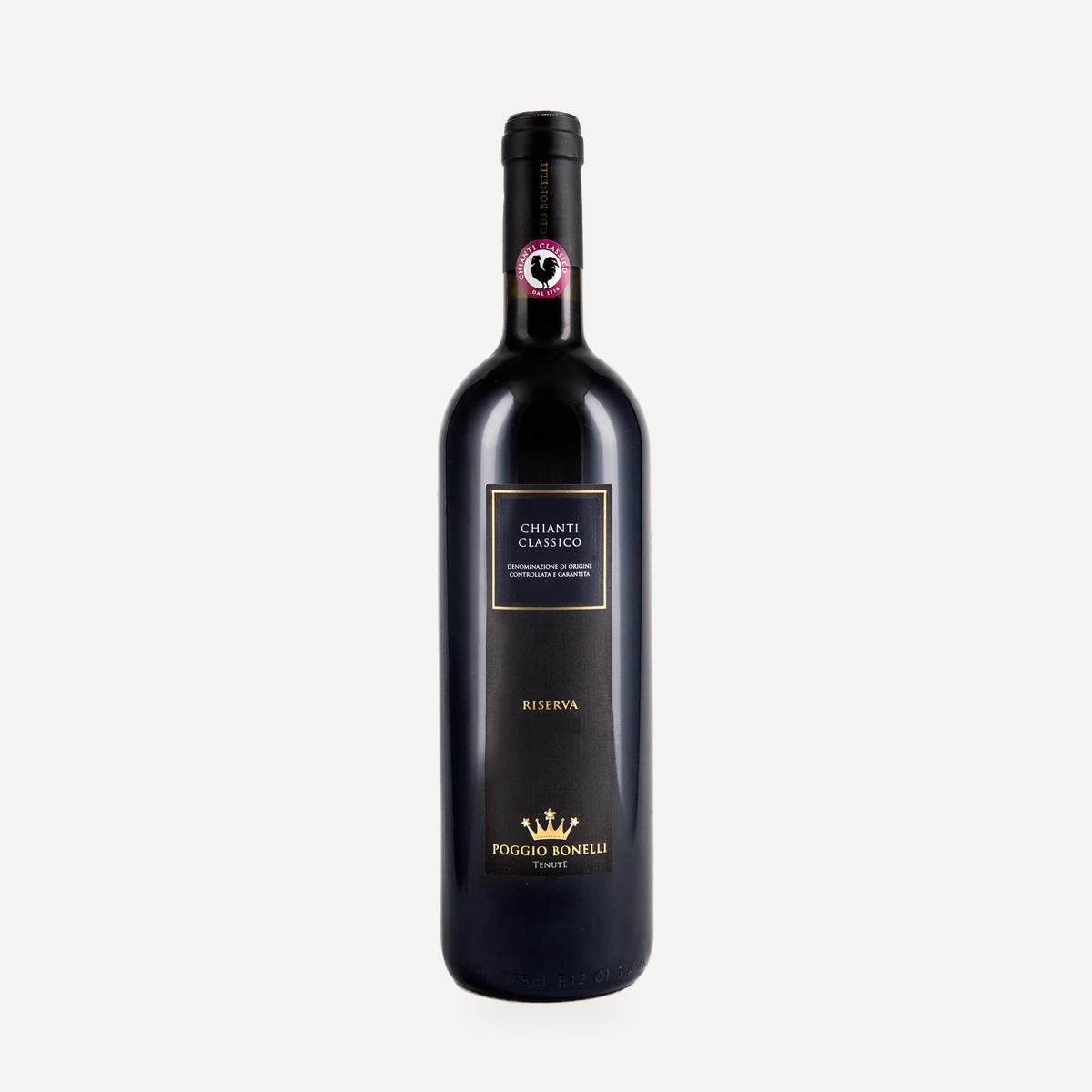
Chianti Classico Riserva DOCG
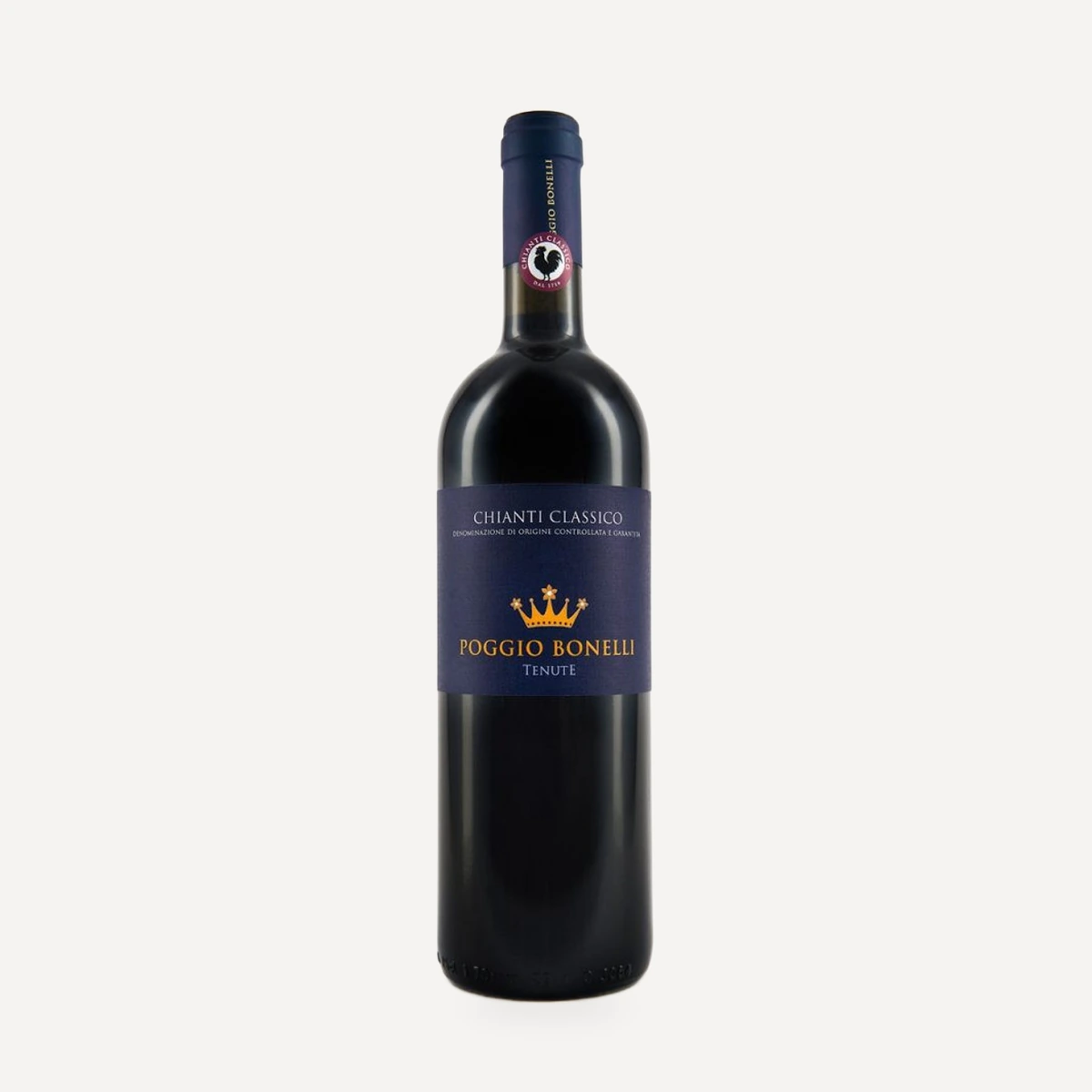
Chianti Classico DOCG