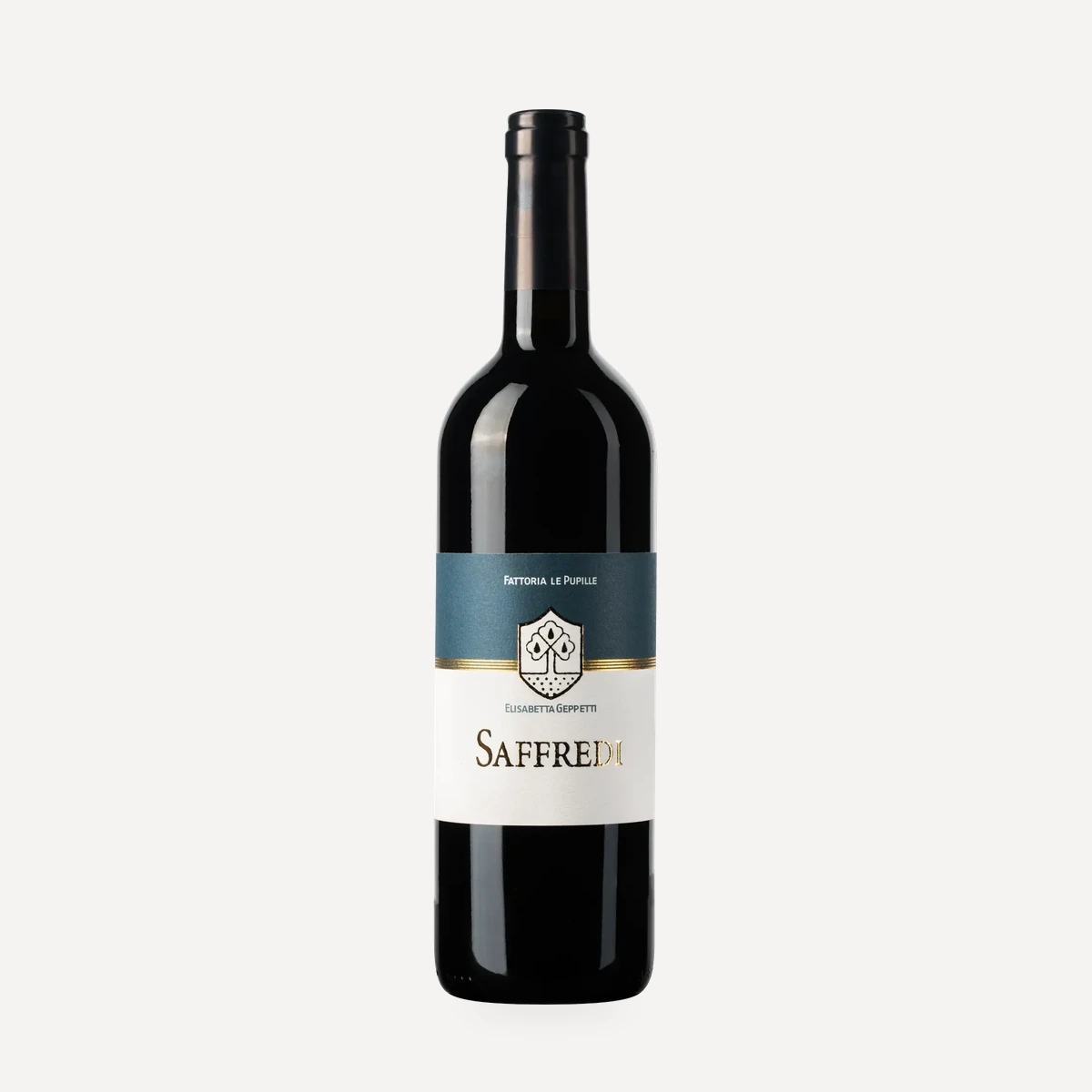
Questo vino
Vineyard and terroir
Saffredi comes from Pereta on the southern Tuscan coast, around 20 minutes from the sea. Its fruit is drawn from two vineyards divided into four parcels. The historic core consists of three parcels named “Saffredi,” planted on sandy soils poor in organic matter. A second, 12-hectare site also contains Petit Verdot and has vines rooted in tuffaceous ground crossed by red clay. The combined vineyard area is 20 hectares.
The 2023 technical profile further characterizes the site as sandstone-derived soil rich in galestro and iron minerals, with little organic matter and clay appearing below 30 cm. The vineyards reach 280 m above sea level, where comparatively cool nights temper the coastal setting. Sea breezes rise through the rows from the coast.
The old vineyard was planted in 1985 and is trained to spur-pruned cordon; the new vineyard was planted in 2006 and is Guyot-trained. Planting density is 4,000 vines per hectare, with a yield of 50 quintals per hectare.
Grapes
Blend proportions vary by vintage. The latest published vintage, 2023, comprises 60% Cabernet Sauvignon, 30% Merlot and 10% Petit Verdot.
Vinification
The grapes undergo careful selection in both vineyard and cellar. Merlot is harvested in the first half of September, followed by Cabernet Sauvignon and Petit Verdot in October. Fermentation takes place in stainless steel at 26°C, with maceration lasting 30–45 days.
Ageing
The wine matures for 18 months in French-oak barriques. For the 2023 vintage, new barrels account for 70% of the total. It then rests in bottle for up to six months before release.
Technical data
The 2023 vintage has 15% alcohol and total acidity of 5.17 g/L. Production amounts to 50,000 bottles. Available formats are 0.75 L, 1.5 L, 3 L, 6 L, 12 L and 18 L.
Tasting profile
The 2023 is an intense, luminous ruby colour. Its elegant aromatic profile combines sour cherry, blackcurrant and blueberry preserve with anise, green pepper and cigar. The palate is harmonious and warm, shaped by fine, closely woven and integrated tannins, and finishes with pronounced persistence.
Serving and pairing
Pair with Rossini-style beef fillet.
Vintage notes
The 2023 growing season is characterized as cool. Production rose to 50,000 bottles from 45,000 bottles in both 2022 and 2021. The published vintage record spans 1987–2023, with no 1996 entry. The wine began as pure Cabernet Sauvignon in its earliest published vintages, while its composition subsequently evolved; current proportions vary with each vintage.
Label / history
First produced in 1987, Saffredi grew from Elisabetta Geppetti’s ambition, developed with Giacomo Tachis, to make a major wine in Maremma. Its name is a personal dedication to Fredi, who inspired her passion for wine. It is positioned as the icon wine of Fattoria Le Pupille and connected to the pioneering origins of the Supertuscan movement.


