Storia
The Imperiale villa
Toledana was built in the mid-16th century by the noble Genoese Imperiale family. Conceived as a fortified and defensive residence, it developed the form of a rural villa enriched with Renaissance architectural elements. Ownership subsequently passed to the Lercari family and then to the Cambiaso family.
The estate and nearby Centuriona were sufficiently prominent to appear on geographical maps from the end of the 16th century through the 18th century.
Early evidence of winegrowing
The earliest written record concerning Cortese dates to 1659, when the factor of Castello di Montaldeo wrote to Marchese Doria about vineyards planted entirely with the variety.
A Toledana sharecropping agreement dated 1669 identifies Agostino Imperiale as the estate’s owner. Under its terms, the wine obtained from the harvest was divided equally between the owner and the massaro, or tenant-farmer.
From the Feudo di Carrosio to the Cambiaso family
In 1775 Toledana formed part of the Feudo di Carrosio, which had been assigned to the House of Savoy. From 1798 to 1802 Carrosio became a Jacobin republic, described as the only one of its kind in Italy.
The Cambiaso family already owned Centuriona when, in 1779, it acquired Toledana through the dowry of Marchesa Marina Imperiale Lercari. The combined holdings reached 22 cascine, or farmsteads, together with a mill on the Lemme torrent.
Marina’s husband, Gian Battista Cambiaso, served for two years as Doge of Genoa. He promoted construction of the Strada Cambiagia, connecting Genoa, the Passo della Bocchetta, Gavi and the Pianura Padana. Until 1822, the route was regarded as the best of the trans-Apennine roads.
At the beginning of the 19th century, the Centuriona and Toledana estates—each comprising 11 farmsteads—were divided between two Cambiaso brothers.
The establishment of Cortese vineyards
In 1856, Marchese Cambiaso established the first large, specialized Cortese plantings at the Toledana and Centuriona estates. Their purpose was to produce dry white wine for the Ligurian market, and neighboring estates soon followed the example. These plantings form part of the historical foundation of Gavi.
De Maria and Leardi produced the first scientific description of Cortese in 1870. They characterized it as the most extensively cultivated white grape in the Province of Alessandria and emphasized its robustness, fertility and the quality of its fruit.
Toward the end of the 19th century, the Cambiaso family added a second floor to the villa and a third floor to each of its two towers, following the building’s original design.
The Martini family and the modern denomination
After further changes of ownership, Toledana became the property of the Martini family. The family’s winegrowing tradition at the estate is identified with three generations, while Cortese cultivation is described as extending for more than 180 years.
Gavi received Denominazione di Origine Controllata status in 1974 and was elevated to DOCG in 1998. In 2002, the Consorzio Tutela del Gavi excluded genetically modified vines from Gavi DOCG production.
A 2003 CNR agronomic study by Mannini identified 75 Cortese biotypes, establishing the variety’s substantial natural biodiversity and providing a basis for selecting material for future vineyard renewal. In 2004, the Albo Vigneti del Gavi was completed as the first comprehensive certification of plantings for an Italian wine denomination.
Today the Martini family’s 25 hectares surround the historic villa and its agricultural buildings. Production is centered exclusively on Gavi and the interpretation of Cortese from the commune of Gavi.
Terroir
Toledana’s 25 hectares form a contiguous holding around the historic villa and rural buildings in the commune of Gavi. Within that single body of land, the vineyards differ in exposure, gradient, geological character, drainage and soil mineral content. These variations give the component areas distinct identities and require viticultural decisions to be adjusted each year.
Technical descriptions place the vineyards at approximately 200 metres above sea level, with southern and south-westerly exposures and calcareous-clay marl soils. The production area experiences hot, dry summers moderated by sea winds. During the final phase of ripening, a pronounced difference between daytime and nighttime temperatures intensifies the grapes’ characteristic aromas.
The Vigne Rade area is distinguished by its natural configuration: some sections have more widely spaced rows, allowing the vines’ fruit access to a greater share of available nourishment. Its interpretation is based on preserving these natural characteristics in both vineyard and cellar.
Vinificazione
Viticulture is adapted to the differences found within the otherwise contiguous 25-hectare holding. Exposure, slope, geology, drainage and mineral content vary between sections, so each vintage requires specific attention rather than a fixed routine.
Cortese’s productivity is controlled closely to develop greater substance, structure and quality in the fruit. Production decisions and grape destinations are reviewed every year in response to the season’s climatic pattern, including the choice of vineyards suitable for late harvesting.
Guyot training, a density of 4,000 vines per hectare and a recorded yield of 65 ql/ha characterize the technically described vineyards. Vigne Rade is harvested manually in October, using 12 kg crates. Genetically modified vines have been excluded from Gavi DOCG production since the Consorzio Tutela del Gavi’s 2002 decision. The variety’s 75 documented biotypes provide a pool from which material can be selected for future vineyard renewal.
Production is devoted to Gavi and the interpretation of Cortese from the commune of Gavi. The approach links traditional practice with careful preservation of the vineyard’s character.
Stainless steel is the principal fermentation and maturation medium described for the current range. The must may undergo static settling before low-temperature fermentation in stainless steel, followed by maturation in steel. Gentle pressing and fermentation away from the skins are also part of the estate’s documented Gavi processing. The Vigne Rade project applies the same emphasis on respecting the natural character of the site in both vineyard and cellar.
Filosofia
Toledana’s approach begins with the premise that no two growing seasons are identical. Vineyard work, grape allocation and late-harvest selection are therefore adjusted to the climatic course of each vintage.
Cortese is treated as a variety whose potential depends on disciplined control of its natural productivity. The objective is to obtain fruit with the substance and structure required for Gavi while retaining the differences created by exposure, slope, geology, drainage and mineral content across the holding.
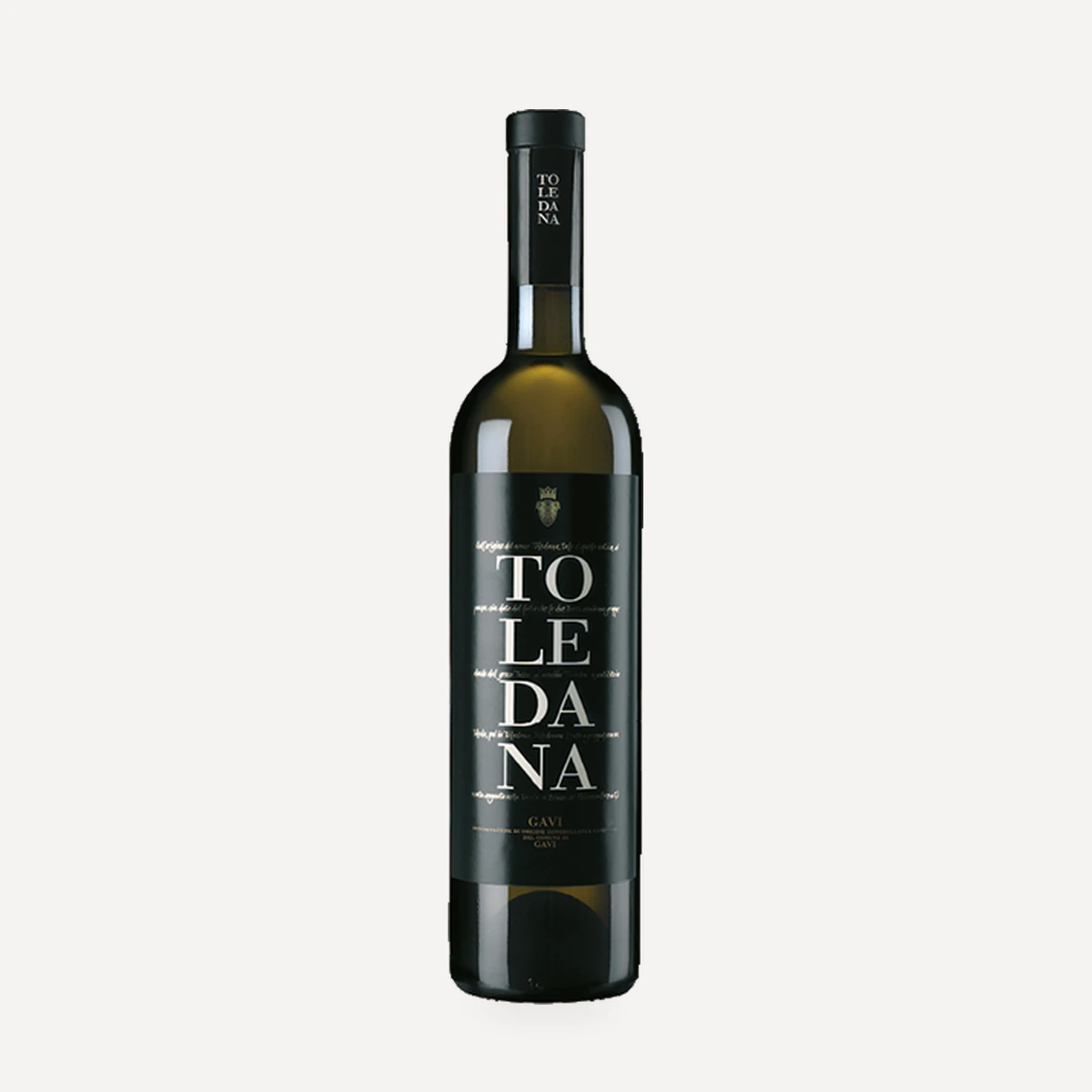
The Vigne Rade project expresses the estate’s stated balance between modernity and tradition. Its guiding principle is respect for the vineyard’s natural configuration and for terroir throughout both cultivation and cellar work, with the ambition of producing a white wine capable of aging.
Vini
Vigne Rade