Storia
From Campania to Marche
Clandestini did not begin with an inherited estate or an established family wine tradition. Its founders describe a journey undertaken through instinct and persistence: they moved from Campania to Marche, encountered different places and people, observed established practices and learned through experience. They characterize the successive stages of this journey as those of nomads, apprentices and, finally, winegrowers.
Establishing the farm in Offida
The project eventually established itself at Contrada Ciafone in Offida, between the Adriatic Sea and the Sibillini mountain chain. Here, winegrowing became connected to the preservation of local history, agricultural vocation and biodiversity. The farm grows grapes for its natural wines as well as most of the botanicals used in its vermouth.
A low-intervention identity
Clandestini developed without adhering to formal production protocols, denomination rules, industrial agricultural models or standardized consumption. Its vineyard and cellar practices instead centre on manual work, natural ecological balances, indigenous fermentations and minimal intervention. Annual output remains limited to a few thousand bottles, varying with the generosity of the season and the capacity of the cellar.
The project subsequently extended this farm-based approach to vermouth production. Its 17 e 17 is presented as a fully agricultural vermouth: grapes, base wine, most botanicals and botanical infusions are grown or produced within the farm.
Terroir
The farm is based at Contrada Ciafone in Offida, in the Marche region of Italy. Its setting lies between two major ecosystems: the Adriatic Sea and the Sibillini mountain chain. This position is presented as fundamental to the area's agricultural history, vocation and biodiversity.
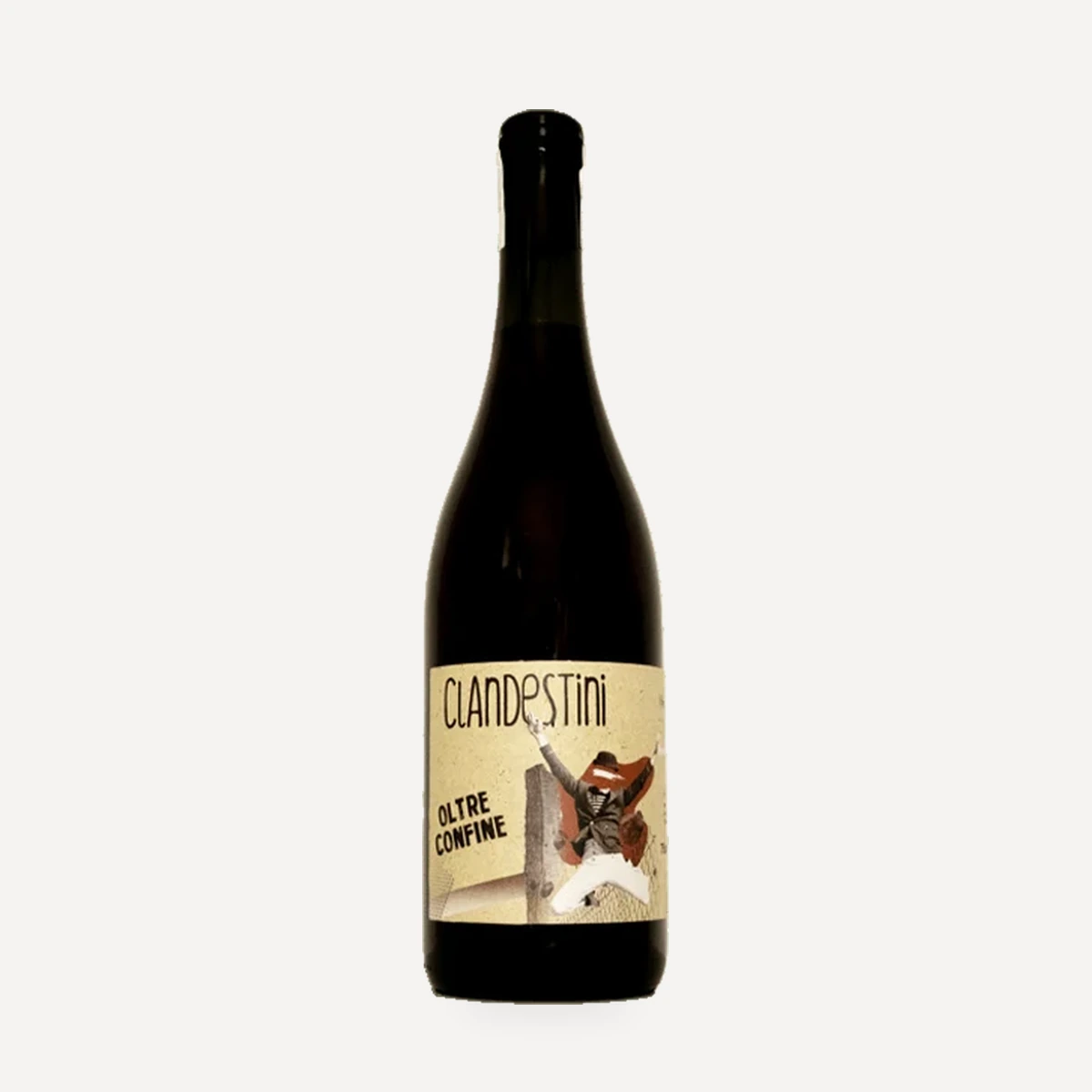
The vineyards comprise parcels with differing exposures and ripening times. These variations are used deliberately in Oltre Confine, which brings together differently coloured grapes harvested from separate parcels and at different stages of maturity. No individual vineyard names, elevations or soil profiles are identified.
Vinificazione
Permaculture and ecological balance
Vineyard management is guided by permaculture: natural ecosystems are observed and imitated to limit pollution and resource exploitation. The farm seeks synergy with seasonal rhythms and the changing conditions of the land, while using resources consciously to make its agricultural systems more self-sufficient.
Traditional local varieties are favoured within an approach intended to protect ecosystem integrity. Biodiversity is encouraged both to reduce agricultural risk and to preserve the distinctive character of the place. Conservation is understood as an active effort to halt degradation and regenerate soils and living systems. Cooperation and resource-sharing with wider networks are also part of this agricultural philosophy.
Limited intervention
Manual operations are preferred to extensive mechanical intervention, while organic farm residues are preferred to systemic treatments. The vines are not topped, chemically weeded or crop-thinned. Sulfur and copper are applied only when necessary. The objective is to work with naturally established balances rather than impose artificial coexistence within the vineyard.
Healthy grapes are picked by hand and placed in small crates before being taken to the cellar.
The cellar follows a deliberately minimal-intervention approach. Healthy grapes arrive after manual harvesting in small crates. Fermentation is entrusted to indigenous yeasts, while maturation is allowed to proceed under the influence of time and ambient climatic conditions.
Fermentation temperatures are not controlled. No additives or processing aids are used, and the wines are neither clarified nor filtered. This approach rejects standardized production protocols and denomination rules in favour of responding to the fruit and conditions of each season.
Filosofia
Clandestini defines its identity as being “by nature, not by tradition.” The project was created without an inherited estate and presents its development as a journey shaped by observation, learning, instinct and persistence.
Its agricultural philosophy rests on seven connected principles: permaculture, synergy with natural rhythms, self-sufficiency, cultivation of traditional local varieties, biodiversity, conservation and equitable sharing of resources. Nature is treated as the primary source of knowledge, with human work kept limited and responsive.
In the vineyard, this means preferring manual work, organic residues and naturally established balances while minimizing mechanical intervention and avoiding systemic treatments. In the cellar, it means allowing indigenous yeasts, time and climate to direct fermentation and maturation without temperature control, additives, processing aids, clarification or filtration.
The project explicitly distances itself from prescriptive production protocols, commercial models, denomination rules, industrial agriculture and standardized consumption. Its objective is not uniformity: production changes with the season, and annual volume depends on both natural conditions and cellar capacity. The same farm-centred philosophy extends to vermouth, for which the grapes, wine and most botanicals are produced internally.
Vini