History
The creation of Belpoggio
In 2005, Enrico Martellozzo purchased an estate in the Montalcino area and named it Belpoggio. The acquisition grew out of his continuing pursuit of quality and the encouragement of his wife, Renata Rami, whose enthusiasm for Tuscany helped inspire the project.
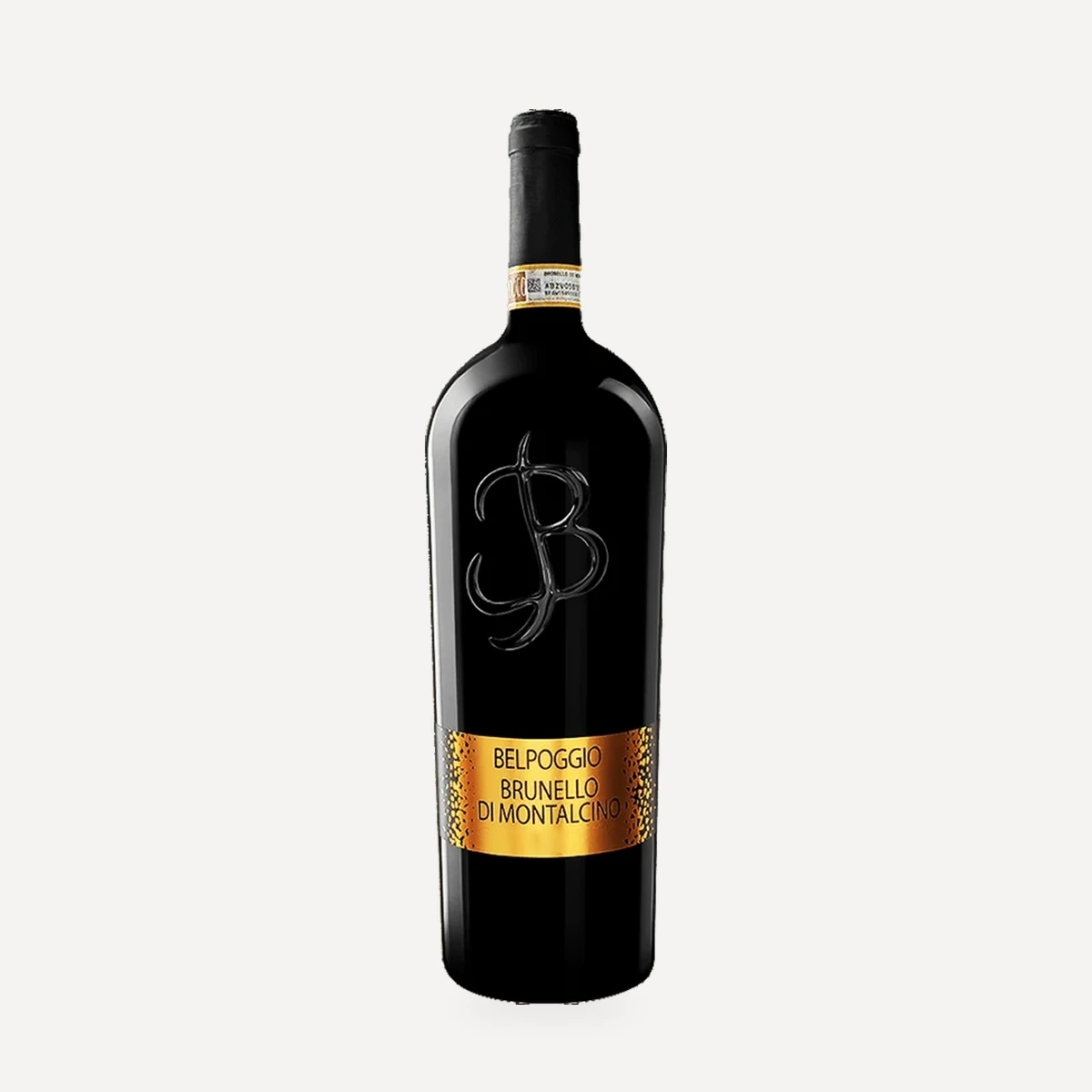
Belpoggio was conceived as a family undertaking. Martellozzo also involved his trusted winemaker, Francesco Adami, who was already responsible for Prosecco production in Martellozzo’s other wine activities. The estate subsequently developed a range centred on Sangiovese from Castelnuovo dell’Abate, including Brunello di Montalcino DOCG and Rosso di Montalcino DOC, alongside a Toscana IGT made from Ciliegiolo.
Terroir
Belpoggio lies southeast of Montalcino in the small village of Castelnuovo dell’Abate, approximately 500 m from the ancient Abbey of Sant’Antimo. The estate overlooks the Val d’Orcia.
The vineyards occupy steep, rocky slopes. The general estate description places them at 400 m above sea level, while the Bellaria production area associated with the Brunello di Montalcino and Rosso di Montalcino is identified at 350 m. Soils are calcareous and rich in coarse rocky material, with tuff components also present. The climate is Mediterranean.
The combination of elevation, steep terrain, rocky and tuff-bearing soils, and other local natural elements creates a distinct microclimate. The vineyard selected for the Riserva has a southern exposure, a pronounced slope and particularly skeletal soil; these conditions promote a high concentration of polyphenols in its Sangiovese fruit.
Winemaking
Five of the estate’s 10 ha are planted with Sangiovese. The Riserva is based on selected Sangiovese grapes from the estate’s best vineyard at Castelnuovo dell’Abate, distinguishing fruit from its southern exposure, pronounced slope and rocky soil.
Belpoggio employs traditional, temperature-controlled vinification for its principal Sangiovese wines. Rosso di Montalcino undergoes 10–15 days of maceration, followed by 9–12 months in 30 hl oak casks and at least three months of bottle maturation.
Brunello di Montalcino receives a longer maceration of 15–20 days at controlled temperature. It then matures for 36 months in 30 hl oak casks and spends a further 6–9 months in bottle before release. The Riserva follows the same 36-month maturation in 30 hl oak casks but receives 12 months of bottle ageing.
All stages of processing operate under HACCP procedures for food hygiene and production self-control.
Philosophy
Belpoggio was founded around Enrico Martellozzo’s continuing search for quality and Renata Rami’s attachment to Tuscany. It was conceived as a family project, supported from the outset by the family’s trusted winemaker.
Its approach connects wine character directly to place: the elevation, steep rocky slopes, tuff-bearing terrain and local microclimate are treated as the foundations of complexity. In the cellar, traditional temperature-controlled vinification and extended maturation in large oak casks define the Sangiovese program.
Wines