History
Umberto Salvioni
The estate’s winegrowing story extends across three generations and is closely associated with hospitality. Umberto Salvioni, who had studied agriculture, made wine to serve to friends, treating it as part of the pleasure of gathering and sharing a bottle.
Giulio and Mirella Salvioni
Umberto’s son Giulio broadened that circle of hospitality by creating a winery with his wife, Mirella. Their objective was deliberately limited production focused on the quality of each bottle rather than volume.
1985: the first Cerbaiola Brunello
The first Brunello della Cerbaiola came from the 1985 harvest. It was followed by further successful vintages that carried the Salvioni family’s name and its association with Montalcino beyond Italy.
The third generation
Giulio’s son David, a graduate in Agriculture, subsequently assumed responsibility for viticulture and winemaking. More recently, David’s sister Alessia joined the family team, working alongside Giulio in marketing, sales and administration. Winegrowing, production and commercial management consequently remain divided among members of the family.
Terroir
La Cerbaiola occupies 20 ha surrounded by woodland and overlooks the Val d’Orcia. The property lies approximately 4 km southeast of Montalcino, forming a plateau with a gentle southeastward slope. Pienza, San Quirico and Ripa d’Orcia are visible across the valley.
The vineyards stand at approximately 420–440 m above sea level and have a southeast exposure in relation to the hill of Montalcino. Clear air, a light breeze and good ventilation contribute to the local microclimate.
The 4 ha of vines are divided among three plots. Each has distinct soil and microclimatic characteristics, and the resulting differences affect the pace of grape ripening. Soil descriptions range from calcareous galestro and chalky schist to stony or pebbly material and stony marl. Altitude, exposure, ventilation and these soil variations form the principal distinctions among the plots.
Winemaking
All vineyard work is carried out by hand and follows a traditional, low-yield approach. Short, severe pruning is used to restrict production. Only one bud is retained during pruning, substantially reducing the potential quantity of fruit.
Green pruning continues after flowering and fruit set. A subsequent green harvest provides the first essential bunch thinning, with the aim of bringing only one bunch to maturity on each retained shoot. The team returns to the vineyards repeatedly during ripening to monitor and control the condition of individual bunches.
Reported yields are very low. The general vineyard description gives 25–35 quintals/ha, while the detailed technical descriptions give 25–40 quintals/ha, with marked vintage-to-vintage variation attributed to weather and bunch thinning. Grape maturity is monitored through frequent analyses.
Harvest generally begins in late September or the first days of October. Picking is strictly manual and selective, continuing the emphasis on small quantities and careful bunch selection.
Two cellars
Production is divided between the Cerbaiola estate cellar beside the vineyards and a second cellar beneath the Salvioni family home in Montalcino’s historic centre. The country cellar handles vinification, racking and bottling. Barrel maturation is divided between the two locations: older casks are kept at the estate, while newer casks are housed under the family home. Tastings of different vintages with clients generally take place in the town cellar. After bottling at Cerbaiola, the bottles return to the cellar beneath the family home to complete their maturation.
Fermentation and extraction
Vinification takes place in 35–40 hl stainless-steel vats and generally lasts 28–30 days, depending on the vintage. Fermentation begins spontaneously in the days after harvest. The fermentation rooms are not climate-controlled, so high temperatures are managed through frequent pumping over during the day and, when required, délestage. The latter moves the fermenting wine into other tanks and helps it cool.
Malolactic fermentation and maturation
Following racking, the clean wine remains in stainless steel for several additional months. Malolactic fermentation occurs naturally during this period. Once it is complete, the wine is racked again and transferred to large casks.
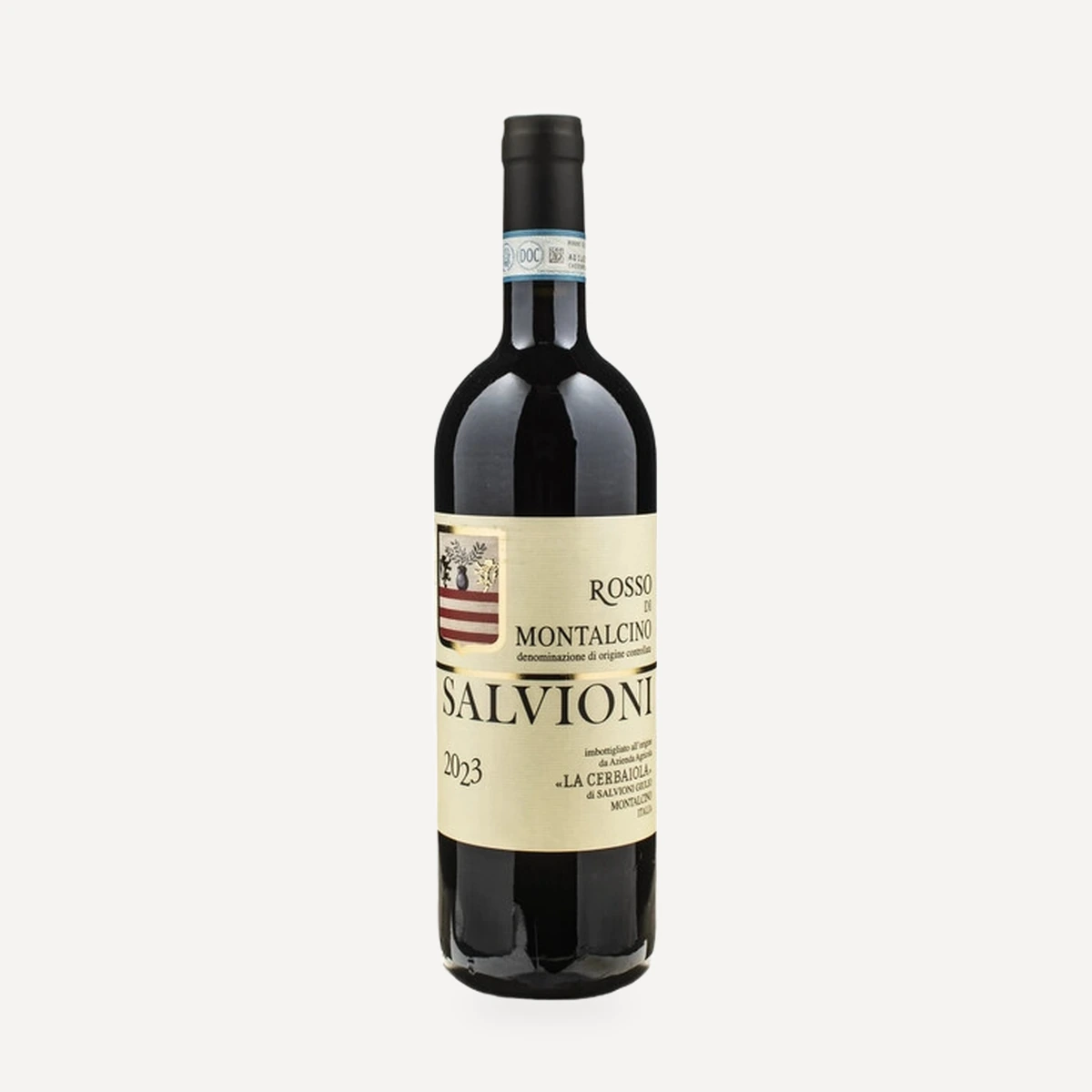
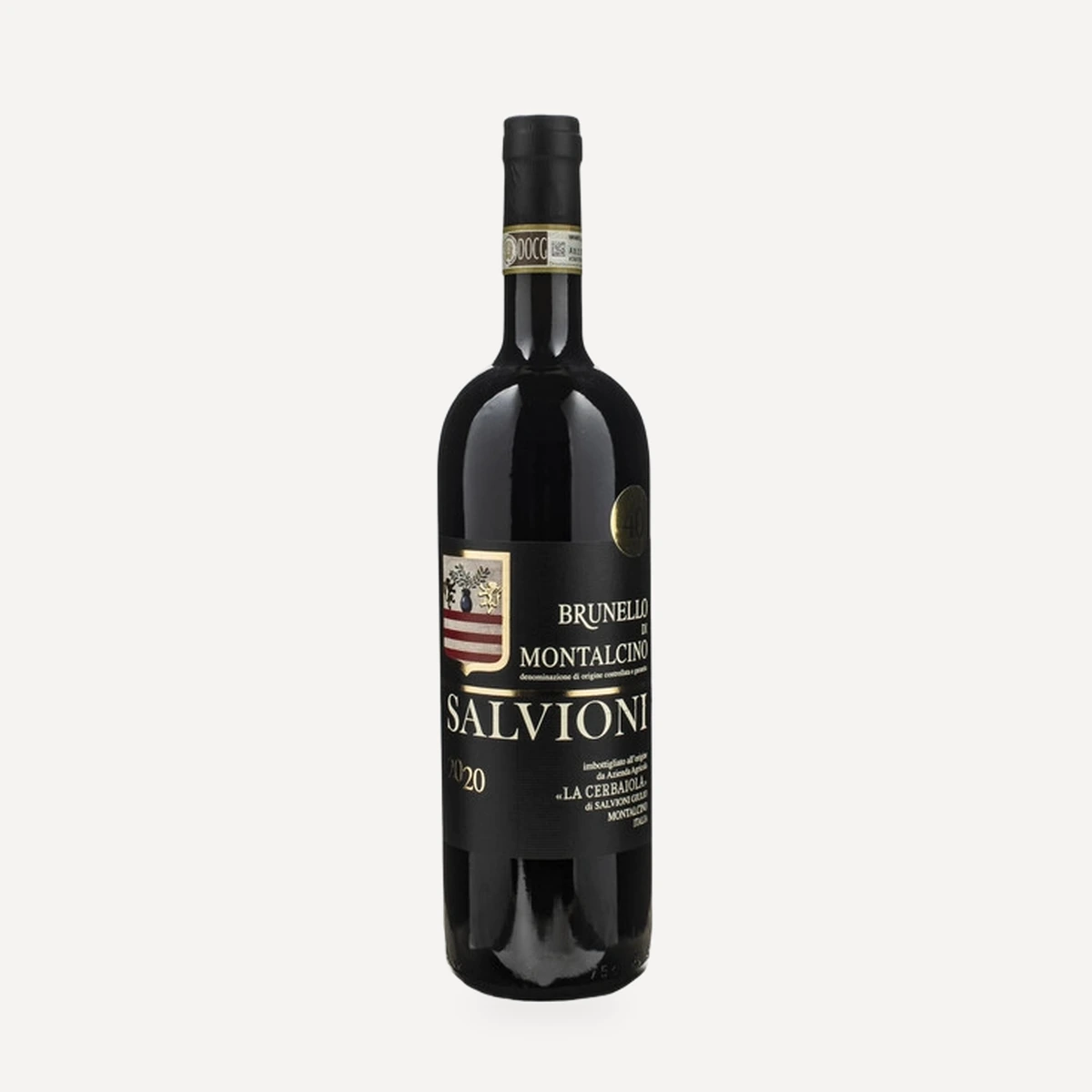
The estate has consistently used large, medium-toast Slavonian oak casks, described as 18–22 hl in the detailed technical information and as 20 hl in the general cellar description. The production approach is explicitly traditional, with the quality of the vintage and harvested grapes determining whether fruit is assigned to Brunello di Montalcino or Rosso di Montalcino.
Philosophy
The Salvioni family presents wine as a collective undertaking rooted in hospitality. Umberto made wine to share with friends; Giulio and Mirella transformed that impulse into a small family winery intended to extend the same circle of conviviality.
The production philosophy favours restriction over volume. Severe pruning, repeated inspection of the vines, green harvesting, manual selection and low yields are intended to concentrate attention on the quality of every bunch. The same selective principle governs the cellar: Brunello is made only when the vintage and harvested fruit meet the family’s quality objective. In less suitable years, the entire harvest is directed to Rosso di Montalcino; Rosso may also be produced when a more generous harvest provides sufficient fruit.
Tradition is expressed through spontaneous fermentation, non-climate-controlled fermentation rooms, large Slavonian oak casks and the continuing use of cellars integrated with family life. The prolonged maturation beneath the family home symbolically keeps this delicate stage within the household.
Wines
Brunello di Montalcino DOCG