History
Ancient viticultural background
Aglianico has been cultivated in the Vulture area for more than 2,000 years. Its local history is traced to Greek colonists, while the Venosan poet Quinto Orazio Flacco celebrated wine with the phrase Nunc est bibendum. In the Roman period, Venosa minted coins dedicated to Dionysus. Documents from the seventeenth and twentieth centuries later recorded the reputation and diffusion of local wine.
Foundation and appellation recognition
Cantina di Venosa was established in 1957 by 27 promoting members as a cooperative devoted to producing and enhancing Aglianico del Vulture. Its original winery remains one of the cooperative's two historic operating structures.
Aglianico del Vulture received DOC recognition in 1971. Following the 1980 earthquake, a second production, warehouse and service facility was built. The two historic plants have since been reorganized and renewed. In 2010, Aglianico del Vulture Superiore gained DOCG status.
Precision viticulture and sustainability
A satellite-mapping programme began in 2018. Sentinel-2 imagery and Oenoview software were introduced to assess the vegetative condition of 150 ha of vineyards at Iatta every week. Field verification and technical bulletins from the ALSIA Basilicata Experimental Center support the interpretation of the satellite data.
From 2020, the integrated management system incorporated ISO 22005:2008 traceability requirements. The cooperative issued its first Sustainability Report in December 2022, covering the 2021/2022 financial year, and adopted its first Code of Ethics on 1 December 2022. That year, the Iatta satellite-mapping project received Coldiretti's Oscar Green.
Equalitas certification followed in 2023. The certification addresses the company, finished products and territory through environmental, social and economic criteria. In the same year, Trapview monitoring was introduced for Lobesia botrana, using ten stations distributed across 700 ha of members' vineyards.
Recent production and development
In 2024, members delivered 26,297 quintals of grapes. The winery produced 19,305 hl of wine, comprising 16,940 hl of red and 2,365 hl of white, and bottled 1,718,198 units. The bottled total was 12.4% above 2023.
The 2025 harvest yielded 48,000 quintals of grapes, including 40,000 quintals of Aglianico; Moscato, Malvasia, Greco and Merlot made up the balance. A cool spring preserved natural acidity and clear aromas, followed by a dry summer and a bright, regular autumn that enabled slow, complete ripening. Donato Gentile described the fruit as notably sound and aromatic, with balance among acidity, maturity and concentration.
By December 2025, annual bottled production had reached 2.2 million bottles, an increase of 169% over five years, against potential capacity of 5 million. The cooperative operated in ten international markets and was preparing to enter China as its eleventh; exports represented 220,000 bottles, or 10% of bottled production, with 60% of exports going to Europe.
A €3.4 million redevelopment programme is connecting the 1957 winery with the facility built after the 1980 earthquake. Of the total investment, €1.25 million is financed through PNRR funds. The existing operating structures occupy 3,500 m². A partially underground, two-level hospitality wing of 1,100 m² is scheduled to open between late 2026 and early 2027, adding a meeting room, 150 m² of tasting space, a small kitchen and a 400 m² terrace. Six multilingual hospitality positions are planned.
Terroir
Cantina di Venosa works in northern Basilicata, principally in the commune of Venosa and on the slopes of Monte Vulture, an ancient volcano. Volcanic soils and the hill climate shape the cooperative's principal variety, Aglianico.
The 2024 vineyard register covered 735.4 ha associated with 272 members. Venosa accounted for 681.9 ha from 252 members, approximately 93% of the registered area. The remaining recorded vineyards were in Maschito (17.95 ha), Ripacandida (9.19 ha), Ginestra (0.42 ha), Lavello (11.73 ha) and Montemilone (14.21 ha).
Individual vineyard descriptions place vines between 400 and 550 m above sea level. The production districts named for the range include Venosa, Maschito and northeastern Potenza. The 2025 season combined a cool spring, a dry summer and a bright, regular autumn, allowing slow, complete ripening while preserving acidity and aromatic clarity.
Winemaking
Viticulture combines member knowledge with precision monitoring and targeted field intervention. Selected harvesting and controlled yields are part of the quality approach.
Since 2018, Sentinel-2 imagery and Oenoview software have provided weekly assessments of 150 ha at Iatta, identifying variations in vegetative condition, water stress, vine health and potential disease. The results are validated through field inspections and compared with technical bulletins from the ALSIA Basilicata Experimental Center. This information supports localized action intended to reduce treatments and waste.
Since 2023, ten Trapview stations distributed over 700 ha have monitored Lobesia botrana. The digital platform permits row-level targeting rather than undifferentiated intervention.
Equalitas certification was obtained in 2023. Its scope evaluates responsible and transparent company practices, finished-product quality and safety, reduced environmental impact, biodiversity, natural resources and local development. Environmental policy also covers lower energy and water use, pollution prevention, renewable resources and recyclable packaging materials.
The winery combines established cellar practices with modern production technology. Every incoming grape lot is assessed at a dedicated refractometer station before entering the cellar. Reception is selective, yields are controlled and vinification is managed with close attention to fruit quality.
Production operates through two historic structures: the original 1957 winery and the plant built after the 1980 earthquake. Together they provide 3,500 m² for production, warehousing and services and have recently been reorganized and renewed.
Food-safety and traceability management follows ISO 22005:2008 and is integrated with BRCGS version 9 and IFS version 7. Traceability extends through the entire production chain. The 2024 cellar processed 26,297 quintals of grapes and produced 19,305 hl of wine, of which 16,940 hl was red and 2,365 hl white. Inputs recorded for that year included 1,870 kg of yeasts and activators, 1,193.18 kg of fining agents, 5,464.5 kg of stabilizing products and 1,709.5 kg of antioxidants, SO₂ and sulphites.
The range employs several approaches according to category. Premium selections are based on vineyard selection, restricted yields and prolonged maturation. Sparkling wines emphasize aromatic clarity, balanced dosage and drinkability; examples use low-temperature Charmat processing, including long Charmat cycles. Selected white-wine production includes crushing, destemming and pressing followed by temperature-controlled fermentation in French-oak vats at 15–18°C. Distillates are made from selected Moscato and Aglianico pomace, with both white and reserve styles.
Philosophy
Cooperation is treated as the foundation of the enterprise: members, employees and winegrowers work toward shared goals of solidarity, responsibility and quality. The guiding production idea combines inherited practices with contemporary technology, seeking innovation without severing ties to local culture.
Environmental, social and economic sustainability informs daily decisions and future investment. The principal aims are to protect the land and biodiversity, reduce environmental impact, improve production processes, preserve local resources and support the surrounding community.
The Code of Ethics places integrity, transparency, fair competition, employee welfare, food safety, full traceability and environmental protection at the center of operations. It also commits the cooperative to energy and water conservation, pollution prevention, clear consumer communication, professional development, equal opportunity, opposition to irregular and forced labour, and responsible relationships with suppliers and collaborators.
Quality is understood as the result of collective work from vineyard to bottle, combining careful cultivation, rigorous grape reception, controlled production and respect for Basilicata's DOP, DOCG and IGP production rules.
Wines
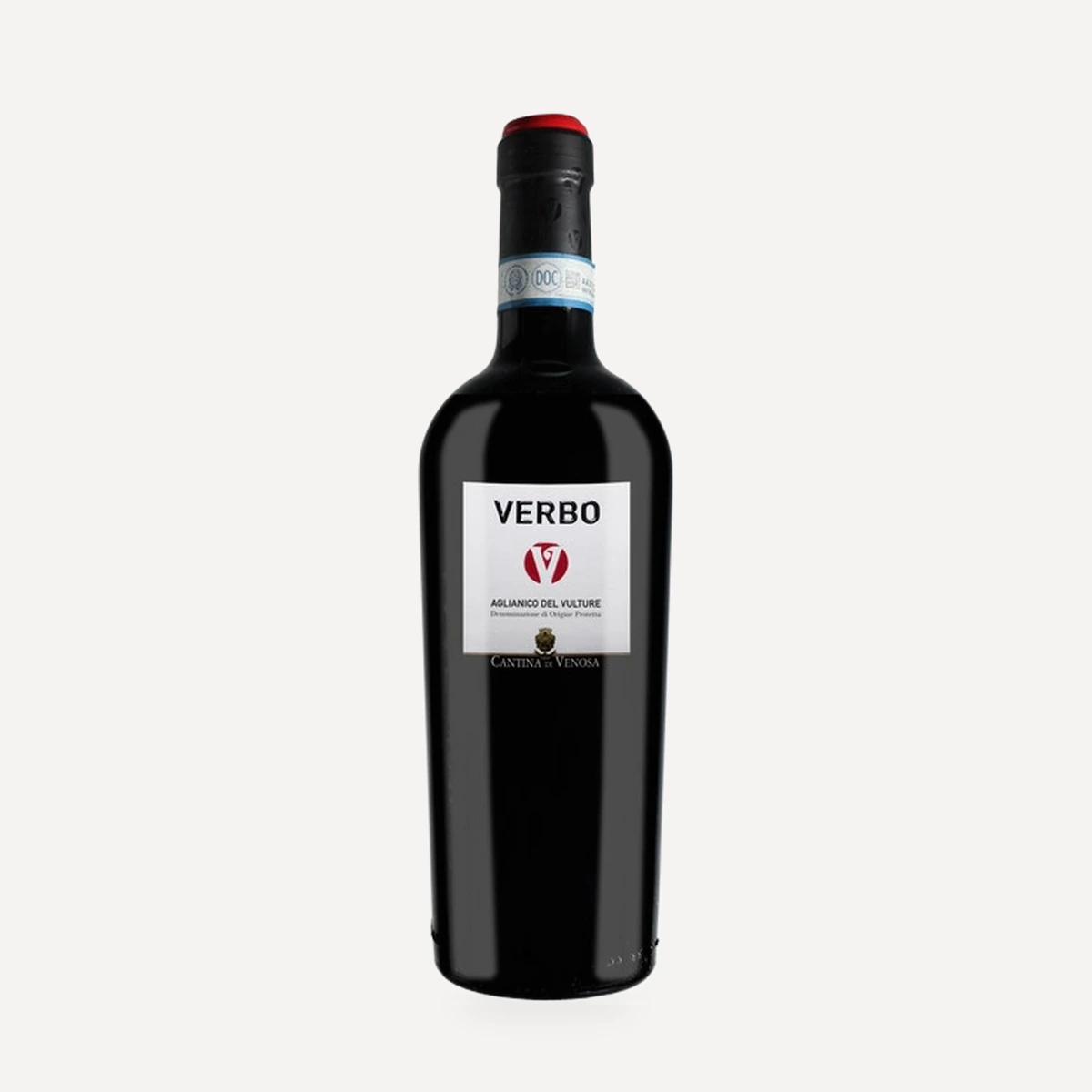
Verbo Aglianico del Vulture Lt. 0.75–Lt. 1.500 DOP