Storia
1997: Mark and Elvezia meet
California winemaker Mark Shannon and Friulian wine-marketing specialist Elvezia Sbalchiero met in Sicily in 1997. Their complementary professional backgrounds—winemaking and marketing—became the foundation of their future partnership.
1998: A journey to Puglia becomes a new life
In 1998, Mark proposed a visit to Puglia to explore its old Primitivo vineyards. Their interest had been stimulated by University of California, Davis research identifying Primitivo and California Zinfandel as genetically identical. The extensive landscape of old, bush-trained vines made an immediate impression on them. What was intended as a short holiday became a permanent commitment to the region, and they began producing wine from Puglian native grapes.
Developing A Mano
The name A Mano, meaning “by hand,” reflects Mark and Elvezia’s conception of themselves as artisans. Their work extends across the entire chain from vineyard to bottle, with close attention to each stage rather than reliance on shortcuts. The resulting style is intended to be contemporary while remaining faithful to the grapes and places of Puglia.
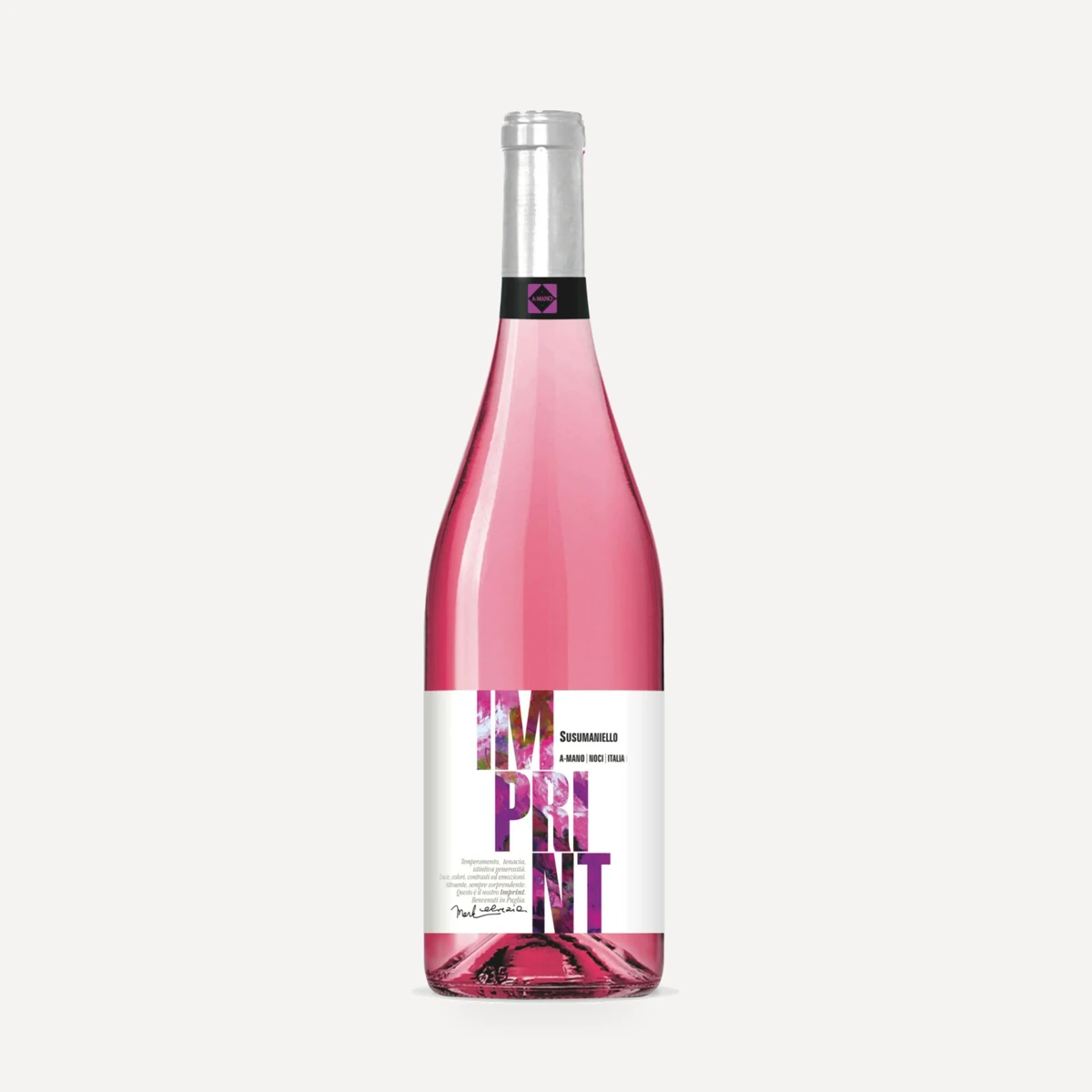
Primitivo played a central role from the outset. A Mano describes itself as an early proponent of vinifying the variety in a modern Puglian style. The portfolio subsequently expanded to Fiano, Negroamaro, Falanghina and Susumaniello, all presented as native Puglian varieties. It now comprises the A Mano, Imprint of Mark Shannon, Prima Mano and Natural Wines ranges.
Continuing work in Puglia
Mark has completed more than 45 harvests in total, including almost 30 in Puglia. His approach has developed through sustained work among the vines and the close observation of each variety. The project remains based in Noci, where A Mano also maintains a tasting room in the town’s historic centre.
Terroir
A Mano draws grapes from several parts of Puglia rather than presenting its production as the result of one continuous estate. The identified growing zones extend from the northern part of the region to coastal and inland sites farther south.
Primitivo sources include Manduria, Torricella, Sava and Lizzano. The vineyards used for the principal Primitivo bottling have an average vine age of 20–40 years. The Prima Mano Primitivo comes from a single vineyard at Lizzano, beside the sea, with vines approaching 70 years of age. The proximity of this vineyard to the coast brings the smell of the sea into the site at dawn alongside the aromas of ripening fruit.
Falanghina is sourced between San Severo and San Paolo di Civitate from an approximately 20-year-old vineyard cultivated organically. Susumaniello for rosato is grown around Brindisi and San Vito dei Normanni. Primitivo for rosato is selected from Manduria, Torricella, Sava and Lizzano, with the specific vineyards reconsidered each year to find fruit that combines sufficient flavour and colour with the lower ripeness and retained acidity required for the style.
Old bush-trained Primitivo vines were among the defining features that first drew Mark Shannon and Elvezia Sbalchiero to Puglia. Their broader approach treats the identity of each indigenous variety and its place of origin as the starting point for both vineyard selection and winemaking.
Vinificazione
Mark Shannon’s vineyard work is based on sustained observation of the grapes and the individual behaviour of each variety. He describes the process as listening to the vines: walking the rows, interpreting the fruit and waiting until the vineyard indicates the right moment to act. Harvest timing can consequently be decided within a very narrow window, as illustrated by the almost 70-year-old Prima Mano vineyard at Lizzano.
A Mano works with mature and old vineyards, including the bush-trained Primitivo vines that originally attracted Mark and Elvezia to Puglia. The main Primitivo sources have an average vine age of 20–40 years, while the Prima Mano site approaches 70 years. The Falanghina vineyard between San Severo and San Paolo di Civitate is approximately 20 years old and organically cultivated.
Fruit sources may be reassessed according to the intended style. For Primitivo Rosato, the team searches each year for vineyards capable of supplying grapes with full flavour and suitable colour at lower ripeness, preserving the acidity that is difficult to retain under Puglian conditions.
No animal-derived ingredients are used either in the vineyard or the cellar under A Mano’s vegan policy. Where processing aids are necessary, natural clays and plant proteins derived from potatoes and peas replace animal-based materials. This policy is maintained through self-certification.
A Mano frames production as an artisanal continuum from vineyard to bottle. Mark Shannon interprets the particular qualities of each grape variety and guides the fruit into wine without forcing the process or using shortcuts. The governing principle is “subtraction, not addition”: rigorous work is intended to reveal fruit purity, preserve provenance and produce a style that is contemporary but authentic.
Cellar protocols vary with the fruit and intended expression. Mature Primitivo is cooled and crushed immediately after arrival, then fermented at low temperature over several weeks. Following pressing, it rests through the winter in concrete tanks without wood and receives at least six months of bottle ageing. Prima Mano Primitivo uses warm fermentation for the skins and cold fermentation for the juice, followed by two years in concrete and at least six months in bottle.
White and rosato production uses particularly cool fermentation to retain fresh-fruit aromas. Falanghina ferments at approximately 7°C for ten weeks, then rests for three months in stainless steel and three months in bottle. For Primitivo and Susumaniello rosati, juice remains in contact with the skins only briefly; fermentation then proceeds at 6°C. The rosati rest for three months in stainless steel and at least three months in bottle.
The vegan production policy excludes animal-derived ingredients from both vineyard and cellar. Natural clays and potato or pea proteins are used only when a processing aid is required. A Mano has chosen self-certification for this policy.
Filosofia
A Mano defines itself through craftsmanship. Its name—Italian for “by hand”—expresses detailed personal involvement from the vineyard through bottling and the dedication associated with something made entirely by hand.
The project’s declared objective is a contemporary but authentic interpretation of Puglia. It works exclusively with native Puglian grapes and seeks to respect both their individual character and their geographic origin. Mark Shannon describes the relationship with the vineyard as one of listening: the grapes determine the timing and direction of the work, while the winemaker interprets rather than forces them.
“Subtraction, not addition” summarises the cellar philosophy. Intervention is directed toward uncovering the purity of the fruit, and the wines are intended to reflect where their grapes were grown. The work is presented as a daily commitment and a way of life rather than an exercise in image-making.
The vegan policy is framed as an ethical and environmental choice. Animal-derived ingredients are excluded in the vineyard and cellar, and plant-based alternatives are used only where necessary. A Mano connects this self-certified practice with more responsible consumption, respect for animals and concern for the planet.
Vini