Storia
Ancient viticultural background
The estate places its vineyards within a much longer history of winegrowing around Vesuvius. Vines were introduced to the area by the Greeks, while the Romans produced wines celebrated by poets and writers. Vineyards climbed the slopes of Vesuvius, whose eruption in AD 79 buried ancient Pompeii.
The Medici connection
In 1567, a branch of the Florentine Medici dynasty moved to the Kingdom of Naples and acquired a feudal estate. Luigi de’ Medici, Prime Minister of the Kingdom, wanted to enrich the cellar of the family’s Neapolitan residence with wines from the estate. He entrusted his favoured nephew, Giuseppe de’ Medici, with improving the quality of the family wines. Giuseppe invested expertise and capital in the improvement of Vesuvian wine and completed the assignment within a few years.
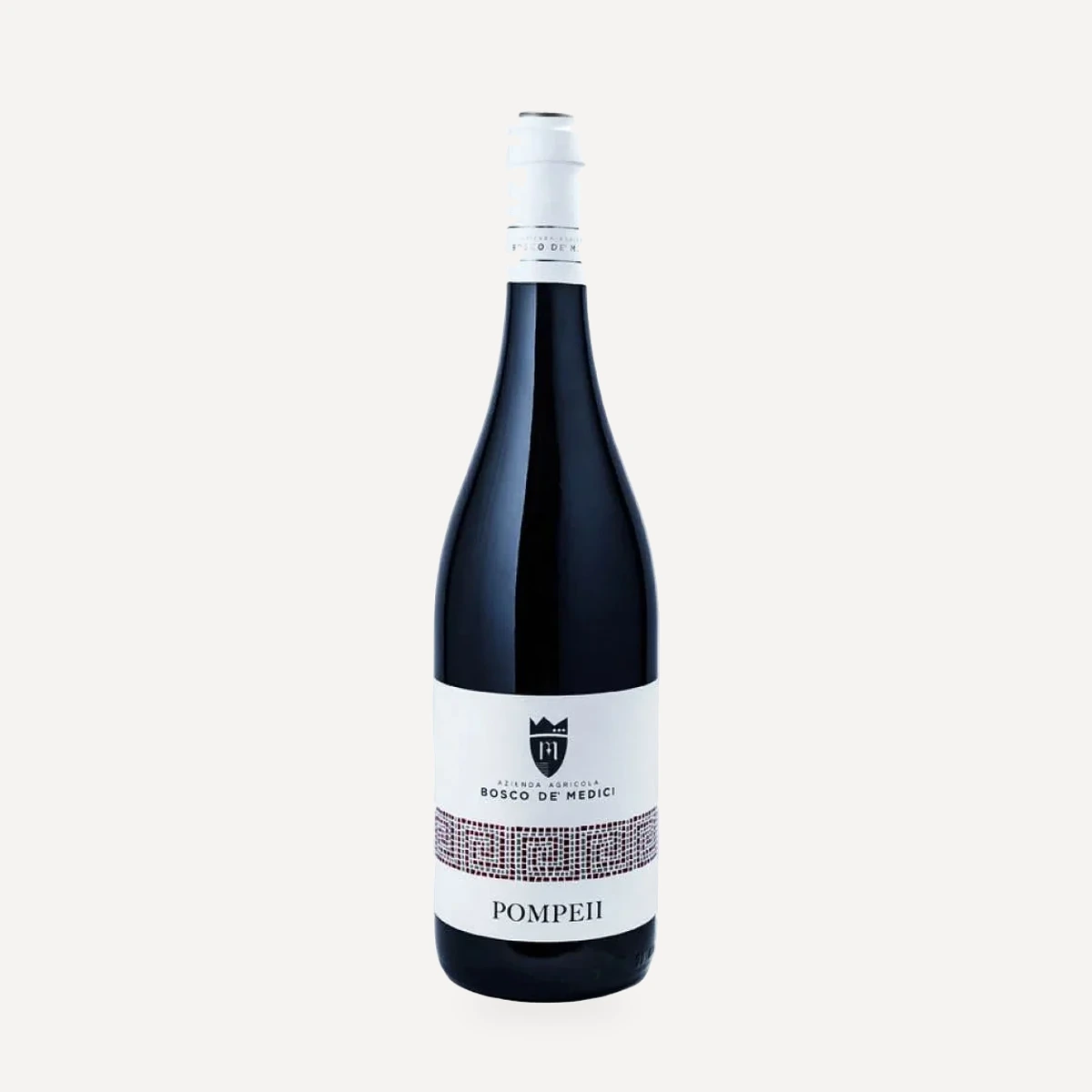
The modern estate’s connection with this history emerged through the discovery of a boundary stone in a vineyard. The stone bears a crowned letter “M,” subsequently adopted as the company emblem. Research connected the land with the branch of the Medici family that had settled in the Kingdom of Naples and had worked to modernize local cultivation and improve Vesuvian wine.
Raffaele Palomba and the first family vineyard
During the 1970s, Raffaele Palomba acquired the family’s first vineyard on the slopes of Vesuvius. He devoted himself to the land and grew grapes sought by local cellars for their quality. He also made a small quantity of wine for family consumption, without commercial ambitions.
The vineyard became a shared gathering place for the Palomba and Monaco families. Time spent among the rows and working together during harvest strengthened both their personal relationship and their working partnership. The original vineyard offered views across the land south of Naples, toward the sea and the beginning of the Sorrento Coast.
The old plantings included a substantial proportion of ungrafted, pre-phylloxera vines. These were later complemented by vineyards planted during the 1980s.
Foundation in 1996
In 1996, Raffaele’s son Gaetano Palomba and Franco Monaco founded Azienda Agricola Bosco De’ Medici, bringing the two families together around Raffaele’s attachment to the vineyards of Vesuvius. For the following years, the business concentrated on cultivating its land and supplying native grapes to other Vesuvian cellars. This work continued after Raffaele’s death.
Estate winemaking and generational transition
In 2014, the next generation took an active role. Antonio Monaco and Giuseppe Palomba advanced the family project by establishing the cellar in Pompei and launching the first official Bosco De’ Medici vintage. The estate thereby moved from growing and selling grapes to vinifying its own fruit, fulfilling Raffaele’s ambition to produce wine in Pompei from native varieties cultivated directly by the family.
The 2014 harvest yielded approximately 8,000 bottles. Production subsequently increased year by year, reaching approximately 28,000 bottles from the 2019 harvest.
Terroir
Bosco De’ Medici cultivates approximately 8 hectares within Vesuvius National Park, divided among the municipalities of Terzigno, Boscoreale and Pompei. The vineyards predominantly face south to south-east and lie at approximately 250–300 metres above sea level.
Their position provides abundant sunlight. The sea is visible from the vineyards, and maritime air currents combine with marked temperature variation to shape the growing conditions. From La Rotonda, the outlook extends across the Gulf of Naples toward municipalities in the province of Salerno.
The soils are volcanic, sandy and rich in iron, potassium, phosphorus and silica. Successive eruptions deposited ash and lapilli in the subsoil. The sandy structure is highly permeable, enabling the vines to send their roots deep into the ground. These sandy volcanic conditions also protect vines from phylloxera, allowing most of the estate’s plants to remain ungrafted.
Vine ages range from young plantings to historic vines more than a century old. The four native varieties cultivated are Piedirosso, Aglianico, Caprettone—also known as Coda di Volpe—and Falanghina.
Vinificazione
The vineyards are divided among several plots in Terzigno, Boscoreale and Pompei and are managed under an organic protocol. The stated purpose extends beyond grape quality to protecting the places where the families and their colleagues live and work.
Only native varieties are cultivated: Piedirosso, Aglianico, Falanghina and Coda di Volpe, locally called Caprettone. Training includes espalier and the traditional tendone vesuviano canopy; Guyot pruning is identified for espalier-trained vines in several vineyard descriptions.
Most vines grow on their own roots. The sandy volcanic soils protect them from phylloxera, and the estate associates the absence of grafting with greater vine longevity and robustness. Historic plants exceed 100 years of age, while later plantings include vineyards established in the 1980s and younger parcels.
Harvesting is carried out by hand with grape selection. White varieties are generally picked toward the end of September, while Piedirosso-based red fruit is harvested around the first part of October.
The winery stands in the centre of modern Pompei, a short distance from the archaeological remains of the Roman city. Educational vineyards surround the building, and remains of an ancient necropolis can be seen from them.
The cellar works with stainless-steel tanks, oak tonneaux and terracotta amphorae. The amphorae are made in Tuscany and left unlined internally. They are used for part of the white-wine production, including fermentation, skin contact and maturation where required. The cellar’s approach combines these vessels, inspired by ancient winemaking, with modern temperature-controlled equipment and stainless steel.
Across the estate’s production repertoire, the declared techniques include direct pressing of whole white grapes, skin maceration, temperature-controlled fermentation, malolactic fermentation in stainless steel, maturation on fine lees, and ageing in stainless steel, terracotta amphorae and oak tonneaux. The work is framed as guiding natural processes as simply as possible while drawing on inherited practice.
Filosofia
Bosco De’ Medici defines itself through family continuity and artisanal production. Vineyard and cellar decisions are directed toward respect for the territory and the pursuit of quality in the finished wine.
Organic vineyard management is presented as both a quality measure and a commitment to safeguarding the landscape and the people who live and work there. This principle is intended to extend through the entire production chain, from the vineyard to the bottle.
In the cellar, the aim is to accompany natural processes in the simplest possible way while preserving lessons inherited from earlier generations. Unlined terracotta amphorae embody the connection the family seeks between the ancient winemaking culture of Pompeii and contemporary vinification methods. Native grapes grown directly by the family are central to the project and to its ambition to produce wines specifically rooted in Pompei and Vesuvius.
Vini