Storia
Family roots and grape growing
Broccardo’s present activity rests on knowledge and vineyard practices transmitted through the family by parents, grandparents and great-grandparents. The parents were already growing and selling grapes in the 1970s.
2009: the siblings enter the business
Filippo, Laura and Federica Broccardo joined the family business in 2009. Their arrival marked the beginning of complete in-house wine production rather than the sale of grapes alone. The business also developed a strong export orientation, principally towards Europe, the United States and Asia.
The range came to centre on Barolo DOCG, supported by Langhe DOC Nebbiolo, Barbera d’Alba DOC, Dolcetto d’Alba DOC, Langhe DOC Arneis and Langhe DOC Rosato. The family describes its work as the continuation of three generations of experience, with the current siblings carrying forward the respect for the Langhe and vineyard practices inherited from earlier generations.
2014: UNESCO landscape
In 2014, the winery became part of the Langhe area inscribed as a UNESCO World Heritage landscape.
2016: lower-impact production
Beginning with the 2016 harvest, Broccardo adopted low-environmental-impact techniques in both viticulture and winemaking. This direction subsequently included SQNPI certification under Italy’s integrated-production framework, together with grassing of vineyard soils, restricted treatments and more rational fertilisation.
Terroir
Broccardo has 13 ha of vineyards distributed among Monforte d’Alba, Barolo and Novello. The holdings encompass the Bricco San Pietro and San Giovanni MGAs in Monforte d’Alba, Paiagallo in Barolo and Ravera in Novello. Of the total vineyard area, 5.5 ha are planted with Nebbiolo destined for Barolo.
The soils across the holdings are composed of alternating layers of clay, tuff, sand and silt deposited by the retreat of the ancient Mare Padano approximately 16 million years ago. Individual parcels add calcareous-clay, sandy-marl and sandy-silty variations to this general profile.
Monforte d’Alba
Bricco San Pietro occupies a large and varied sector on the western side of Monforte d’Alba. The wider MGA runs from a cool, steep side above Corsini to a warmer, more humid side above Settevie and Manzoni, then towards Tantesi and the gentler hills of Pansoglio, Cucchi and Viglioni. Its overall elevation extends from 250 to 520 m. The best-exposed vineyards range from south through south-west, while other sectors face west to north-west or east to north-east. Broccardo’s Vigna Martina lies at 410 m.
San Giovanni comprises both sides of the hill leading to the locality of the same name. One side faces Novello with a western exposure; the other faces east and has a longer record of separate vinification. The overall MGA covers elevations from 260 to 440 m. Broccardo’s historic San Giovanni vineyard lies at approximately 400 m on calcareous-clay to clay-silt soils.
Barolo
Paiagallo occupies the fourth sector of the eastern side of the commune of Barolo and has rounded landforms. The MGA contains three distinct areas: Villa, associated with a more fruit-oriented and elegant expression; Paiagallo proper, where a deep inlet turns south; and San Sebastiano, overlooking Barolo and approaching Terlo and Via Nuova in morphology and exposure. The MGA ranges from 310 to 380 m with exposures between east and south. Broccardo’s Nebbiolo parcel is represented at approximately 350 m, with south to south-west exposure and clay and sandy-marl components.
Novello
Ravera is a large, heterogeneous MGA divided into four morphological nuclei. The first continues the upper part of Terlo from the Barolo boundary to Cascina Serra. The second lies below the Barolo–Monforte d’Alba road between the Rivassi boundary and Cascina Ravera. The third extends from Cascina Parusse to Cascina Ravera, with its best positions on the south-facing side around Bricco Pernice. The fourth corresponds to the broad, bright basin around Cascina Pratorotondo and Cascina Nuova. The MGA lies between 340 and 420 m and generally faces south to south-east. Broccardo’s Nebbiolo holding is in the Terlo sector at 390 m; the parcel associated with the Ravera bottling is described at 350 m on limestone and clay.
Vinificazione
Broccardo trains its vines with the Guyot system and follows sustainable vineyard practices within an integrated-production framework. The winery complies with the cited EU integrated-production technical provisions, including grassing of vineyard soils and containment of treatments.
SQNPI certification formalises this approach. The system combines available agronomic and crop-protection measures while seeking to minimise synthetic chemical products and rationalise fertilisation according to ecological, economic and toxicological principles. Low-environmental-impact viticultural and oenological techniques have been applied since the 2016 harvest.
The named Barolo parcels are harvested manually. Harvest timing is adapted to site and intended use: late August to early September for white grapes and Nebbiolo picked early for sparkling production; late September to early October for Barbera; and principally mid- to late October for Nebbiolo destined for red wines.
Production begins with careful grape selection and is organised around preserving the identity and fruit character of each wine so that differences among the Langhe sites remain perceptible.
Wood is used selectively. Slavonian and French oak are favoured for the maturation of Barolo, Nebbiolo and Barbera. Stainless steel is preferred for the fresher, more fruit-driven Dolcetto, white and rosé wines. Across the principal Barolo bottlings, the cellar works with temperature-controlled fermentations, steel for malolactic fermentation and French and Slavonian oak vessels of varying capacity, including large barrels up to 60 hl. The estate also produces a bottle-fermented Metodo Classico from Nebbiolo, involving an early harvest, white vinification, tirage, secondary fermentation in bottle, lees ageing, riddling, disgorgement and minimal dosage.
The labelling and bottling area is underground. Its naturally stable conditions allow it to operate without heating or cooling.
Filosofia
Broccardo presents its work as a continuation of values passed down by parents, grandparents and great-grandparents: gratitude towards the Langhe, respect for the land and acceptance of the sustained labour demanded by vineyards.
The three siblings combine this inheritance with a desire to develop the business. Their stated priority is to preserve each wine’s purity, fruit and individual character rather than obscure its origin. Tradition is therefore expressed through site-sensitive vineyard work and restrained, purposeful use of steel and wood, while integrated production and SQNPI certification give the environmental commitment a formal framework.
The family associates wine with conviviality through the Horatian phrase Nunc est bibendum, nunc pede libero pulsanda tellus—an invitation to drink and celebrate freely.
Vini
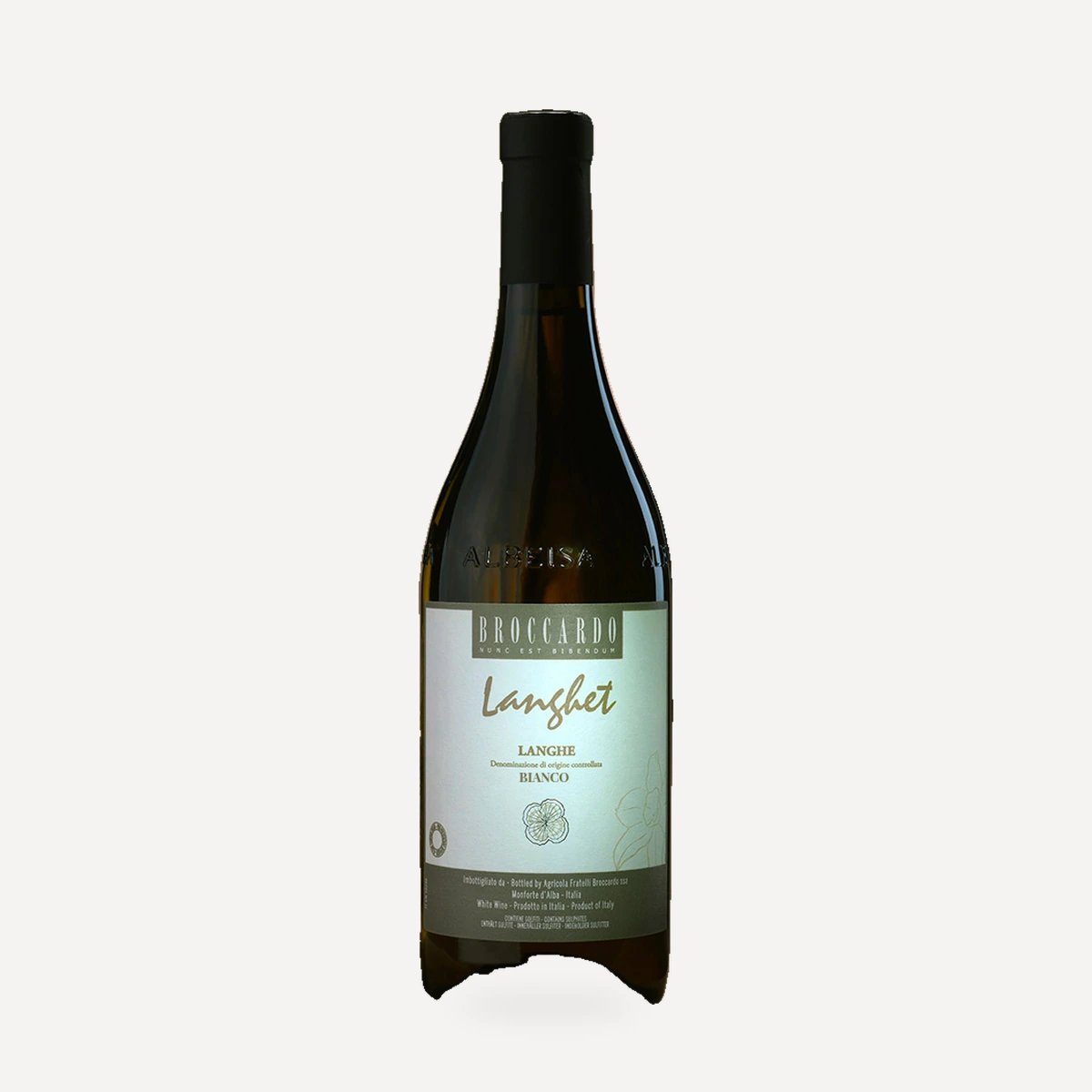
Langhe DOC Bianco Langhet
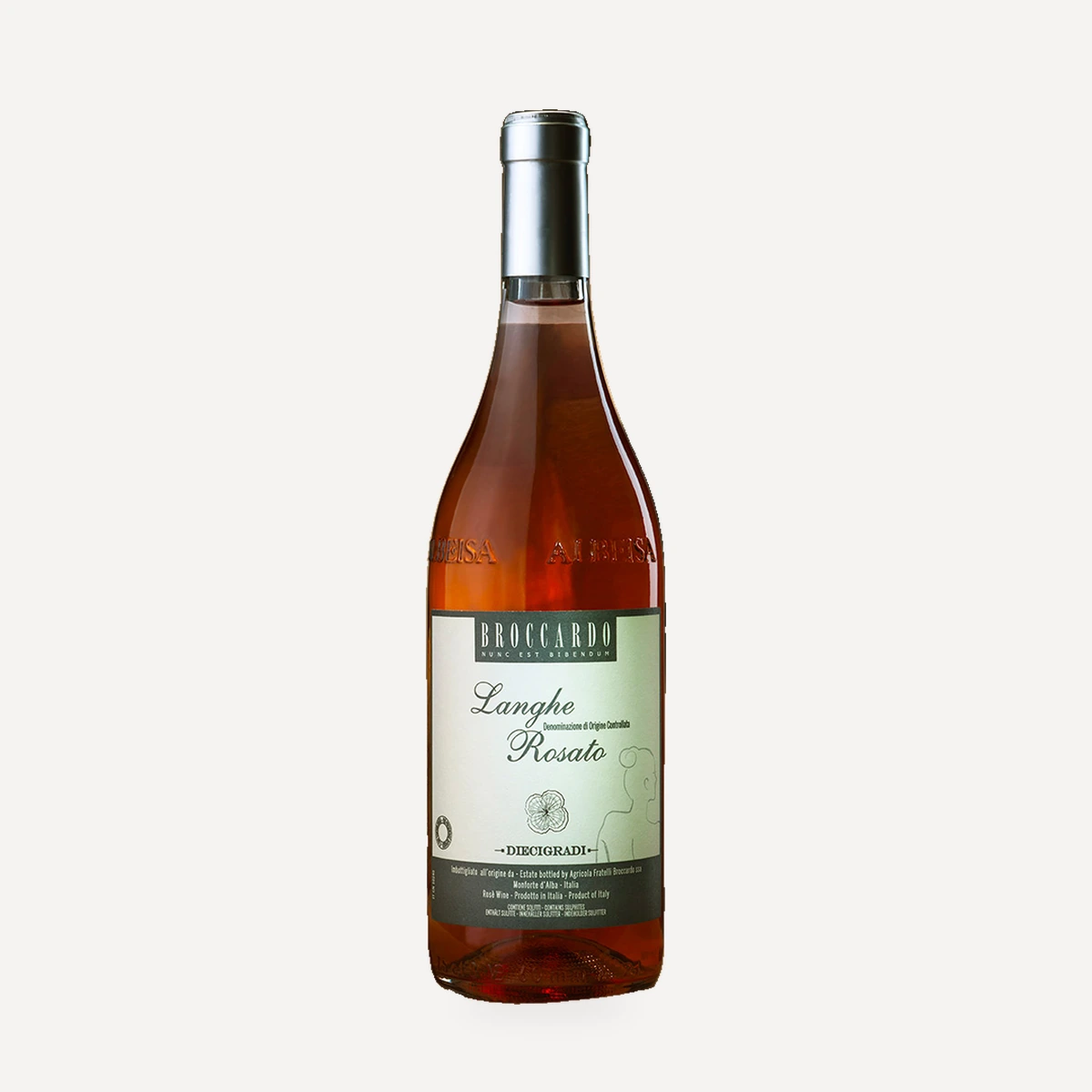
Langhe DOC Rosato Diecigradi