Storia
Local roots before Colonnara
Cupramontana was known as Massaccio from the Middle Ages until 1861. Its present name refers to Cupra, a fertility and love deity associated with Bona Dea, Venus, Aphrodite and Astarte. A Roman marble fragment depicting a cornucopia laden with grapes and supported by a winged putto attests to the locality’s ancient wine culture.
Vines were present on the hill of Rovejano during the Lombard and Frankish periods, between the 8th and 10th centuries. Benedictine monks subsequently renewed local agriculture and viticulture. By 1789, Francesco Menicucci described Cupramontana as abundant in vines producing fine wine in substantial quantities.
A wine school was proposed in 1883, the itinerant chair of viticulture and oenology was established in 1893, and the Mercato dei Mosti followed in 1912. Local sparkling-wine precedents went back still further: the Fabriano physician and Benedictine monk Francesco Scacchi discussed sparkling wines in 1622, while Ubaldo Rosi recognized Verdicchio’s aptitude for sparkling production in 1843.
Cupramontana’s first grape festival took place on 23 September 1928. In 1939 the town was formally recognized as the “Capital of Verdicchio.”
1959–1968: foundation and first bottled Verdicchio
Nineteen winegrowers founded the cooperative in Cupramontana in 1959 under the name Cantina Sociale di Cupramontana. It grew rapidly. The historic vineyard nucleus occupied medium-to-high hills on the right bank of the Esino, principally around Cupramontana, Apiro, Staffolo and San Paolo di Jesi.
The wine tower was designed in 1961 by engineer Luigi Spinolo of Piacenza, using a system patented by oenotechnician Emilio Sernagiotto and engineer P. Marchino. Its communicating vitrified-concrete tanks moved wine downward by gravity, reducing reliance on hydraulic pumps while maintaining a stable internal temperature.
Experimentation with Verdicchio’s potential and capacity for long ageing began in the early 1960s. In 1966 Colonnara released its first bottled Verdicchio, carrying a label created by Bruno da Osimo. Verdicchio dei Castelli di Jesi obtained DOC recognition in 1968; the decree identified Cupramontana and neighboring municipalities as the historical production zone entitled to the term “Classico.”
1970–1985: sparkling-wine development and selection
In 1970 cooperative president Luigi Ghislieri revived Cupramontana’s early-20th-century sparkling tradition and initiated Colonnara’s sparkling-wine production with a Verdicchio Metodo Martinotti. That year the cooperative also attended its first international fair in Germany.
The first Verdicchio sparkling wine made by Metodo Classico followed in 1980. Development of bottle refermentation drew on the historical work of Francesco Scacchi and Ubaldo Rosi and was advanced by Ghislieri together with oenologist Carlo Pigini Campanari.
In 1982 the Colonnara Brut Metodo Classico Millesimato received a Gold Medal at the fifth Banco di Assaggio dei Vini d’Italia in Torgiano. November 1985 brought another Gold Medal for the 1982 vintage of the same sparkling wine. That year the organization adopted the name Colonnara Società Cooperativa Agricola a responsabilità limitata, began its first formal Verdicchio selection, and introduced two wines central to its subsequent history: Verdicchio Cuprese and the red Tornamagno.
1989–2002: the ageing cellar and new wines
A large underground ageing cellar opened in 1989. Its controlled environment combines near-total darkness, a stable temperature of approximately 14–16 °C, appropriate humidity, and an absence of noise and vibration. It became the principal space for the long maturation of wines and bottle-fermented sparkling wines.
Ubaldo Rosi Brut Metodo Classico Riserva Verdicchio DOC joined the range in 1997. In 1998 Colonnara introduced the late-harvest Verdicchio Superiore Tufico, named for the locally called “tufo” soil of its source vineyard; it quickly received national and international recognition. Lyricus followed in 2000 as an accessible introduction to Verdicchio. In 2002 the cooperative created the passito Sanctorum, whose name evokes a sancta sanctorum: a place of encounter, silence, contemplation and the preservation of precious things.
2010–present: commemorative cuvées and cooperation
In 2010 Colonnara introduced a Verdicchio DOC Metodo Classico dedicated to Luigi Ghislieri and his work restoring Cupramontana’s sparkling tradition. In 2013 Ubaldo Rosi Brut Metodo Classico Riserva 2006 received Gambero Rosso’s Tre Bicchieri, the first time that distinction had been awarded to a sparkling wine from Marche.
In 2014 Colonnara and the historic Pesaro cooperative Pisaurum united in Marchedoc, creating a broader framework for cooperation while seeking to preserve their separate territorial identities and regional winemaking traditions.
Colonnara now brings together more than 100 grower-members. Its program encompasses the principal regional denominations and both Metodo Classico and Metodo Martinotti sparkling production. The cooperative continues to use the lower part of its historic wine tower for winemaking and the underground cellar for extended bottle ageing; selected Verdicchio, including Cuprese, has demonstrated an ability to remain in bottle for approximately 30 years.
Terroir
Historic Verdicchio zone
The historic core lies on medium-to-high hills along the right bank of the Esino, between Cupramontana, Apiro, Staffolo and San Paolo di Jesi. Verdicchio vineyards average approximately 450 m above sea level. Slow ripening under these conditions produces the acidity, minerality and elegance sought for both sparkling production and long ageing.
The broader Verdicchio sources extend across hilly and foothill sites at approximately 350–550 m in Cupramontana, Monte Roberto, Maiolati, Castelbellino, Staffolo and Apiro. The soils are of marine origin and medium texture, with locally elevated proportions of clay and sand.
Higher sparkling-wine sites around Cupramontana and Apiro lie at approximately 500–600 m. They share marine-origin, medium-textured soils with clay-rich and sandy sections.
Contrada San Marco
Tufico comes from a single vineyard in Contrada San Marco, Cupramontana, at approximately 400 m. Its marine-origin soil is predominantly sandy, interrupted by clay layers and Pliocene sandstone in banks or blocks. This material is known locally as “tufo,” the origin of the wine’s name.
Other Marche production zones
Cuprese draws on hilly and foothill vineyards at approximately 350–500 m in Cupramontana, Maiolati and Staffolo, again on marine-origin, medium-textured soils with clay and sand.
The Lacrima di Morro d’Alba zone in the province of Ancona lies at approximately 200 m and has loamy soil with a slight predominance of clay. The Monte Conero source area, within the commune of Ancona, has predominantly clay soil. Rosso Piceno vineyards occupy typical Marche hills with gravelly, medium-textured soils.
Vinificazione
More than 100 grower-members cultivate the cooperative’s grapes. The shared approach emphasizes careful, rigorous work in the vineyard before fruit passes to the cellarhands and oenologists.
Verdicchio intended for Metodo Classico is picked early, with selection focused on the ripest suitable bunches. The single-vineyard Tufico program follows a different objective: low production, manual harvesting at a very late stage and a long fermentation are used to express the Contrada San Marco site.
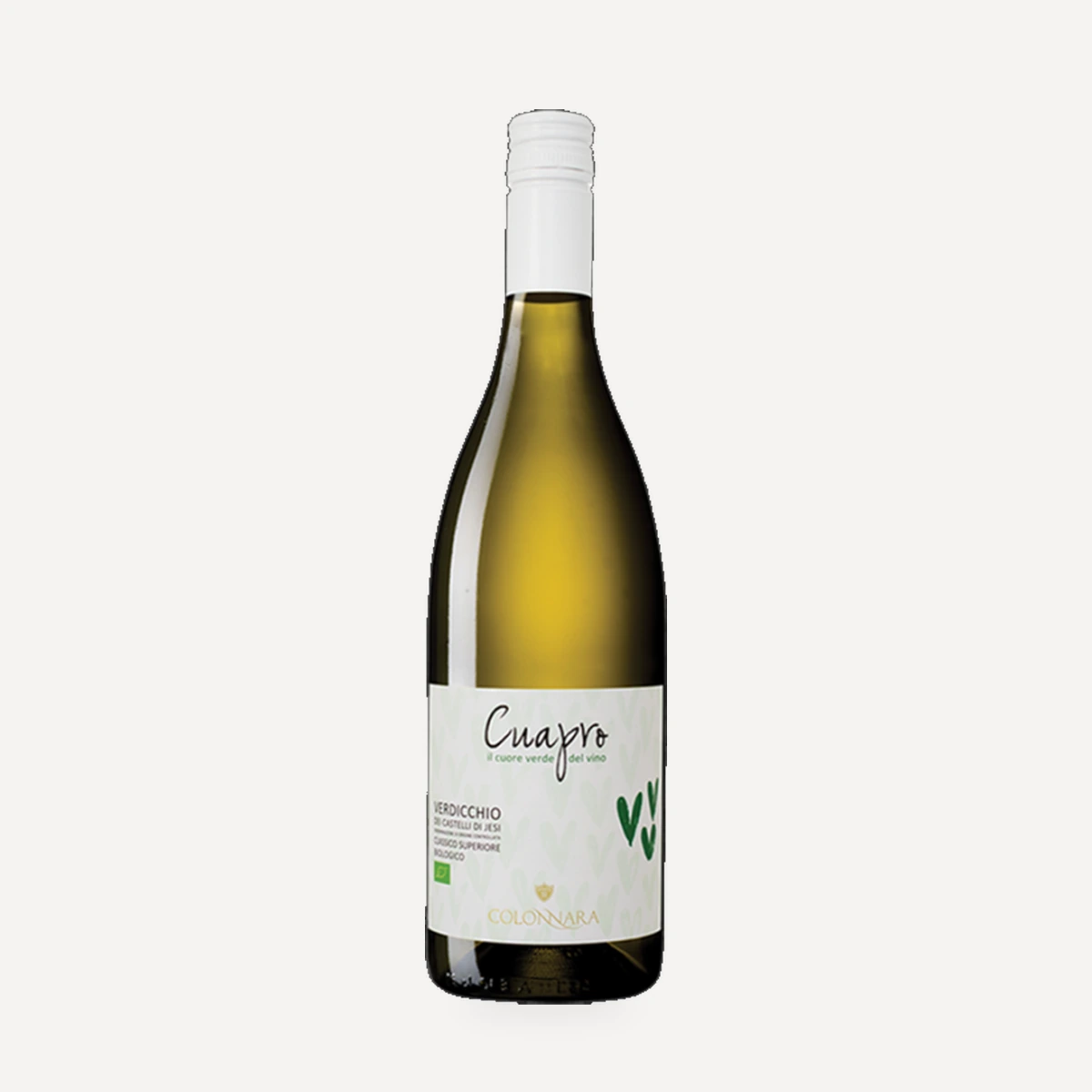
Several Verdicchio wines and sparkling wines are explicitly designated biological, including Cuprese, Ubaldo Rosi, Luigi Ghislieri and Cuvée Tradition. Cuapro is made from organic grapes grown in Cupramontana, Apiro and Rosora, the three communes encoded in its name. The alcohol-free Icemary is also based on organic grapes from Marche.
Technical material for individual products identifies manual harvesting, Guyot and double-arched-cane training in parts of the vineyard base, but these practices are not presented as universal across all member holdings.
Historic winery infrastructure
The 1961 wine tower contains communicating vitrified-concrete tanks. Gravity carries wine from the upper vessels to those below, limiting hydraulic-pump use. Vitrified concrete helps maintain a stable internal temperature, and the tower’s lower section remains in use for some winemaking stages.
The underground ageing cellar created in 1989 provides near-total darkness, a stable temperature of about 14–16 °C, appropriate humidity and protection from noise and vibration. Wines and sparkling wines mature there for years; Cuprese has demonstrated the ability to remain in bottle for approximately three decades.
Metodo Classico
Production begins with an early harvest and selection of suitably ripe grapes. The first fermentation takes place in an open tank to create a base wine of approximately 11% alcohol. Liqueur de tirage, yeasts and sugar are then added, and the wine is sealed in bottles with crown caps.
The second fermentation and prise de mousse take place in bottle. Bottles are stacked horizontally sur lattes in the traditional French manner for 30–60 months, and some maturation periods exceed 60 months. During this interval, yeast settles along the side of the bottle while sugar is converted into alcohol. Extended lees contact develops complexity and a fine, persistent mousse.
For remuage, bottles are transferred to wooden pupitres and held at an angle so that the sediment moves gradually into the neck and the bidule beneath the crown cap. Cellarhands turn every bottle manually on alternate days for approximately two months.
Disgorgement is performed à la glace: the neck is rapidly and partially frozen, allowing the yeast deposit to be expelled. Before final corking, liqueur d’expédition is added to set the dosage; its composition is treated as the oenologist’s proprietary recipe. The finished bottle receives its wire cage before release.
The cellar also has long-standing expertise in Metodo Martinotti, first used for a Colonnara Verdicchio sparkling wine in 1970. The range includes both bottle-fermented and tank-refermented sparkling wines.
Filosofia
Colonnara defines itself through cooperation among its grower-members and through the combination of territorial identity, tradition and experimentation. The cooperative gives wine and sparkling wine the time required for maturation rather than treating speed as an objective.
Its development of Verdicchio Metodo Classico illustrates this balance: historical local precedents were recovered, then pursued through decades of technical experimentation and long bottle ageing. The same outlook is embodied by the preserved wine tower, whose gravity system remains operational, and by the purpose-built underground cellar.
The cooperative presents careful grape cultivation, the practical knowledge of cellarhands and oenologists, and respect for the separate identities of Marche’s production zones as collective responsibilities. Its 2014 union within Marchedoc was framed as an opportunity for growth and collaboration without erasing those territorial identities.
Hospitality forms another part of this outlook. Visits, cellar tours and vineyard walks are intended to connect the wines with the people, places and traditions from which they come.
Vini
Cuapro