Storia
Piedmontese origins, 1568–1757
The family’s documented wine history begins in Pecetto Torinese in 1568, when Antonio Cinzano was registered as a vineyard and distillery owner. The family’s activities were connected from the outset with the House of Savoy.
A 1621 tax record associated with financing the war effort identifies Francesco Cinzano, a soldier in the Duke’s army, and records that his family produced wine, rosolio and medicinal wines. In 1707, Pecetto distiller Giovanni Battista Cinzano obtained a government licence to distil spirits and make rosolio for sale in both Pecetto and Turin, expanding the family business beyond its home locality.
A company bearing the Cinzano name was operating by 1749. On 6 January 1757, Giovanni Battista’s sons Carlo Stefano and Giovanni Giacomo Cinzano received accreditation from Turin’s University of Confectioners and Spirit Manufacturers. The family regards this accreditation as the creation of the Cinzano brand.
Royal patronage, sparkling wine and international expansion, 1840–1883
Between 1840 and 1860, King Charles Albert commissioned a large winery at Santa Vittoria d’Alba to process grapes from the Royal Estates and introduced sparkling-wine production in Piedmont. During this period, Francesco Cinzano II secured the designation of supplier to the Royal House. Cinzano began producing its own Champagne-style blend in 1860.
The brand was subsequently presented at international exhibitions and received recognition in Florence in 1861, London in 1862, Asti in 1868, Vienna in 1873, Philadelphia in 1876, Paris in 1878, Melbourne in 1880 and Amsterdam in 1883.
The twentieth century
A Cinzano neon sign installed in Paris in 1913 helped build the name’s international visibility. Enrico Marone Cinzano was granted the title of Count by King Victor Emmanuel III in 1940. At the end of the Second World War, he became company vice-president and pursued an expansionist business strategy. Major investments included the acquisition of Florio in Marsala and the establishment of the first company vineyards on Pantelleria, an initiative associated with the development of Passito production.
Return to winegrowing in Montalcino, 1972–2013
After a short interruption in the family’s wine activity, Count Alberto Marone Cinzano became head of the family in 1972 and initiated a return to its winegrowing roots. He purchased Col d’Orcia in 1973 and planted the Poggio al Vento vineyard in 1974.
The family has cultivated Sangiovese on the Sant’Angelo hill for more than half a century: at Col d’Orcia from 1973, at Argiano for a 30-year period ending in 2013, and subsequently through the plots used for Lot.1.
Following the sale of the Cinzano brands, Count Francesco Marone Cinzano went to Chile during the 1990s. There he encountered biodynamic viticulture and developed an international career that brought him the description “vigneron of two worlds.” After returning to Tuscany, he directed an organic conversion that became influential among other local growers.
The idea of an itinerant cru, 2002–2025
The concept behind Lot.1 can be traced to a family memory from summer 2002. An eight-year-old member of the family was sitting beneath the centuries-old oak at the centre of the estate when his father explained that Poggio al Vento would not be produced that year because the vintage was insufficiently exceptional. The decision prompted a question that later became a production objective: instead of depending permanently on one vineyard, could the finest plot of each individual year be identified?
With growing experience, that question developed into a plan to select one plot whose fruit most clearly expressed the conditions of each harvest. Increasing climatic unpredictability reinforced the case for a mobile, vintage-specific selection rather than reliance on a fixed vineyard.
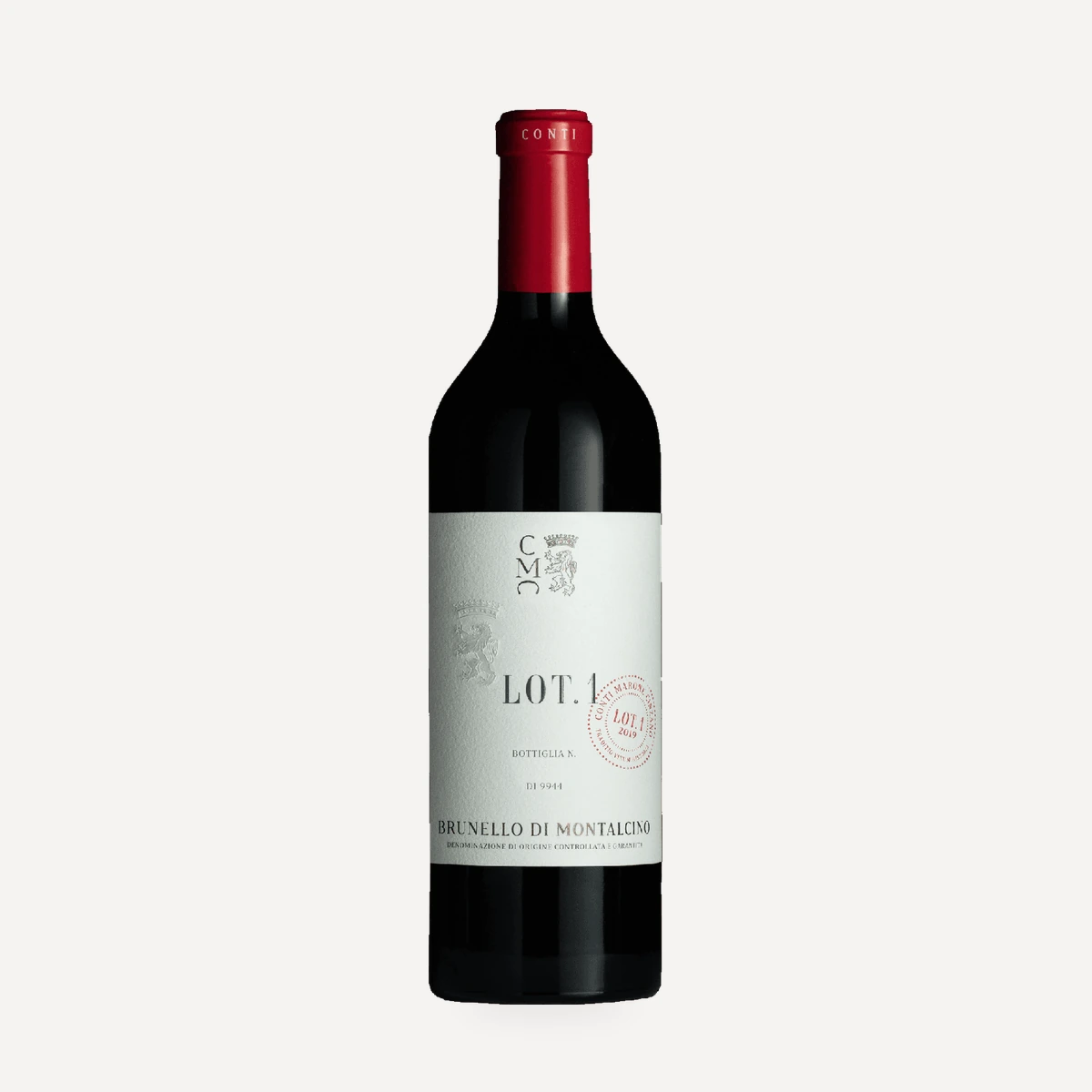
In 2025, after more than 50 years of Sangiovese cultivation in Montalcino, the family released the first lot of Brunello bearing the Conti Marone Cinzano name and image. The release reconnected the family name with a wine label while acknowledging a winegrowing lineage extending back to the sixteenth century.
Terroir
Sant’Angelo hill
Sant’Angelo is the southernmost and most Mediterranean hill within the Montalcino denomination. Its proximity to the coast allows marine breezes to reach the terroir and influence the soils. The hill’s exposure provides abundant sunlight.
The area has been cultivated since Roman times. Historically known as the “golden hill,” its agricultural landscape has included wheat, spelt, olive groves and Moscato grapes.
More than 50 years of family experience with Sangiovese on Sant’Angelo underpin the project. Its approach is based on the relationship between the hill’s individual characteristics and the behaviour of Sangiovese, with one plot chosen to represent the conditions of each vintage.
Vinificazione
The family cultivates 108 ha of Sangiovese, of which more than 70 ha qualify for Brunello di Montalcino DOCG. The vineyards carry organic certification and are tended according to biodynamic principles.
The viticultural strategy treats the differences among plots as a resource. Each year, the project searches across the vineyards for the single parcel whose fruit most successfully interprets that growing season. The selection responds to climatic variability instead of assuming that one fixed vineyard will deliver the strongest expression every year.
This approach draws on more than five decades of family experience with Sangiovese on the Sant’Angelo hill and on Count Francesco Marone Cinzano’s earlier exposure to biodynamic farming in Chile, followed by his leadership of an organic conversion in Tuscany.
Lot.1 is produced as a single lot from the finest grapes of one plot selected specifically for the vintage. The plot may change each year, allowing the finished Brunello to record the character of that harvest rather than reproduce the identity of a permanently fixed cru.
The bottles are numbered by hand. The 2019 harvest produced 9,944 bottles. Releases displayed for Lot.1 comprise the 2019, 2020 and 2021 vintages.
Filosofia
Conti Marone Cinzano presents Lot.1 as a “liquid memory” of the growing season. Its central principle is that the finest expression of a vintage may come from a different parcel each year. A fixed vineyard can perform unevenly under increasingly unpredictable climatic conditions; an itinerant selection allows the project to identify the plot best suited to each season.
The philosophy combines inherited experience with the curiosity of a new generation. More than 450 years of family history and over half a century with Sangiovese in Montalcino provide the foundation, while the annual search for the strongest parcel introduces an adaptive model of cru selection.
Organic certification and biodynamic principles form the agricultural basis of the project. The 2025 debut also carries a family objective: restoring the Conti Marone Cinzano name to a wine label while honouring ancestors involved in winegrowing since the sixteenth century.
Vini