Questo vino
Vineyard and terroir
Il Coroncino principally expresses vineyards in Contrada Coroncino at Staffolo, supplemented by Cerrete at San Paolo di Jesi and Mimosa at Cupramontana. The sites lie at 250–350 m above sea level, with northeast and southwest exposures. Their soils contain very high proportions of clay, forming a rich, water-retentive substrate whose structure remains highly mobile. Planting dates include 1975, 1976, 1990, 2013 and 2017, extending through 2021.
The vineyards receive no fertiliser. Soil cultivation is occasional, spontaneous ground cover is cut roughly twice as needed, and both under-row management and single- or double-Guyot pruning are manual.
Grapes
Verdicchio; the percentage is not specified.
Vinification
Bunches are inspected meticulously at harvest, then gently crushed. The must undergoes static settling. Fermentation proceeds spontaneously with indigenous yeasts in stainless steel and concrete under gentle temperature control.
Ageing
Ageing takes place exclusively in concrete and stainless-steel tanks on fine lees. Wood is deliberately avoided to retain a direct expression of the fruit and variety. The blend centres on lots from Contrada Coroncino, with complementary components chosen to present Verdicchio in an unadorned form.
Tasting profile
A varied nose offers field herbs, citron and bergamot, followed by a light white-floral note. The palate is taut and distinctly savoury, with a subtle almond character and a fine tannic edge wrapping the palate. It closes with a lightly rich sensation that persists at length. The style combines the power of Verdicchio with agility, clarity and vertical drive.
Serving and pairing
Its savoury acidity refreshes the palate alongside rich, structured fish dishes. It also suits traditional white meats, intense truffle-based first courses and semi-aged cheeses. Ageing potential is 6–10 years and beyond. Formats are 750 ml, 1.5 L and 3 L.
Label / history
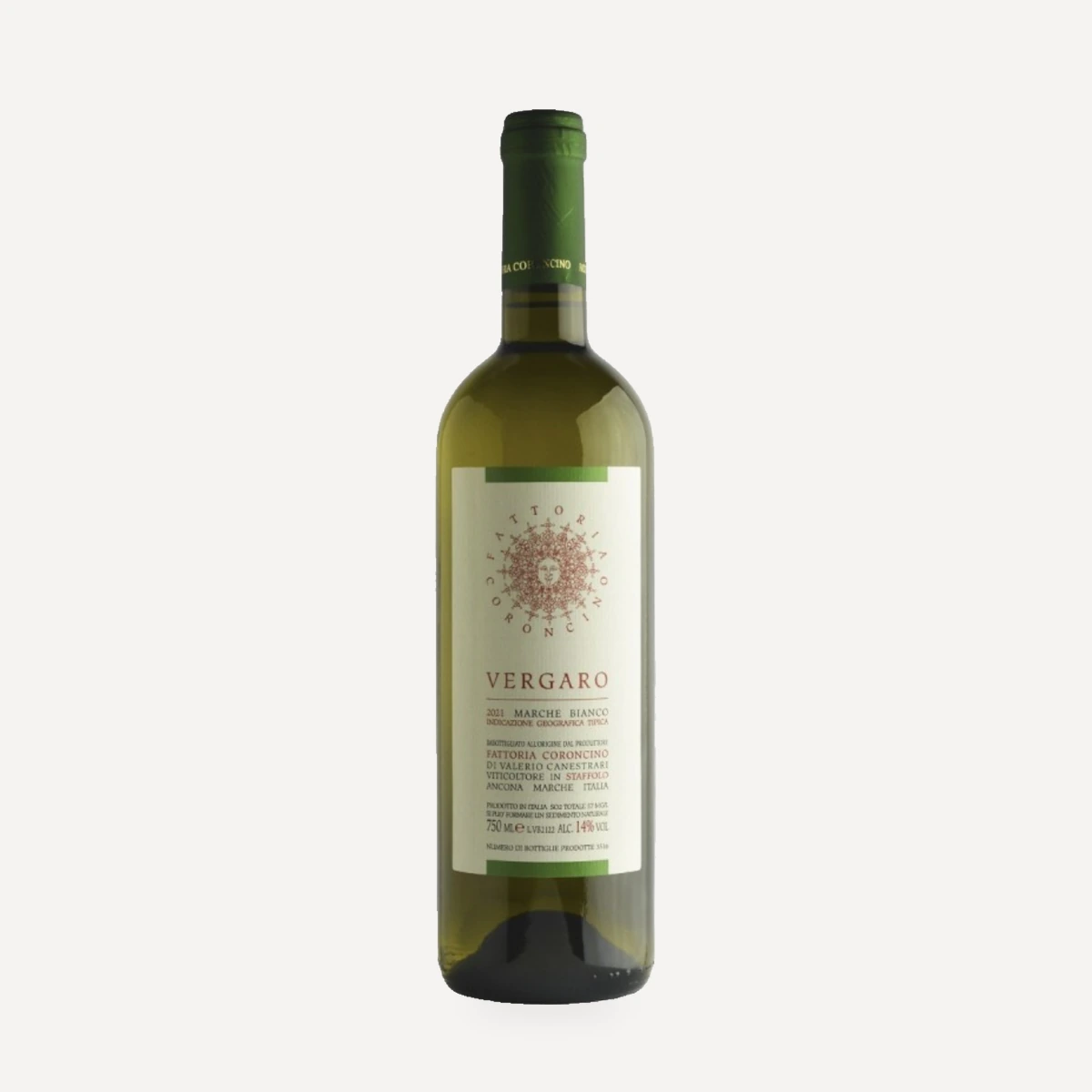
Historic labels are shown for 2010, 2006, 1998, 1997, 1996, 1995 and 1992, together with a 1985 presentation from the period when the wine was sold loose.
Awards
The 2009 vintage received Bibenda's 2012 Oscar del Vino for a wine combining notable quality and price. Slow Food Editore's 2010 Guida al Vino Quotidiano recognised the quality-to-price ratio of the 2000 vintage. The 2003 vintage received A.I.S. Duemilavini's 5 Grappoli in 2006.