Storia
Agricultural roots of the Vincenti family
Croce di Febo has its roots in the agricultural history of the Vincenti family. The family’s historic cellar in central Montepulciano now houses the Caveau di Evelina, a small museum devoted to the estate’s production and an archive where its vintages, Vin Santo, traditional-method sparkling wine and olive oil are preserved and presented.
The present estate
The agricultural business is registered as Az. Agr. Croce di Febo di Vincenti Silvia. Its vineyards and winery are in Montepulciano, with wine production centred on two vineyards—La Pietra and Cappuccini—and nine separately interpreted parcels. The estate works with organic and biodynamic agriculture, native grape varieties and parcel-by-parcel harvesting and vinification.
The family legacy also appears in the wines: one of the estate’s principal labels, Amore Mio, is dedicated to Maria Russo, the mother of Silvia Vincenti. The Caveau di Evelina continues the family dimension by presenting historic vintages through tastings led by Evelina.
Development of the estate’s public activities
Croce di Febo has extended its activity beyond the winery through direct hospitality and education. Visits introduce the vineyards, cellar, barrel room and maturation areas, while the Caveau di Evelina offers comparative tastings of historic and current vintages. In the historic centre of Montepulciano, AmoreMio combines the estate’s organic and biodynamic wines with selected Tuscan food products and pairings developed with cheese affineur and researcher Andrea Magi.
In 2022, the estate documented several aspects of its evolving practice: spontaneous fermentation with indigenous yeasts, long-standing use of green manure, and adaptations to increasingly hot and dry growing seasons. These climate adaptations included reducing summer ground cover, periodic shallow cultivation, abandoning shoot topping, and using horn silica and chamomile infusions in canopy management.
Terroir
Croce di Febo cultivates just over 4 hectares in two vineyards at Montepulciano. The vineyards contain nine distinct soils, corresponding to the estate’s parcel-by-parcel interpretation of the land. Surrounding woodland influences the vineyards and creates a particular local microclimate. Their relatively high positions and cool nights help reduce the danger of sunburn and heat damage to the bunches.
Clay and limestone are the defining geological components. The porous clay stores moisture and nutrients and makes them available to roots during dry periods. The sedimentary limestone stabilises organic matter and is associated with fragrant, refined and structured fruit. Variations in the rocky fraction across these clay-limestone soils create different expressions of Sangiovese.
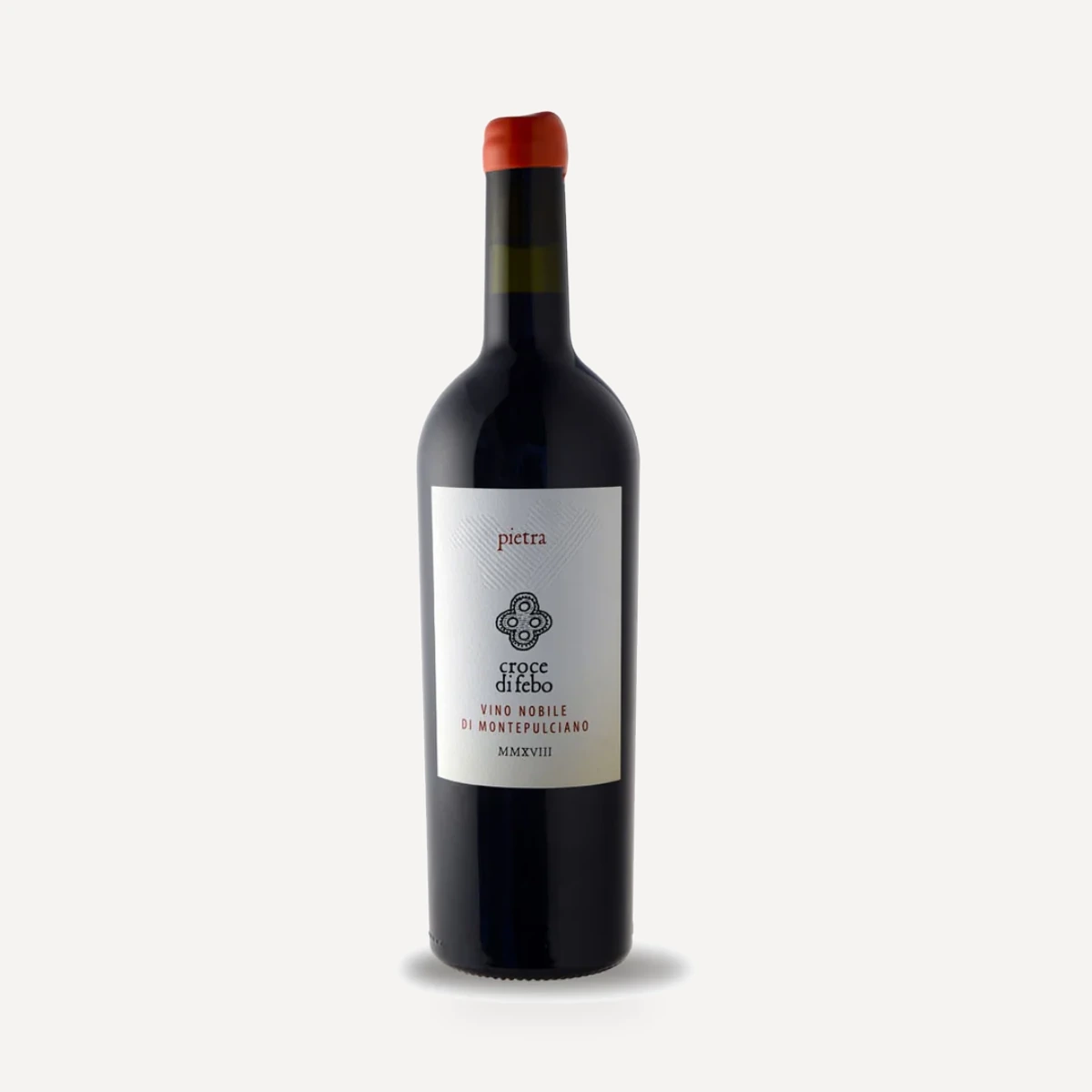
Vigna La Pietra
Vigna La Pietra lies in Pieve di Valardegna at 470 m above sea level. It faces southeast and comprises four soils of Pliocene origin. The clay-limestone ground contains sandstone and fossils. The land is described as having once been a beach, a geological identity reflected in its fossil-rich structure.
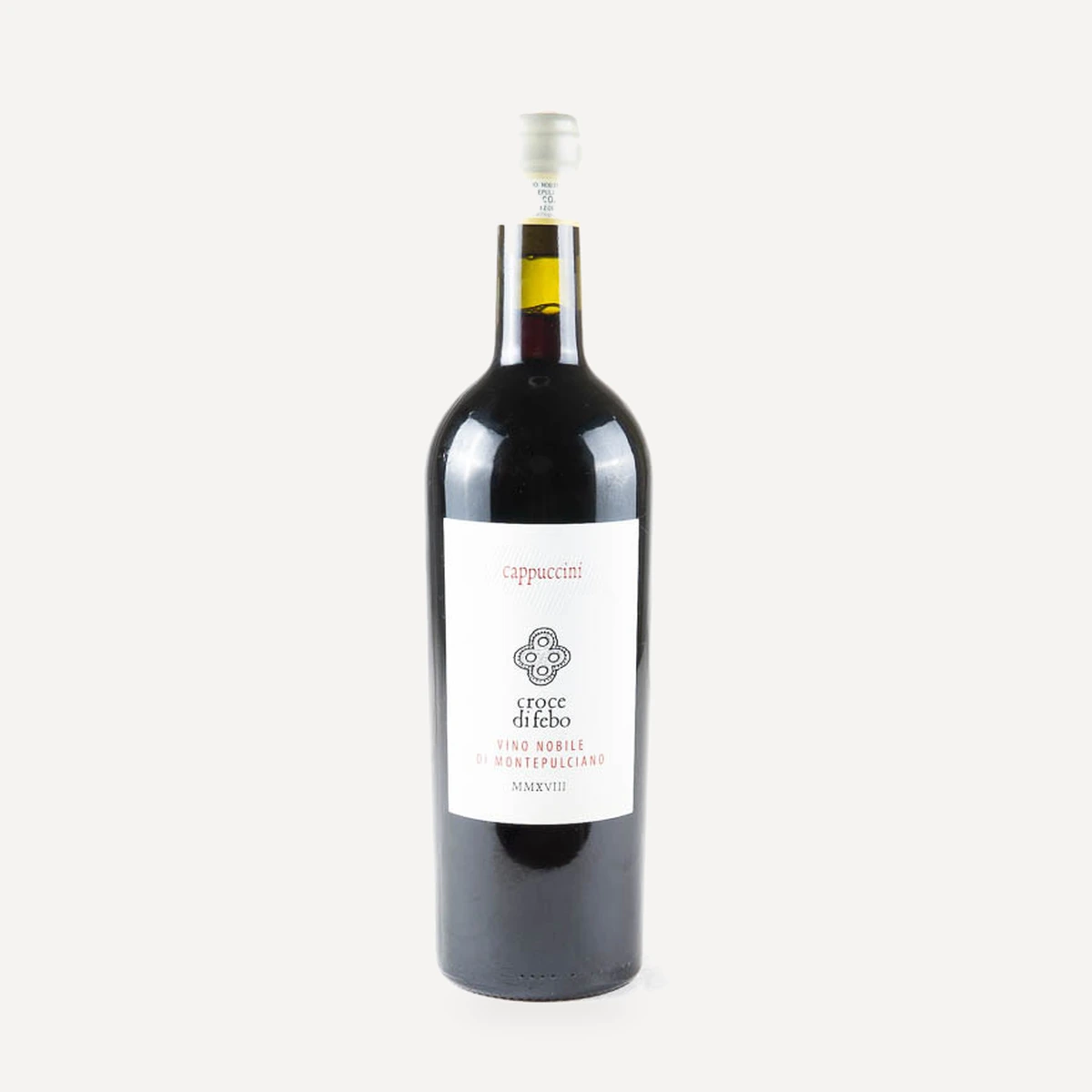
Vigna Cappuccini
Vigna Cappuccini lies in Pieve di S. Albino at 520 m above sea level. It faces north and contains five soils of Mesozoic origin. Its clay-limestone ground includes dolomite, travertine and granite; descriptions of individual wines also identify ferruginous components in parts of the vineyard.
Vinificazione
All vineyards are cultivated according to biodynamic principles, following lunar and astral rhythms. Croce di Febo presents biodynamics as a practical route towards environmental sustainability and the preservation of the Tuscan agricultural landscape. Biodiversity is encouraged to balance relationships among people, vines, other plants, animals, insects, microorganisms, yeasts and fungi, improving the vines’ capacity to withstand adversity.
Organic-wine certification is attributed to CCPB, while current wines also carry BIODYVIN biodynamic-wine certification. Certification dates are not given.
Soil fertility and green manure
The vineyards have not been fertilised. Green manure has been practised for many years using mixtures of seeds that change annually. The aims are to increase soil organic matter and nutrients available to subterranean microorganisms while using the action of plant roots to improve the soil naturally. The resulting improvement in structure permits fewer mechanical operations and reduces both runoff and erosion. Greater root development is intended to make the vines stronger and better able to withstand environmental stress.
Biodiversity and plant balance
The estate seeks intact energy and essence in the bunches rather than pursuing a standardised technical result. Biodynamic preparations include systematic applications of horn manure and Maria Thun preparation to support soil fertility and vine resilience. Horn silica is used in canopy management.
Adaptation to heat and drought
High, well-exposed vineyards and cool nights provide some protection from scorched or sunburned bunches, but lower rainfall and rising average temperatures have required changes in vineyard management. Partial ground cover became unsustainable under severe water scarcity and has been removed almost completely from May onward to reduce competition for subterranean moisture. Periodic shallow cultivation is used to counter the clay’s tendency to form a dense, columnar structure.
Shoot topping has been abandoned so that the vines can regulate their own vigour and water consumption. Chamomile infusions are applied to the canopy alongside horn silica to moderate water stress and help the vines reach maturity.
Harvest decisions
Harvest timing begins with tasting the berries. The determining criterion is balance in skin maturity, with the objective of retaining mineral character and tension. Grapes are harvested entirely by hand. Each of the nine parcels is picked separately and sent to its own fermentation vessel.
Croce di Febo treats each of its nine parcels as an individual cru with its own identity. Every parcel is harvested and vinified separately in a different vessel before any broader interpretation of the vineyards is assembled.
Fermentations are spontaneous and driven by indigenous yeasts. The estate regards yeast populations—which may vary by year, vineyard and even within a single vineyard—as part of the site’s biodiversity. Rather than relying on a single selected strain, spontaneous fermentation allows successive native yeast species to participate, each contributing to the finished wine. This is intended to preserve differences among vintages and parcels.
The cellar uses steel tanks, concrete tanks, small concrete vessels, concrete eggs, earthenware or clay eggs, terracotta amphorae, oak barrels and larger casks. Maturation may continue in concrete after wood, and certain wines receive further bottle ageing. Traditional-method sparkling wine is matured on fine lees and bottled without dosage. White varieties may be co-fermented with brief skin contact, while the estate’s Vin Santo practice includes grape drying and extended fermentation and maturation in oak followed by demijohn ageing.
Bottling without fining or filtration is a recurring practice across the range. The guiding cellar approach is progressively lower manipulation and fewer additions, allowing wines to reach balance without forcing them into a preset recipe.
Filosofia
Croce di Febo describes its role as that of artisans and custodians of nature. Its concept of winegrowing combines inherited experience with modern knowledge while respecting natural systems. The estate calls this balanced and considered position “bio-conscious”: artisanal production that limits synthetic and chemical inputs and seeks an honest expression of vintage and terroir.
Biodynamics is approached with pragmatism and positive intent rather than as a rigid formula. It is regarded as a workable compromise for the future of agriculture, a means of pursuing environmental sustainability and a way to retain the traditional Tuscan landscape. Biodiversity is central because equilibrium among people, plants, animals and the wider environment is expected to help vines respond to adversity.
In the cellar, Croce di Febo rejects fixed recipes and standardisation. Its preferred model is tailored to the identity of each parcel and vintage. Intervention and additions are progressively reduced so that differences can emerge naturally and the finished wines can reflect Montepulciano. Patience, observation and sensory response are placed ahead of forcing wine towards a predetermined style.
Emotion is also presented as a working principle: direct sensory engagement guides decisions in the vineyard, while the cellar is treated as a place for listening to the developing wine and waiting for equilibrium. The estate’s bottles are intended to carry both the character of the land and the people responsible for them.
Direct relationships with visitors and customers have been a priority from the beginning of the project. The wine club was conceived around personal exchange, with part of the production reserved for people who visit Montepulciano.
Vini
Appovento
Cappuccini
Nobile