Storia
1925: foundation
The first generation of the Pasqua brothers founded Pasqua Vigneti e Cantine in Verona in 1925. The business remains in the ownership of the Pasqua family and developed around the production and international representation of wines from Veneto, with Valpolicella at the centre of its accumulated expertise.
1980–2001: development of named vineyards
The Mizzole vineyard was planted in several stages between 1980 and 1990 in the eastern part of Valpantena. San Felice followed in 1993 around the present company headquarters north-east of Verona. Poiano was planted in 2001 near the San Felice winery, at the western entrance to Eastern Valpolicella.
2007–2015: third-generation transition
Riccardo Pasqua joined the family business in 2007. After overseeing operations in the United States, he became Sales Director in 2014 and Chief Executive Officer in 2015. A new management team and the family’s third generation took the helm in 2014, initiating substantial investment in vineyards, operations, research and portfolio development. This transformation also recast the company as an expression of the family’s grape-growing and winemaking heritage together with the art, culture and lifestyle of Verona.
The Icons portfolio began to take shape in 2015 as the principal vehicle for the family’s experimental projects. Over the following decade, sustained investment in research, vineyards and market development helped the company double its revenue.
2016–2020: experimental releases
Mai Dire Mai was introduced in 2016 with Amarone 2010 and Valpolicella 2012. Conceived as a concentrated interpretation of Valpolicella, the project relies on selected vineyard sources and includes wines from Montevegro.
The first 11 Minutes rosé followed in 2017, combining Corvina and Trebbiano di Lugana with Syrah and Carmenère. In 2019, the family released the first Hey French: You Could Have Made This But You Didn’t, a still multi-vintage white based principally on Garganega, with smaller proportions of Pinot Blanc and Sauvignon from Monte Calvarina. Y by 11 Minutes arrived in 2020; a later release became certified organic.
2021–2024: collaborations, manifesto and recognition
American winemaker Charles Smith joined the development of a Valpolicella Pinot Noir project in 2021. The concept had been under development for almost a decade and evolved through vineyard visits and tastings of base wines dating to 2018.
In 2022, the family presented the Pasqua House of the Unconventional manifesto, visually interpreted by Giuseppe Ragazzini. It formalized a position centred on experimentation, creative dialogue and the coexistence of tradition and innovation.
Wine Enthusiast named Pasqua Wines its 2023 Innovator of the Year, making it the first Italian winery to receive that Wine Star Award. Riccardo and Alessandro Pasqua accepted the award in Miami in February 2024. The recognition covered innovation in vineyards and winemaking styles as well as the company’s approach to communication and international markets.
2025: the centenary
Pasqua celebrated its first 100 years in 2025. The anniversary programme centred on Ode to the Future, a Rizzoli book and an immersive exhibition connecting the company’s history with Famiglia Pasqua, Mai Dire Mai, 11 Minutes, Hey French and Terre di Cariano Cecilia Beretta. The exhibition occupied Giardino Giusti during Vinitaly and brought together work by Enzo Ragazzini, Giuseppe Ragazzini, Michael Mapes, Sofia Crespo and Gaia Alari. The centenary programme later travelled to New York for a presentation at Rizzoli Bookstore.
At Vinitaly 2025, Umberto Pasqua and the company received the Vinitaly International Award in the Italy category for a century of work joining quality, innovation, tradition and creativity.
The company closed 2024 with consolidated revenue of €63.5 million, 6% above 2023. Exports represented 90.2% of revenue, its wines reached 71 markets, and United States business grew by almost 40%. Investments in artistic projects since 2018 had reached almost €6 million by the centenary year.
In July 2025, Charles Smith selected Pasqua as exclusive international distributor for K Vintners, Real Wine and Sex in selected markets. Pasqua also became a minority partner in Real Wine, with provision to acquire up to 20% subject to performance and growth targets. Distribution began in September 2025.
During the same year, Pasqua invested in Carole Bouquet’s Sangue d’Oro project in Pantelleria and acquired ownership, presenting the venture as a combination of winemaking development and protection of the island’s cultural heritage.
2026: expansion through partnerships
In 2026, Pasqua and Charles Smith unveiled their first joint wine project, a multi-vintage Pinot Noir from Campiano combining the 2018, 2022, 2023 and 2025 harvests. The collaboration brought together Pasqua’s work with multi-vintage blends and Smith’s Washington State perspective. Artist Sara Ricciardi interpreted the partnership through Resonance, a site-specific installation unveiled at Palazzo Maffei during Vinitaly.
Pasqua also expanded its cultural and commercial programme through international events in New York, Paris, Milan, Verona and London, continued its support of the Arena di Verona Foundation’s “67 Colonne” initiative, and launched a limited-edition vineyard work boot with Superga in September 2026.
Terroir
Pasqua’s vineyard sources extend across Valpantena, Eastern Valpolicella, the eastern Soave hills and the high ground above San Giovanni Ilarione.
Valpantena and Eastern Valpolicella
San Felice surrounds the headquarters north-east of Verona in Valpantena. Its clay-limestone soils are alluvial in origin. Mizzole lies farther east in a valley crossed by the Fibbio stream, where mountain indentations and alternating hills and plains create varied growing conditions. The vineyard is at 200 metres above sea level.
Montevegro occupies a hill at 350 metres, with exposure on all sides. It faces Val d’Illasi and Val di Mezzane, while the Lessini range stands behind it. Its soils are basaltic and calcareous. A secluded 5.1-hectare sector facing north-east supplies Cabernet Sauvignon and Oseleta for one of Pasqua’s projects.
Poiano stands at the western entrance to Eastern Valpolicella near San Felice and has clay-limestone soils. Cascina S. Vincenzo occupies approximately 4 hectares on the same ridge as Mizzole, about 8 kilometres farther north, at 350 metres at the entrance to Valpantena. Its clay-limestone soil derives partly from the transformation of local rock; the clay retains minerals and makes them available to the vines.
Eastern Soave hills
Monte Calvarina rises to approximately 500 metres in the eastern Soave area and faces south-west. Its basaltic-calcareous soils reflect the volcanic character of the hills. The altitude brings cool, breezy summers and pronounced temperature variation, supporting slow flavour development and aromatic complexity.
Campiano
Campiano is a nine-hectare amphitheatre-like vineyard above San Giovanni Ilarione at approximately 600 metres. Its clay and limestone soils formed from ancient seabeds and drain freely across the slopes. The plots face south-west and are surrounded by forest, creating a cool, airy and sheltered microclimate. Large day-to-night temperature shifts and gradual ripening support aromatic development in the Pinot Noir vines.
Vinificazione
Viticulture is adapted to a set of markedly different sites rather than presented as a single estate-wide regime. Cascina S. Vincenzo’s native Valpolicella vines have always been grown organically. A later vintage of Y by 11 Minutes also received organic certification, while Pasqua maintains Biological certification among its quality systems.
Altitude and exposure are important selection criteria. Monte Calvarina combines south-west exposure with elevations approaching 500 metres; Campiano reaches approximately 600 metres, and Montevegro occupies a fully exposed 350-metre hill. At Campiano, forest cover, free-draining slopes and temperature variation support slow Pinot Noir ripening. Harvesting by hand is used for the joint Pasqua and Charles Smith Pinot Noir project.
The broader sustainability programme includes optimized energy consumption, temperature-regulating structures, reduced packaging waste and maintenance of ISO, BRC, IFS and Biological certifications. Pasqua has also worked toward conformity with the Equalitas SOPD standard.
Research and experimentation are continuing parts of Pasqua’s production model, combining long experience with Valpolicella fruit and new stylistic approaches. Recent work includes traditional co-fermentation of varieties and plots for the classic Valpolicella interpretation, single-vineyard selection at Montevegro, and multi-vintage blending.
Multi-vintage composition has become a recurring stylistic tool. Hey French was developed as a still white assembled from multiple harvests so that vineyard identity and house style could extend beyond the character of a single year. The joint Pasqua and Charles Smith Pinot Noir likewise combines several vintages after separate maturation, using blending to build complexity, structure and consistency while retaining varietal delicacy. Extensive tastings of base wines and continuing research underpin this approach.
Temperature-regulating structures and optimized energy use form part of the production facility’s sustainability strategy. Quality and environmental systems include ISO, BRC, IFS and Biological certification, with work toward Equalitas SOPD conformity.
Filosofia
House of the Unconventional expresses a philosophy of preserving inherited knowledge while using it as a platform for experimentation. The family describes wine as an ensemble of past, present and future: experience passes between generations, while projects are expected to mature, evolve and remain relevant over time.
Boldness, curiosity and a willingness to explore guide both strategic and production decisions. The intended balance is not tradition against innovation, but preservation and innovation operating together. Place identity and human creativity are treated as complementary forces, with each project joining the character of its origin to the ideas of the people who conceived it.
Pasqua aims to function as a research laboratory and a space for dialogue in which quality and creativity remain central. Multi-vintage wines, high-altitude plantings and collaborations with figures from other winemaking cultures are practical expressions of that ambition.
Art is treated as a parallel creative language rather than decoration. Long-term collaborations with artists rest on the belief that meaningful innovation begins with informed knowledge of history and tradition. Sustainability is framed as a long-term responsibility requiring investment, planning and changes extending from energy use and packaging to certified management systems and cultural engagement with the communities connected to wine.
Vini
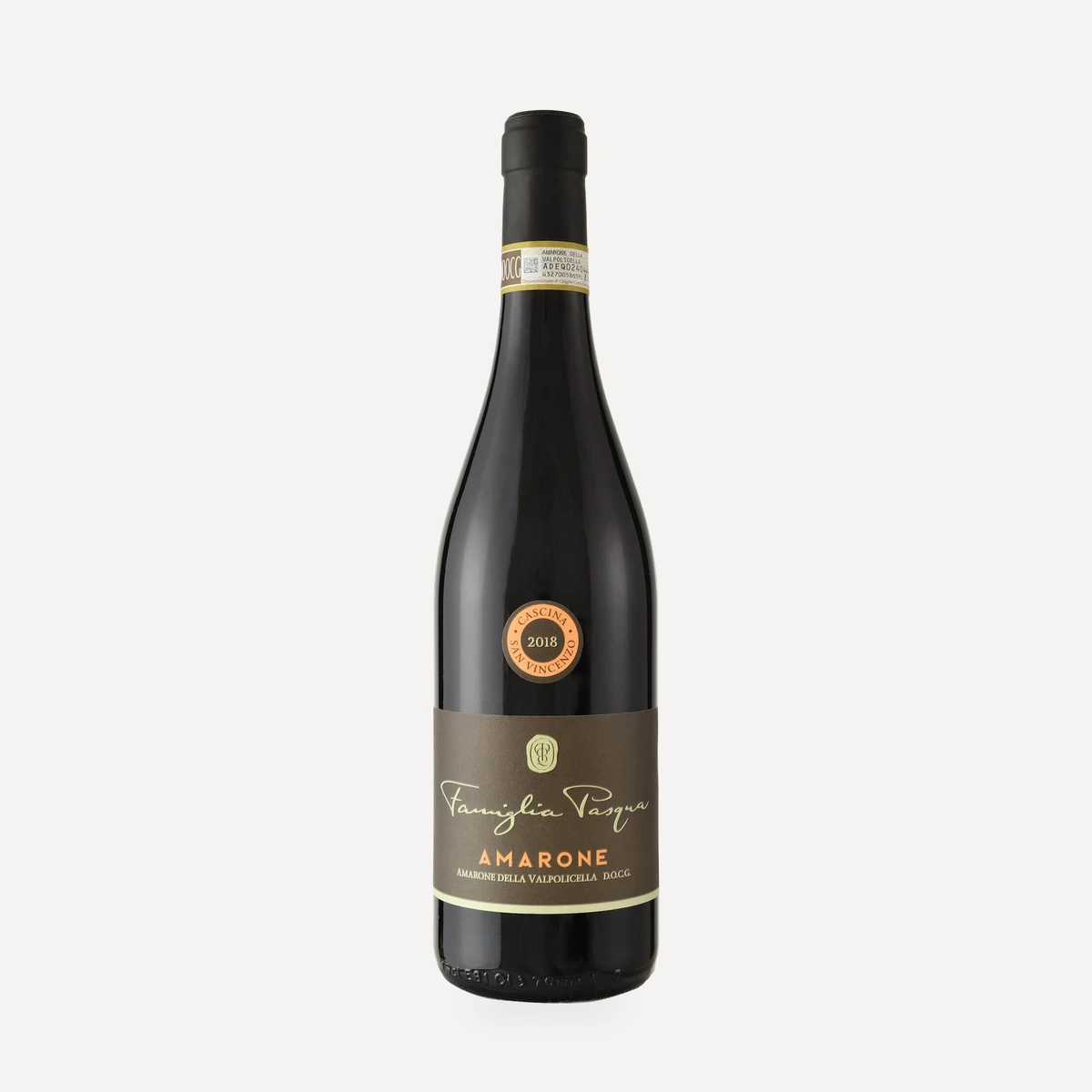
Cascina San Vincenzo Amarone della Valpolicella DOCG
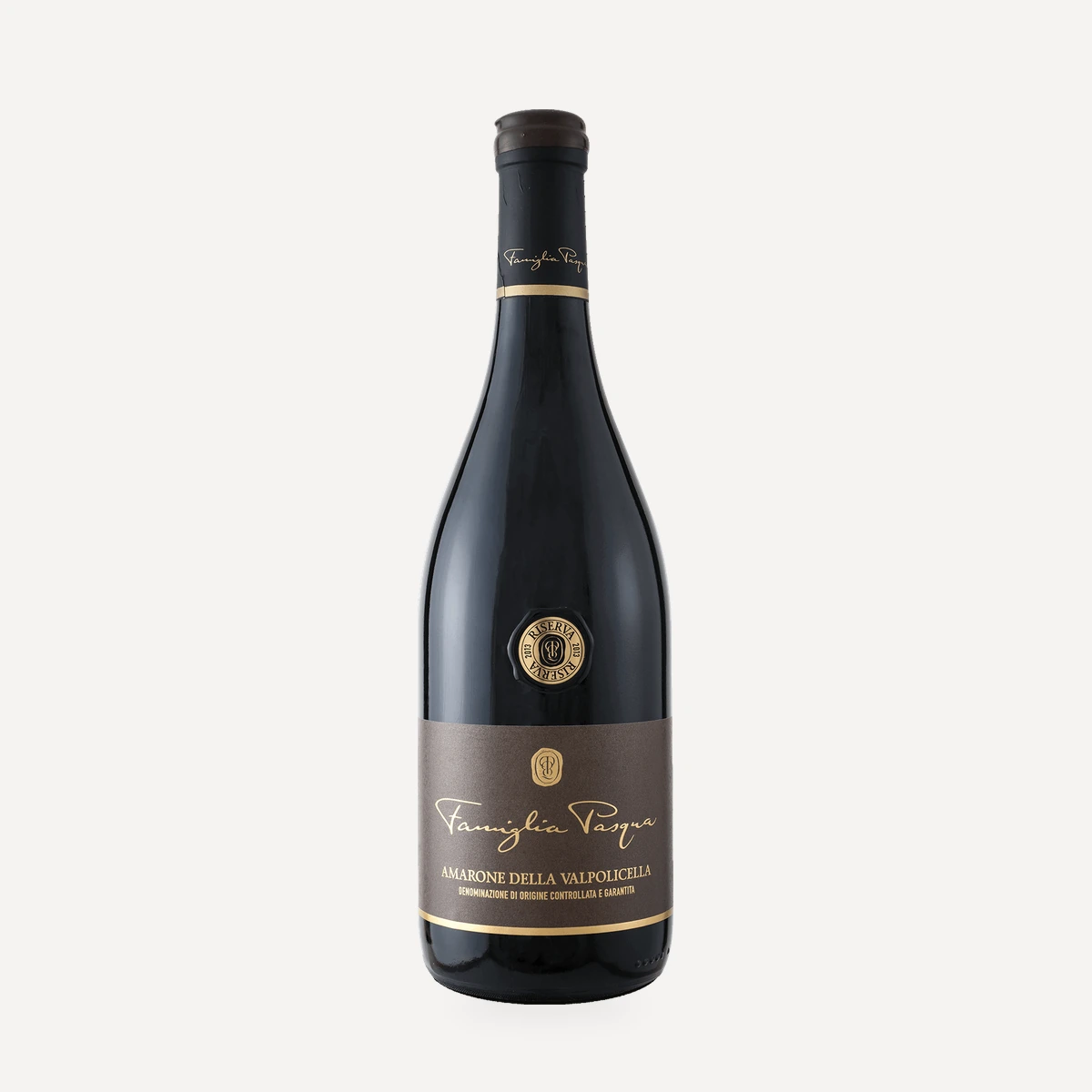
Famiglia Pasqua Amarone della Valpolicella DOCG Riserva