Storia
The family estate
The Piccioli family has owned Podere San Vito for approximately three centuries. Its name derives from an ancient church dedicated to San Vito, dating to around AD 1000. The remains of that church were discovered on the farm and excavated by the University of Pisa.
Vines and olive trees had long occupied the land, but until 1989 the family did not directly manage both cultivation and transformation. From that year onward, it took direct responsibility for the vineyards and olive groves and for turning their grapes and olives into wine and extra-virgin olive oil. The proximity of the plantings to the cellar allowed harvested fruit to be processed while fresh.
Matteo Piccioli and the natural-wine direction
In 2011 Matteo Piccioli, previously a bookseller, assumed responsibility for the family vineyard and olive grove. The economic recession prompted his change of profession and gave him the opportunity to pursue a longstanding interest in agriculture and wine. He continued the work ethic and family tradition associated with his father while adopting organic practices and a natural-wine approach.
This direction included recovering old vineyards, cultivating without synthetic agricultural chemicals or genetically modified organisms, fermenting with native yeasts, minimizing cellar intervention, using very small additions of sulfur dioxide only during racking, and avoiding filtration.
Hospitality and recognition
Fattoria San Vito subsequently developed vineyard walks, cellar-door sales, and tastings of its wines and olive oil. In 2020 it received a Tripadvisor Travelers’ Choice Award as a tourist attraction and winery, placing it among the top 10% of places in the award’s worldwide ranking. Matteo Piccioli connected the recognition with the recovery of old vineyards, the decision to make organic natural wine, and a form of hospitality based on personally welcoming visitors to the family property.
Terroir
Fattoria San Vito’s vineyards lie in Valgraziosa, a broad, naturally terraced basin at the foot of Monte Pisano. One hectare surrounds the farm and another hectare adjoins the Certosa Monumentale di Pisa. Monte Pisano shelters the vineyards from the northeast, while maritime influence moderates conditions from the southwest.
The soils are compact clayey silt and clay-sand, ranging in color from distinctly reddish through reddish brown to ochre. They contain a substantial proportion of rock fragments, varying from coarse sand to clasts measuring tens of centimeters. These fragments are sometimes poorly sorted and lack clearly defined layering within the clay-sand horizons. In some sectors the rocky skeleton becomes dominant, forming layers of gravel—including coarse gravel—within a clay-sand matrix. The variations are associated with historical shifts in the principal watercourse and corresponding changes in depositional energy. The deposits are approximately two million years old.
Valgraziosa is crossed by numerous streams and contains Calci, Montemagno, Tre Colli, Nicosia, and other small settlements. Old mills and olive presses remain visible along the waterways. The basin’s cultural landscape includes Calci’s 11th-century Romanesque Pieve and the Certosa di Calci, founded in 1366.
Vinificazione
The vineyards are managed under organic protocols and the principles of natural winegrowing. Synthetic fertilizers, herbicides, fungicides, insecticides, and other synthetic pesticides are excluded, as are genetically modified organisms. Vineyard treatments are limited to copper, sulfur, propolis, and seaweed.
Soil fertility is supported through green manure. A mixture of legumes is sown in alternating rows to fix nitrogen and is mown in spring. Grapes are harvested by hand and taken immediately to the nearby cellar, preserving freshness between picking and processing.
The estate’s broader agricultural work includes the recovery of old vineyards. Fattoria San Vito also defines the independent winegrower as the custodian of a terroir: the same person tends the vines, harvests the grapes, makes and bottles the wine, sells it, and welcomes visitors.
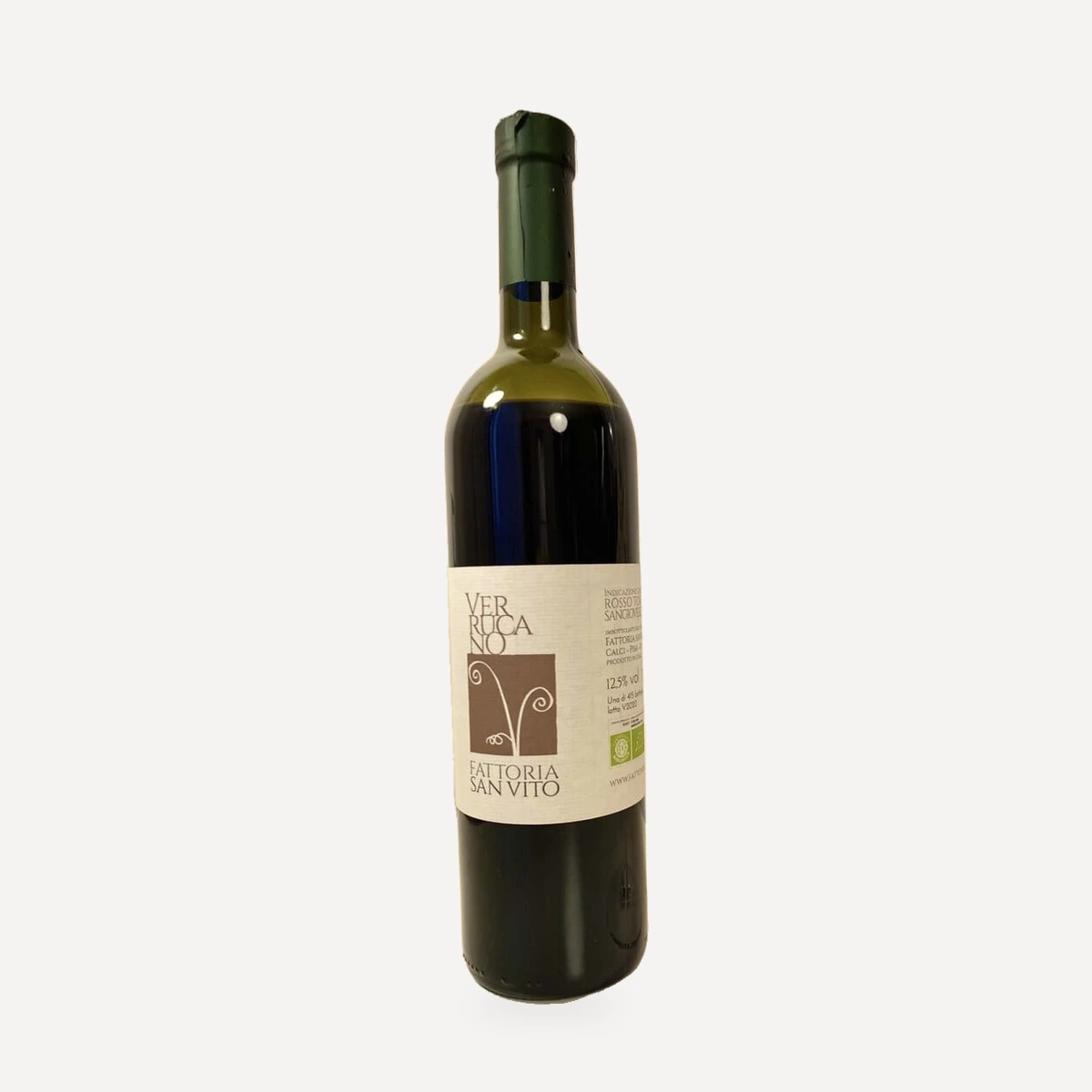
Hand-picked grapes are brought immediately from the nearby vineyards to the cellar. They are destemmed and placed in vats, where spontaneous fermentation begins on the skins without inoculated yeast.
Cellar intervention is deliberately limited. Sulfur dioxide is used only in very small doses during racking and at levels described as substantially below the maximum permitted by organic regulations. Wines mature in stainless steel and cement. Clarification occurs naturally through settling and decantation, and the wines are bottled without filtration.
Filosofia
Fattoria San Vito aligns itself with natural winegrowers and summarizes its agricultural ethic as loving the land as one loves oneself. Its approach joins respect for family tradition with organic cultivation and minimal cellar intervention.
The farm regards wine as an expression of its land, Mediterranean climate, vintage conditions, and the care applied from vine to bottle. Its stated model of the vignaiolo is an independent custodian of place who personally cultivates the vineyard, harvests, vinifies, bottles, sells the wine, welcomes visitors, and communicates the culture surrounding it.
In the cellar, the guiding principle is to allow wine to follow its own development with as little intervention as possible. Spontaneous fermentation, restrained sulfur use, natural settling, and the absence of filtration are practical expressions of that position. Matteo Piccioli describes the resulting wines as genuine, honest, and intended for people who share his belief in the land.
Vini