Storia
Arrival on Etna: 2006–2009
The Planeta family established its Etna estate on the volcano’s northern slope in 2006. After searching for suitable land among the woods and lava flows around Passopisciaro, the project took concrete form in 2008 with the planting of Sciara Nuova, including Nerello and Carricante. The estate’s first harvest followed in 2009. Carricante and Brut also entered the Planeta range that year, while the first Eruzione 1614 Carricante vintage came from the 2009 harvest.
The Etna project introduced Planeta to high-altitude mountain viticulture. At Sciaranuova, research into white varieties led to the planting of 4,500 Riesling Renano vines during the first years of development. A particularly small terrace was planted with 3,000 Pinot Nero vines. The vineyards were established beside the lava field produced by the eruption that began in 1614 and continued for ten years.
The first wines and construction of the winery: 2010–2012
Eruzione 1614 Nerello Mascalese first appeared from the 2010 vintage, and the same year marked the first vintage of Brut Metodo Classico. By 2011 the Nerello Mascalese wine had entered the estate chronology under the Eruzione 1614 name.
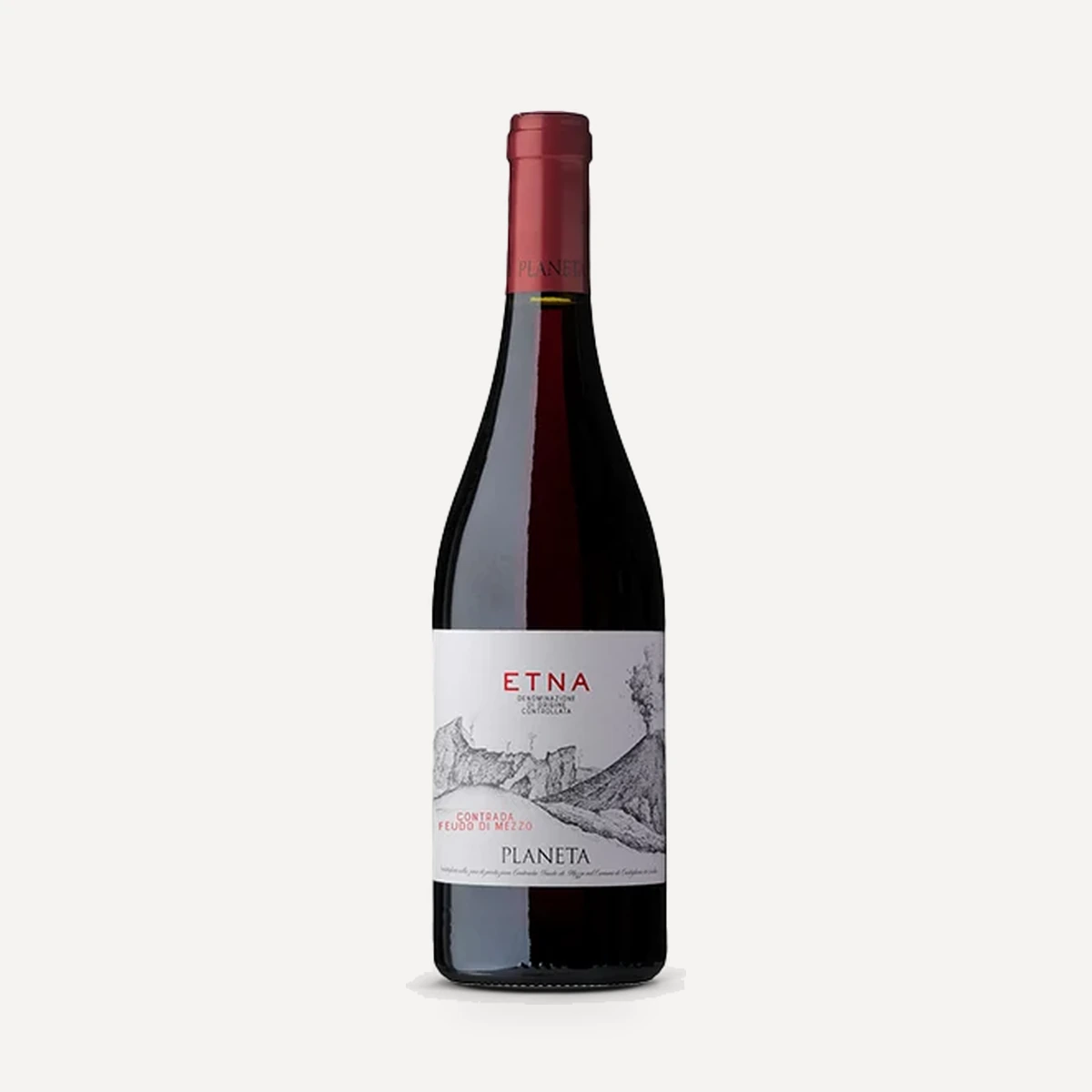
Until the construction of Feudo di Mezzo, the Etna project lacked its own place of vinification. The new winery was positioned in contrada Feudo di Mezzo, between Sciara Nuova and Montelaguardia and a short distance south of Passopisciaro. It was inaugurated for the 2012 harvest, Planeta’s first harvest vinified in its own winery on the volcano. The inauguration embodied the family’s principle of creating a dedicated winery for each territory.
The first Etna D.O.C. Bianco and Rosso vintages were also produced in 2012. The original cellar program envisaged four wines: two wines from the high Sciara Nuova vineyard, then based respectively on Carricante with a small Riesling component and Nerello Mascalese with a small Pinot Nero component; an Etna Bianco D.O.C. from Carricante at Montelaguardia; and an Etna Rosso D.O.C. associated with Pietramarina and nearby managed vineyards.
Completion and architectural definition: 2013
By April 2013 the new winery was complete and ready to receive the 2012 wines. Sicilian architects Gaetano Gulino and Santi Albanese developed the project with the Planeta family, who participated in its technical and stylistic decisions. The building was conceived as a modern interpretation of the traditional materials and forms of Etna.
Black volcanic stone became the dominant architectural element. A stone perimeter wall acts both as insulation and as a link between the contemporary building and local construction traditions. The barrel room was designed in the form of a traditional rural Etna structure. Its outer envelope of carefully stacked lava stones protects the barrels and barriques from temperature fluctuations while recalling the historic practice of removing volcanic stones from vineyard land and piling them beside the fields.
The technical design gave particular attention to grape reception. Sorting tables and conveyor systems were installed to minimize stress to incoming fruit. White grapes are pressed with a pneumatic press, while red grapes are handled with a modern vertical press. Bottling precedes the final maturation stage.
At Sciara Nuova, conservative restoration of the pre-existing historic wine buildings was completed in 2013. The restored complex became the base for hospitality and public-relations activities on Etna.
Cultural development and vineyard expansion: 2015–2020
In 2015 part of Sciaranuova’s old terraces was transformed into the Teatro in Vigna, a natural vineyard amphitheater. It became the setting for the first Sciaranuova Festival, linking the estate’s wine landscape with theater and contemporary culture.
A new 10-hectare vineyard planted as a single block in contrada Feudo di Mezzo reached its first productive harvest in 2020. One of the larger vineyards in the northern Etna denomination, it was planted entirely to Nerello Mascalese and Nerello Cappuccio. The same year marked the completion of the organic-conversion period on Etna.
Organic certification and energy management: 2022–2023
By 2022, all Planeta-cultivated land, including the Etna vineyards, held organic certification. This formalized an approach already based on organic farming and the SOStain® sustainability protocol.
In September 2023 the Etna winery adopted a formal energy policy aligned with UNI CEI EN ISO 50001:2018. Its commitments include monitoring and progressively reducing electricity and LPG consumption, minimizing energy waste, evaluating the energy implications of materials and products, training employees, adopting technically and economically sustainable improvements, and continuously improving overall energy performance.
Terroir
Feudo di Mezzo belongs to the Planeta estate on the northern slope of Mount Etna, around Castiglione di Sicilia and Passopisciaro. The vineyards lie among wooded areas, ancient and recent lava flows, volcanic terraces and traditional dry-stone structures. Elevations range from approximately 610 metres at Feudo di Mezzo to about 860 metres in the upper parts of Sciaranuova.
The soils derive from the slow degradation of lava rock, volcanic ash and organic matter. They are black, mineral-rich and characterized by abundant coarse skeletal material. The quantity and size of the rock fragments and the effective depth of soil change substantially from one terrace to another, creating marked differences within the estate. Fertility and complexity are recurring characteristics across these volcanic soils.
Sciaranuova occupies terraces around 815–860 metres above sea level, bordered by oak, chestnut and olive groves. The vineyard meets the edge of the lava field created by the eruption that began in 1614 and lasted ten years, the longest eruption recorded in Etna’s history. Some vines grow directly over material from this flow. The combination of elevation, black lava sands and surrounding woods defines the estate’s highest vineyards.
Montelaguardia lies at approximately 690–720 metres. Its volcanic ground is black with lava sand, rich in minerals and coarse fragments, with woods and younger lava flows around it. Feudo di Mezzo lies lower, at approximately 610 metres, in the central part of northern Etna’s viticultural district. The winery itself stands within an old lava flow, giving the site the appearance of a stone garden.
Vinificazione
The vineyards are cultivated according to organic-farming criteria and SOStain® protocols. Organic conversion on Etna was completed in 2020, and the cultivated land subsequently achieved organic certification.
Spontaneous wild vegetation is maintained as ground cover to increase soil organic matter and support the vitality and abundance of soil microfauna. Plant health is protected with small quantities of sulfur and copper. Pest management employs beneficial insects and mating disruption, supplemented by natural strengthening and protective materials such as zeolite, kaolin and plant extracts.
Training and pruning vary by vineyard and variety. Espalier is the principal training system. Guyot, spurred cordon and double spurred cordon are used at Sciaranuova; Feudo di Mezzo uses spurred cordon; Montelaguardia uses Guyot. The early red vineyards also included alberello-trained vines.
Harvest timing reflects the elevation of the vineyards and the late season on Etna. The 2020 harvest report anticipated completion of the Etna harvest at the end of October. Grapes intended for the original white and red programs were harvested into crates; the winery’s reception line includes manual selection facilities, sorting tables and conveyors designed to handle the fruit gently.
The winery was purpose-built to vinify the estate’s Etna fruit and received its first harvest in 2012. Its technical layout places particular emphasis on the arrival and selection of grapes. A series of sorting tables and conveyor belts reduces mechanical stress during reception.
White grapes are handled with a pneumatic press. Red grapes are pressed with a modern vertical press. The cellar includes facilities for maturation in both larger wooden casks and barriques. The barrel room is protected from temperature variation by an outer structure of carefully stacked lava stone. Bottling is followed by further maturation.
The production program encompasses still white and red wines from Carricante, Nerello Mascalese, Nerello Cappuccio, Riesling Renano and Pinot Nero, together with a traditional-method sparkling Carricante. Stainless steel and oak are both represented within the estate’s production, while the sparkling wine is produced by Metodo Classico.
Filosofia
Feudo di Mezzo expresses Planeta’s principle of giving each territory its own winery. The Etna project combines research into native grapes—particularly Carricante, Nerello Mascalese and Nerello Cappuccio—with experimentation involving Riesling Renano and Pinot Nero in high-altitude volcanic conditions.
The family presents sustainability as a direction of continuous improvement rather than a completed objective. Its framework combines economic durability, ecological care and social equity. In the vineyards this translates into low-intervention organic practices, soil cover, reduced quantities of sulfur and copper, biological pest management and the SOStain® protocol.
Architecture follows the same territorial approach. The winery does not imitate a historic building, but reinterprets the black stone, dry-stone forms and thermal logic of Etna’s rural landscape through a modern production structure. Landscape protection, bio-architecture, energy efficiency and the preservation of local cultural forms are treated as connected parts of the estate.
Research and precision are central to the production philosophy. Native varieties provide the foundation, while carefully selected international varieties are used to investigate how different grapes respond to lava soils, high elevations and individual terraces. Hospitality, theater and contemporary art extend this interpretation beyond wine, presenting the vineyard as an agricultural and cultural landscape.
Vini
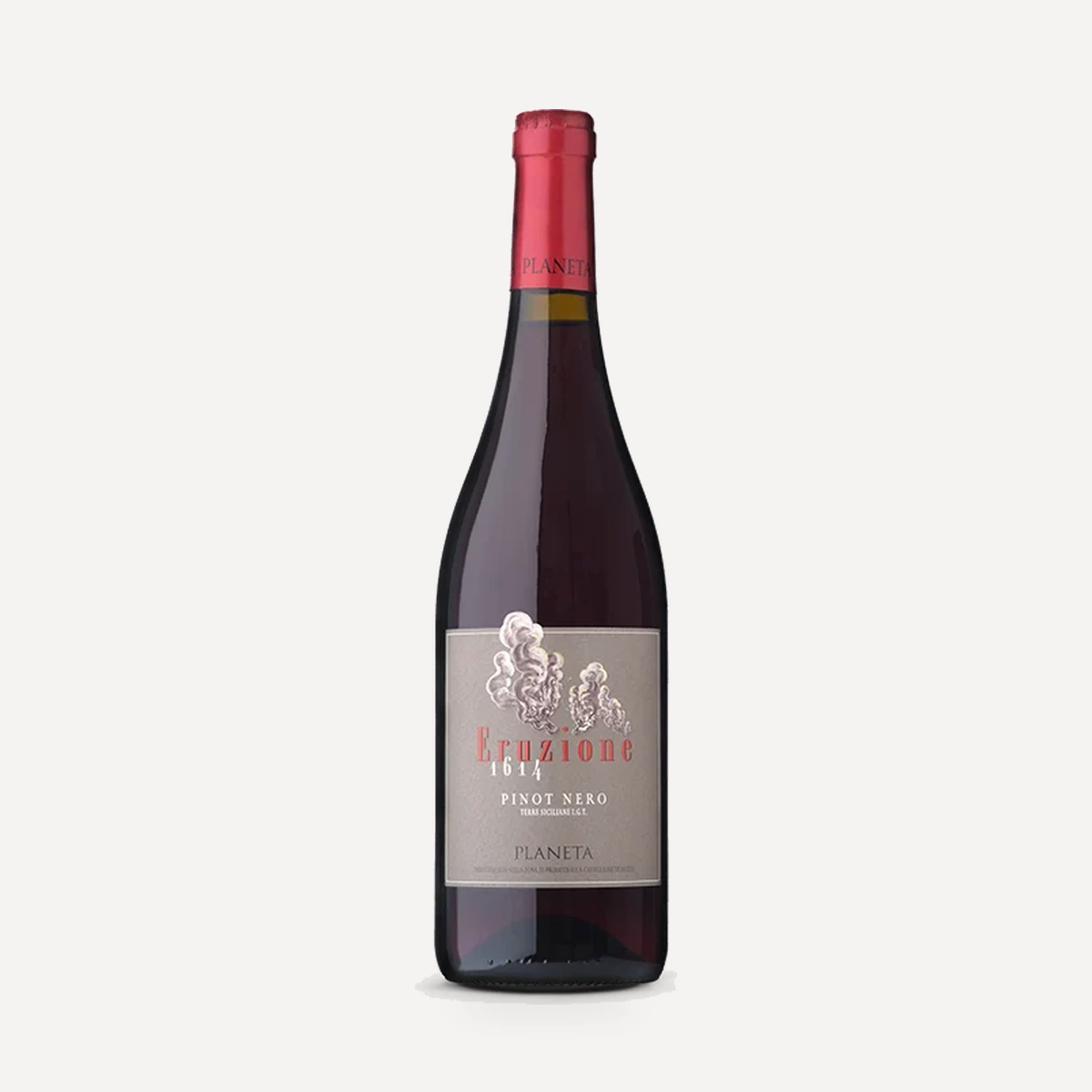
Eruzione 1614 Pinot Nero
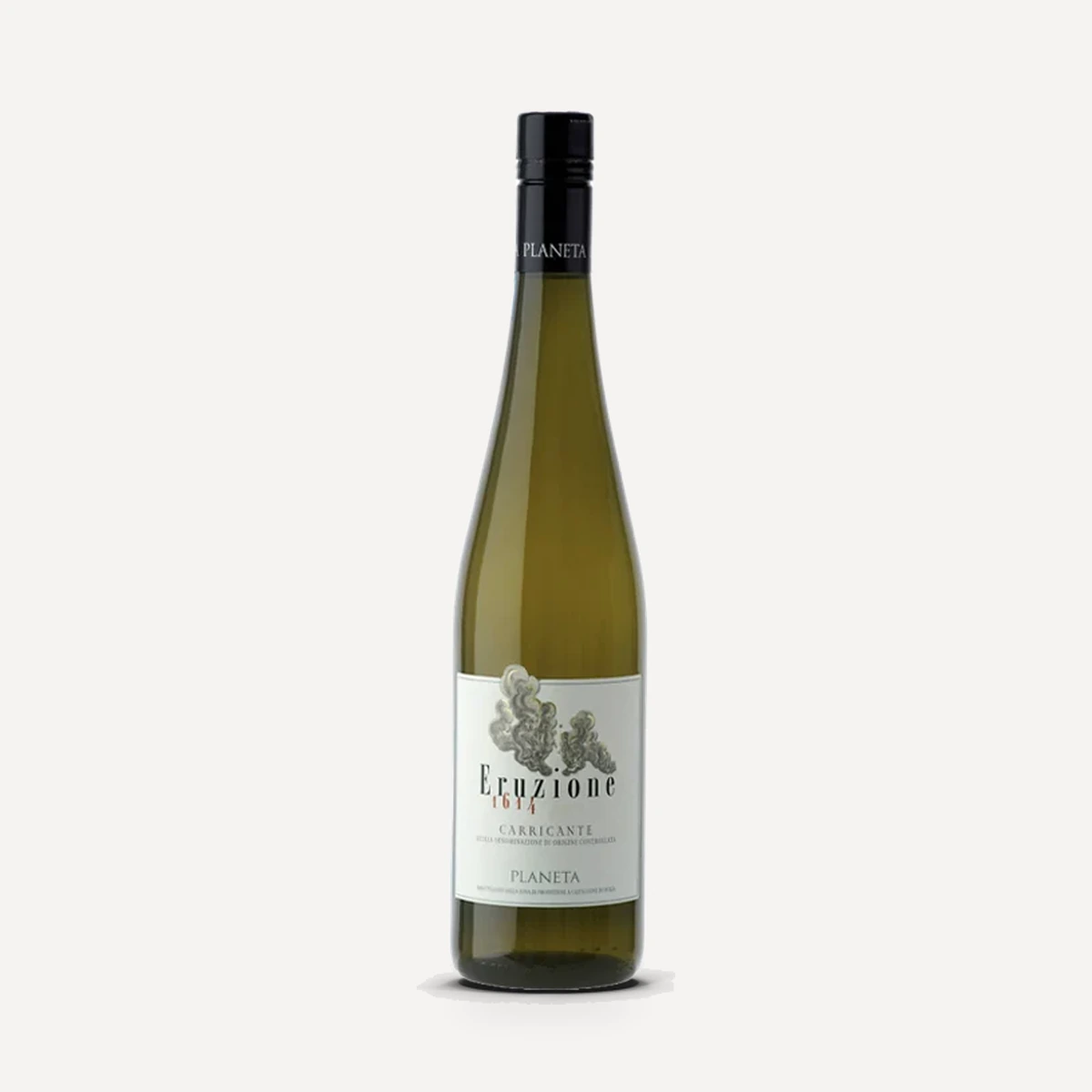
Eruzione 1614 Carricante
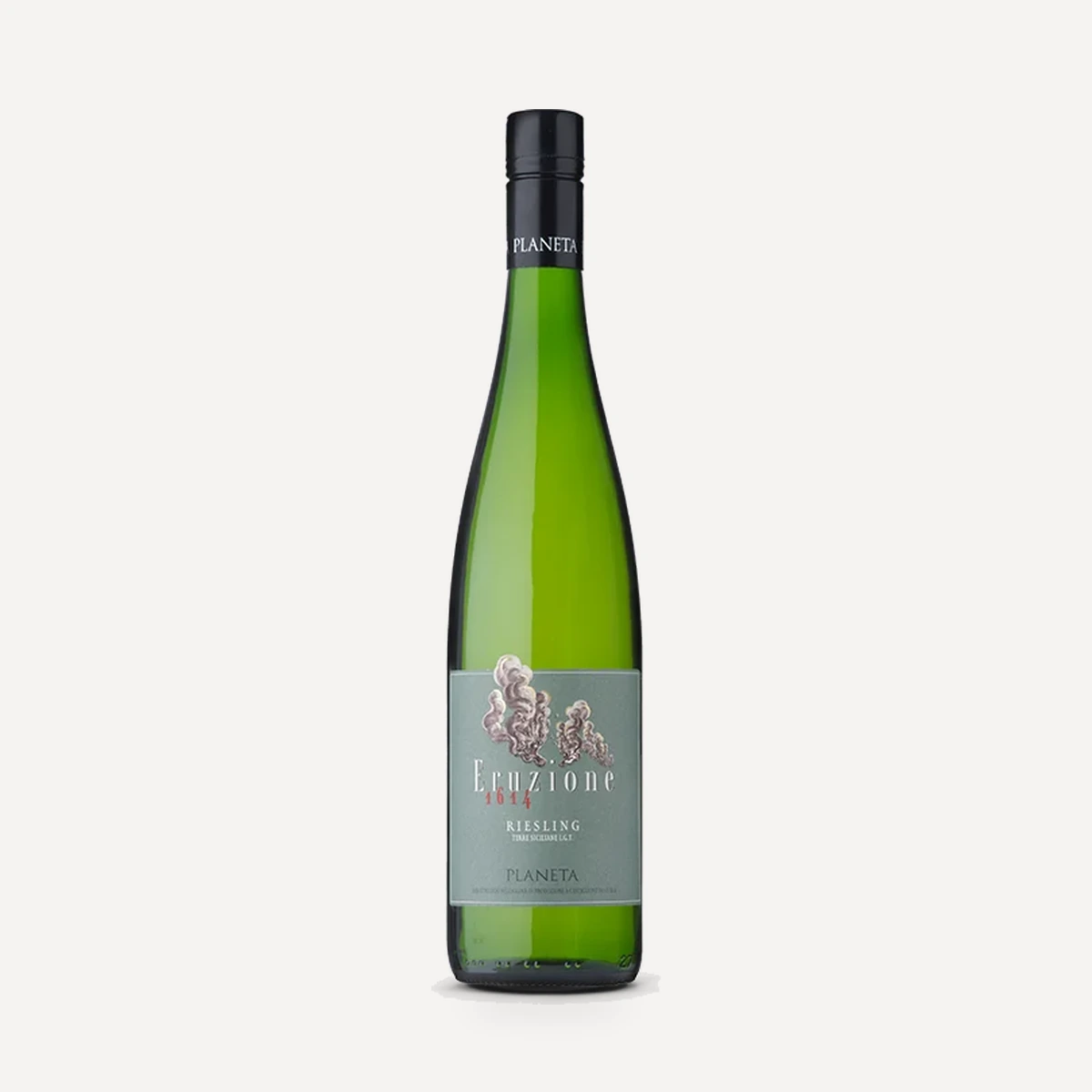
Eruzione 1614 Riesling
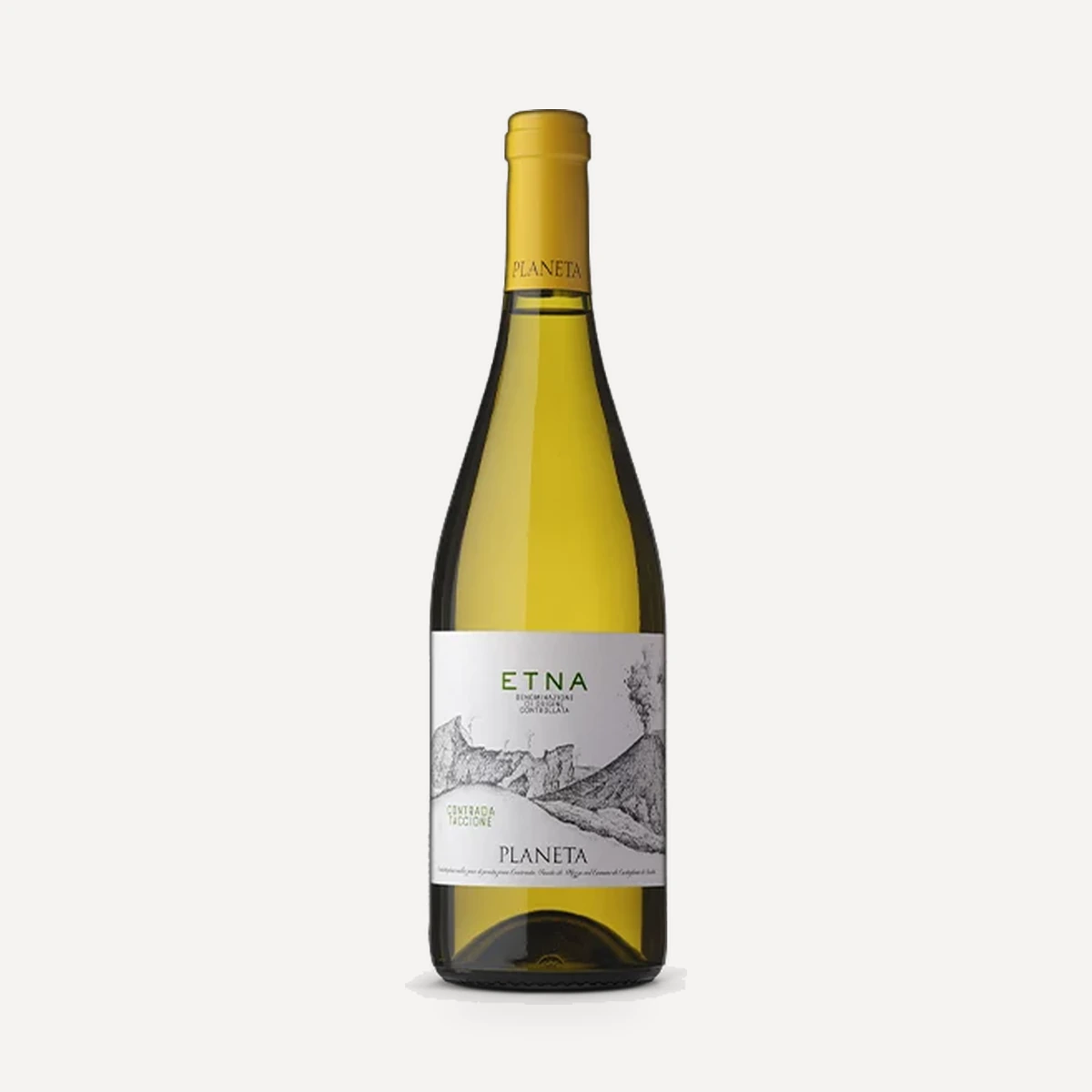
Etna Bianco Contrada Taccione
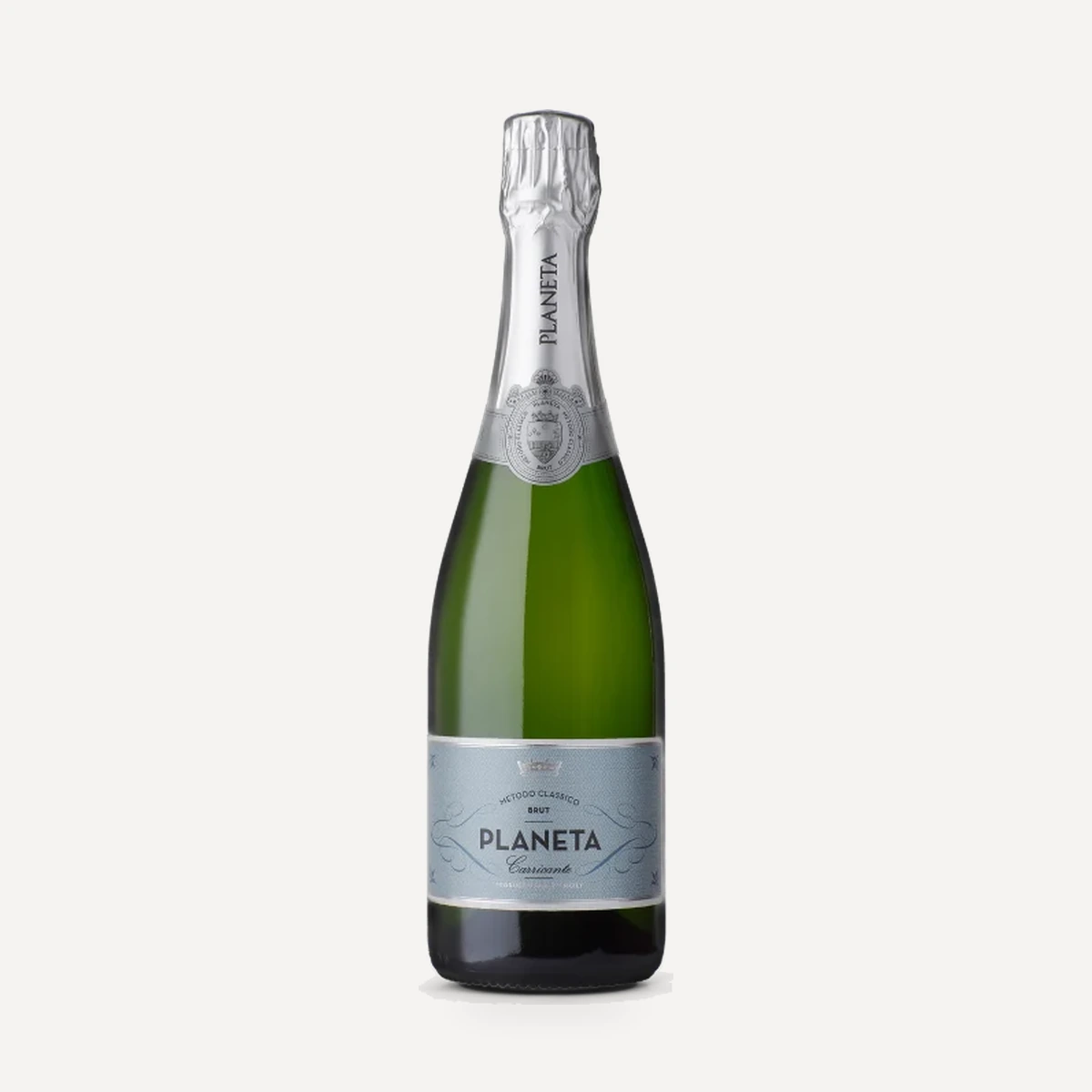
Brut Metodo Classico