Storia
Medieval roots
The estate’s recorded history reaches back to 994 AD. An ancient document preserved in the State Archives of Siena recounts that these lands were donated as a fief by the son of Berengario, king of the Lombards. This distant origin underpins Gagliole’s narrative of family continuity, successive custodians and responsibility for the land.
The historic property was formerly known as Gallule. Its terraced vineyards were already associated with grape growing in medieval times, and the ancient property name survives as the name of one of Gagliole’s wines.
The Bär family and the beginnings of Gagliole
Monika and Thomas Bär were captivated by the Tuscan countryside from their first encounter with it. In 1990, they decided to make Tuscany their second home. The property initially served as a family home and retreat—the place the family came to call its Terra dei Sogni, or “Land of Dreams.” Their experience of the wine produced from its vineyards subsequently suggested a larger project.
The wine estate took shape in 1993 with a small, 3-hectare vineyard holding. The ambition was to become winegrowers and produce their own wine, guided by their enthusiasm for wine and their conviction that the site possessed a character worth expressing. The cellar library now preserves Gagliole labels from 1993 onward.
Expansion into Panzano
In 2011, Gagliole expanded into the Conca d’Oro of Panzano in Chianti. Its vineyards there grew to 10 hectares planted with Sangiovese, Merlot and Cabernet Sauvignon at elevations of 500–510 metres. The planting programme employed selected clones and rootstocks chosen for the conditions of the site.
The same year marked the first trials of Vinification Intégrale. A small selection of Cabernet Sauvignon was fermented and matured in purpose-made Tonnellerie Baron “Elegant Cult” barrels. Encouraging results in the 2011 and 2012 vintages led to an expansion of the programme. Twenty-five new barrels were scheduled to arrive for the 2013 harvest to receive selected Sangiovese, Cabernet Sauvignon and Merlot. Gagliole intended this development to extend integral barrel vinification to Sangiovese as well as the international varieties.
The quality achieved by Cabernet Sauvignon in the 2015 growing season prompted the creation of Balisca, conceived as a pure expression of the variety from the south-western slopes of the Conca d’Oro.
Badia a Passignano and the new cellar
In 2019, Gagliole acquired 4 hectares at Cappella dei Pesci near Badia a Passignano, the part of Chianti Classico closest to Florence. The woodland-encircled property stands at approximately 450 metres. New Sangiovese vineyards were planted there in 2020 as a long-term addition to the estate’s vineyard resources.
The 2019 harvest also inaugurated Gagliole’s new cellar in the Conca d’Oro of Panzano in Chianti. Developed through a long-term investment in production and hospitality, the building was set into its hillside position and faced with Pietraforte so that its architecture would merge with the surrounding vineyards. Advanced cellar technology was combined with an emphasis on manual work and close human oversight.
Continuity after Thomas Bär-Bettschart
Thomas Bär-Bettschart, Gagliole’s founder and owner, died at the age of 87; his death was announced on 3 January 2025. The estate continues under the Bär family, with three generations involved in carrying the project forward.
Terroir
Three areas linked by Pietraforte
Gagliole’s 22 hectares of vineyards are divided among Castellina in Chianti, the Conca d’Oro of Panzano in Chianti and the historic area of Badia a Passignano. Their elevations, exposures and soil compositions differ, but all three share the presence of Pietraforte, an ancient limestone-and-sandstone rock that forms a geological thread across the estate.
Castellina in Chianti
The 8-hectare Castellina holding lies at approximately 420 metres on traditional terraces arranged as a natural amphitheatre. Its aspects range through west, south-west, south-east and east, exposing different sections to sunlight over the course of the day. Brownish-yellow soils derive from Pietraforte. Vines grow within a mixed landscape of olive trees, cypresses, rosemary and holm-oak woodland.
Conca d’Oro, Panzano in Chianti
The 10 hectares in Panzano stand at 500–510 metres. Their soils are predominantly clay, with limestone, sandstone and mineral components. This composition is valued for its capacity to provide water balance and sufficient depth for the roots. A vineyard used for Riserva occupies a natural plateau at 450 metres with a south-western exposure and loamy-clay soil containing stones and balanced proportions of clay, sand and silt. The site’s microclimate also receives cooling sea breezes.
On the north-western ridge of the Conca d’Oro, the Pecchia site reaches approximately 510 metres and rests on compact Pietraforte sandstone and calcareous soil. Cabernet Sauvignon also grows on the south-western slopes at roughly 500 metres.
Badia a Passignano
The 4-hectare Cappella dei Pesci property near Badia a Passignano lies at about 450 metres. It occupies a privileged, woodland-encircled position in the Chianti Classico area closest to Florence.
Vinificazione
Gagliole’s vineyards and cellar are certified organic. Vineyard management follows the natural rhythm of the individual sites and their microclimates, with the stated intention of preserving differences among plots rather than making their expression uniform.
In Panzano, vineyard establishment involved the deliberate selection of clones and rootstocks suited to the site. At Castellina, the historic terraced structure is preserved through maintenance of its dry-stone walls, while vines coexist with olive trees, cypresses, rosemary and holm-oak woodland.
Harvest begins only when the fruit has reached full ripeness and maturity. All grapes are picked by hand by workers familiar with the vineyards. Bunches are selected in the field, placed in small boxes and transferred immediately to the cellar to protect fruit integrity. A second manual selection takes place on the sorting table, where unsuitable grapes and foreign material are removed by hand.
Cellar and grape reception
The cellar inaugurated for the 2019 harvest occupies a hillside position in the Conca d’Oro of Panzano. Its Pietraforte façade and integration into the slope connect the architecture with the surrounding vineyards. Inside, modern production equipment operates alongside processes that retain close manual supervision.
Hand-harvested grapes arrive immediately in small boxes. Every bunch is inspected on a sorting table, with unsuitable fruit and foreign material removed manually before the selected grapes enter the fermentation vessels.
Fermentation and extraction
Fermentation is managed through decisions on temperature, maceration time, pumping over and punching down. These operations are adjusted to the fruit rather than applied with the aim of forcing extraction.
Selected wines employ indigenous yeasts and ferment in stainless-steel tanks or truncated-conical French oak vats. Current technical protocols include macerations of approximately 20–30 days, depending on the wine. Integral barrel vinification remains part of the estate’s repertoire for selected Cabernet Sauvignon lots.
Integral barrel vinification
Gagliole began experimenting with Vinification Intégrale in 2011 using selected Cabernet Sauvignon and Tonnellerie Baron “Elegant Cult” French oak barrels. After sorting, grapes are transferred directly into the barrel, where alcoholic fermentation, post-fermentation and maceration can take place with the skins for as long as 45–60 days. The barrels are rotated several times daily to keep skins and must in contact and to suspend the lees; the bung is opened during rotation to release carbon dioxide and control pressure. After cleaning, the same barrels may be used for malolactic fermentation and maturation.
The barrels use selected French oak whose staves are naturally seasoned for at least five years and slowly toasted. Barrel fermentation provides a comparatively low and even temperature, avoids conventional pumping over and reduces the need for technical cooling.
Maturation
Wines are kept separate according to grape variety and vineyard of origin. Maturation generally lasts 12–24 months and uses both wood and concrete: wood supports structure, while concrete is used to preserve finesse and the clarity of site expression. Each lot is monitored throughout ageing before blending and bottling.
Library
A ground-floor wine library preserves a selection of Gagliole labels from 1993 onward, maintaining a record of the estate’s vintages and development.
Filosofia
Gagliole defines its work through “Passion for Taste,” a daily search for quality, authenticity and balance shared by the Bär family and the estate team. Its approach joins respect for Chianti Classico tradition with contemporary agricultural sensitivity and technical precision.
The estate describes attention as the starting point of its wines: observing changes in light, season and atmosphere, then interpreting the characteristics of each place with depth and restraint. Its objective is not to standardise vineyards or vintages, but to accompany the natural rhythm of individual sites and microclimates so that each plot retains its own character.
Environmental responsibility extends from farming into architecture and cellar operation. Organic practices apply to both vineyards and production. The cellar is integrated into the hillside and supported by geothermal probes and solar panels. Innovation is treated as a tool serving the terrain, while manual work and human judgement remain central from harvest through maturation.
The family dimension is represented by the idea of the Terra dei Sogni and by the participation of three Bär generations. The Gagliole emblem—a compass resting on a balanced horizontal beam, derived from the Bettschart family coat of arms—expresses the associated values of precision, quality and care in workmanship.
Vini
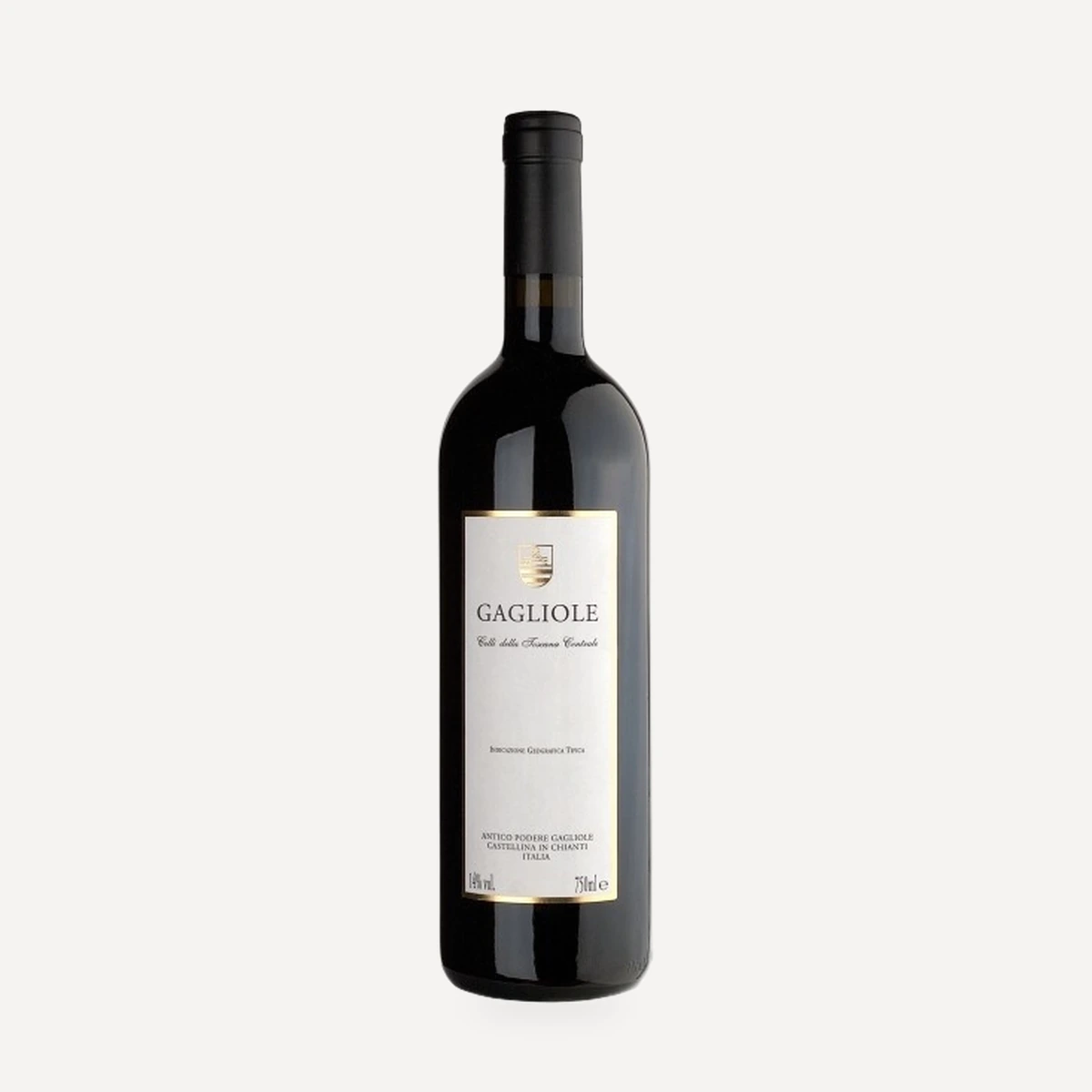
Gagliole Colli della Toscana Centrale IGT
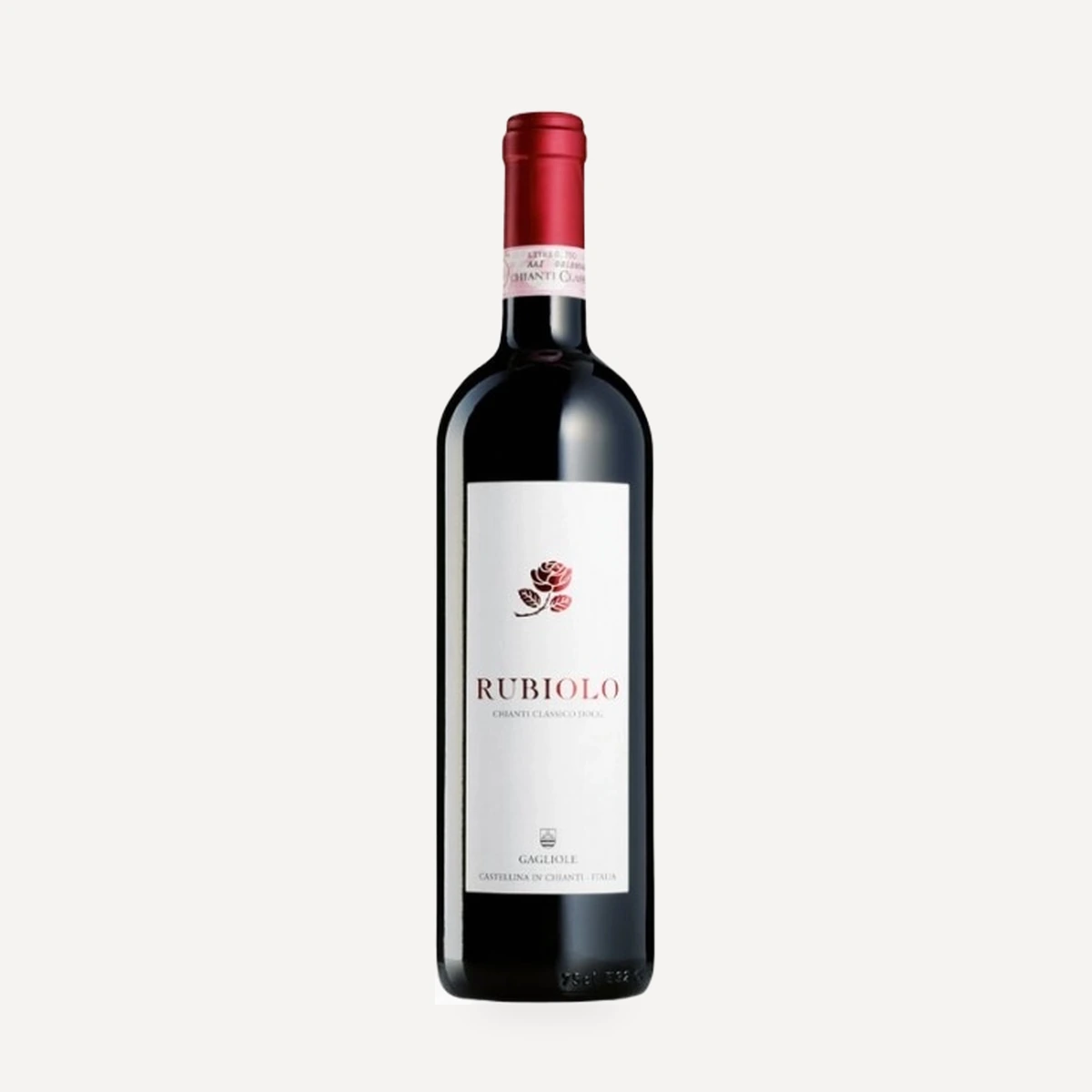
Rubiolo Chianti Classico DOCG