Storia
Foundation
Bruno and Giulia Tissi founded Il Poggiolino on the hills of Montemurlo, within the protected area of the Parco Naturale del Monteferrato. No foundation year is given. They developed the agricultural estate around the conservation of Tuscan agronomic biodiversity and the recovery of old regional animal breeds and plant varieties.
Recovery of agricultural biodiversity
Traditional rural knowledge became the basis for preserving the estate’s long-established habitat. The work encompasses vines, old olive trees, local fruit varieties, pasture, woodland and threatened livestock breeds. Particular attention has been given to the Suino Nero Macchiaiola Maremmana and the Pecora Garfagnina.
The Macchiaiola Maremmana had been regarded as extinct until a breeding nucleus was found on the slopes of Monte Amiata. Its formal recovery then began in collaboration with the Università degli Studi di Firenze and was accompanied by the establishment of the Associazione Allevatori per la Promozione e Tutela della Macchiaiola Maremmana Suino Nero del Territorio Toscano. Il Poggiolino became involved in breeding and safeguarding the recovered population.
An integrated biodynamic farm
The founders organized the farm according to biodynamic principles and the rhythms of nature, excluding pesticides, herbicides and chemical fertilizers. The agricultural cycle relies principally on resources generated within the estate: livestock manure fertilizes the fields, while forage is cultivated to feed the animals. This integration of crops, woodland and livestock is intended to maintain the balance of the agro-silvo ecosystem.
Education and public engagement
Il Poggiolino subsequently established the Scuola del Poggiolino educational-farm project. Its guided programs introduce children, school groups and older students to cultivation, animal husbandry and rural food production. The estate also makes its native biodiversity available for academic research and collaborates with university institutions. Guided farm visits now connect the vineyards and olive groves with the livestock areas and conclude with tastings of estate products.
Terroir
Il Poggiolino lies on the hills of Montemurlo, in the protected landscape of the Parco Naturale del Monteferrato. The I Panconi vineyards occupy a hillside at approximately 360 m above sea level, with a southwesterly orientation described as 180°.
The agricultural setting combines vineyards with old olive trees, pasture and established woodland. Oak and Turkey-oak woods frame the cultivated land and provide areas for grazing and foraging. The broader habitat also includes natural grass and legume species and pure-water springs. No detailed geological, soil-composition, rainfall, temperature or wind data are given.
Vinificazione
Il Poggiolino works according to biodynamic principles, coordinating agricultural activity with the rhythms of nature. Pesticides, herbicides and chemical fertilizers are excluded. Livestock manure is returned to the fields as fertilizer, while forage is cultivated on the farm to feed its animals. The system is designed as a largely internal cycle linking vines and other crops with pasture, woodland and livestock.
The vineyard forms part of a wider biodiversity program. The estate maintains old olive cultivars, local fruit varieties, spontaneous native grasses and legumes, forage beet plantings, oak woodland and threatened regional livestock breeds. Production is deliberately limited and selective. No biodynamic or organic certifying body, certification status, conversion date, pruning method, disease-control regimen, irrigation policy, yield figure or professional grape-sorting procedure is identified.
Harvest is presented as a manual activity in the educational program: grapes are collected into traditional bigonge before being taken for processing. This description relates to the educational harvest workshop rather than a complete technical protocol for commercial production.
The documented cellar practices vary by wine style. Red grapes are vinified by a traditional method, with at least one red matured in stainless steel to preserve primary aromatic character. Rosé is produced from Sangiovese following a short period of skin maceration.
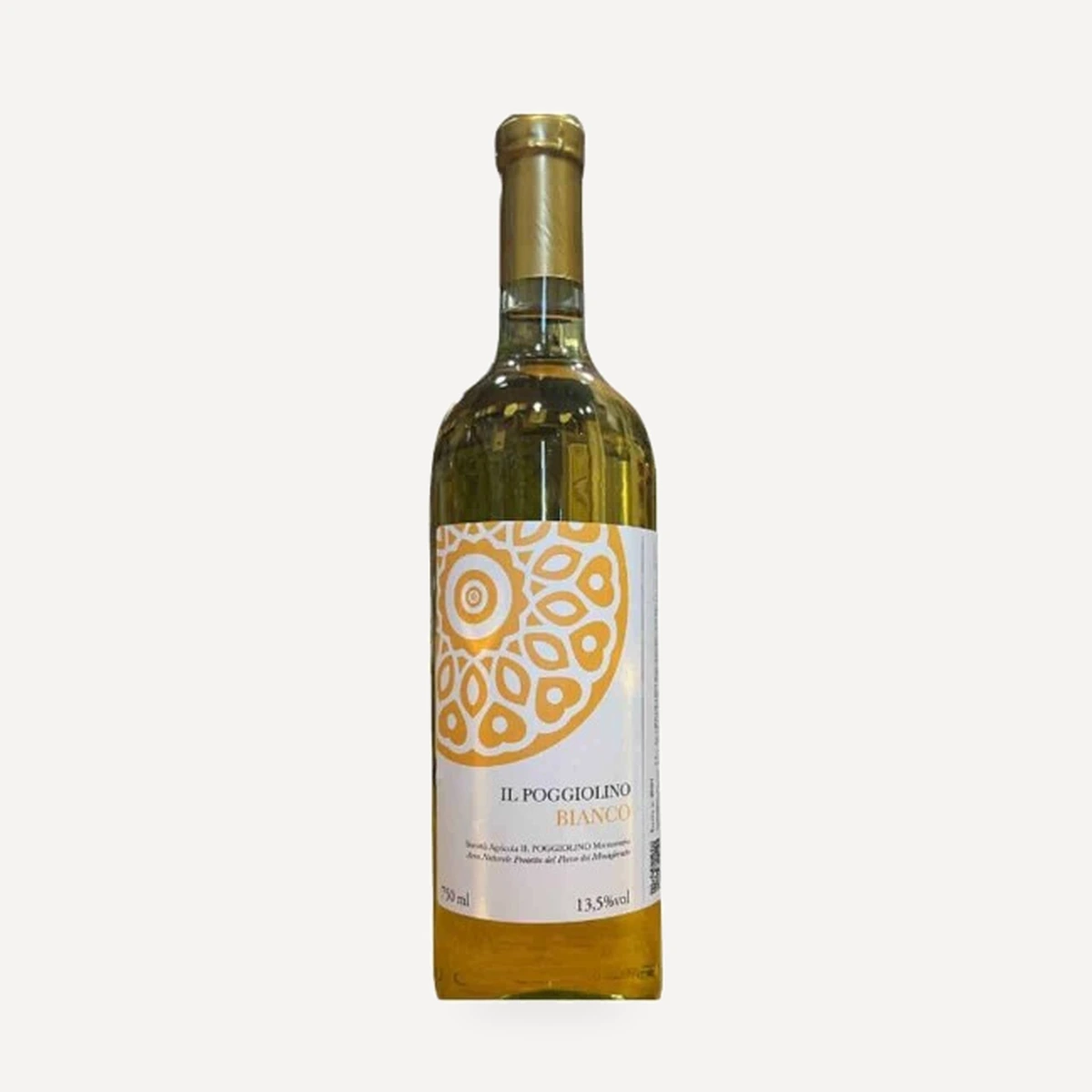
White production uses Trebbiano and Malvasia harvested around mid-September. The grapes are vinified off the skins in stainless-steel tanks. Fermentation lasts approximately 20 days, after which the wine is racked to remove the gross lees and matured on fine lees for 30 days.
The educational harvest program demonstrates traditional small-scale processing: grapes are placed in bigonge, crushed, moved to the cellar and the pomace placed in a press. No general information is given about commercial grape reception, temperature control, yeast selection, malolactic fermentation, extraction routines, oak, filtration, fining, sulfur additions, bottling or bottle maturation.
Filosofia
Il Poggiolino defines its work through the continuity of past and future. Bruno and Giulia Tissi seek to preserve inherited rural knowledge and use it to recover old flavors, values, plant varieties and animal breeds.
The estate’s agricultural philosophy treats vines, other crops, woodland and livestock as parts of one system. Biodynamic work follows natural rhythms; chemical pesticides, herbicides and fertilizers are excluded; and farm-generated resources circulate between animals and fields. The goal is a stable agro-silvo ecosystem in which human activity remains in harmony with the surrounding habitat.
Biodiversity conservation extends beyond winegrowing. Rare Tuscan animal breeds, old olive cultivars, local fruits, spontaneous pasture plants and woodland all form part of the same program. The educational farm and cooperation with universities are intended to transmit this knowledge and make the estate’s native biodiversity available for study.
Vini