Storia
The family property
The estate centres on an early-20th-century farmhouse at San Terenzano, in the Carano district of Sessa Aurunca. The building and surrounding vineyards and olive groves had long been connected with the family. The property also retained an old vineyard that has always belonged to the family; now approximately 90 years old, it remains vigorous and productive.
1995: the birth of Masseria Felicia
Masseria Felicia’s modern history began in 1995, when Alessandro Brini and Giuseppa Ruggiero decided to restore the family farmhouse and return land that had been resting to viticulture. They planted a new 1.5-hectare vineyard with Aglianico and Piedirosso for the production of red Falerno del Massico. The decision restored an agricultural purpose to the land and established the project that became Masseria Felicia.
1999: the first wine
The replanted vineyard produced Masseria Felicia’s first wine in 1999. Its forthright fruit, substantial structure and need for time helped define the estate’s subsequent preference for patient maturation rather than immediate release.
2002: the first label
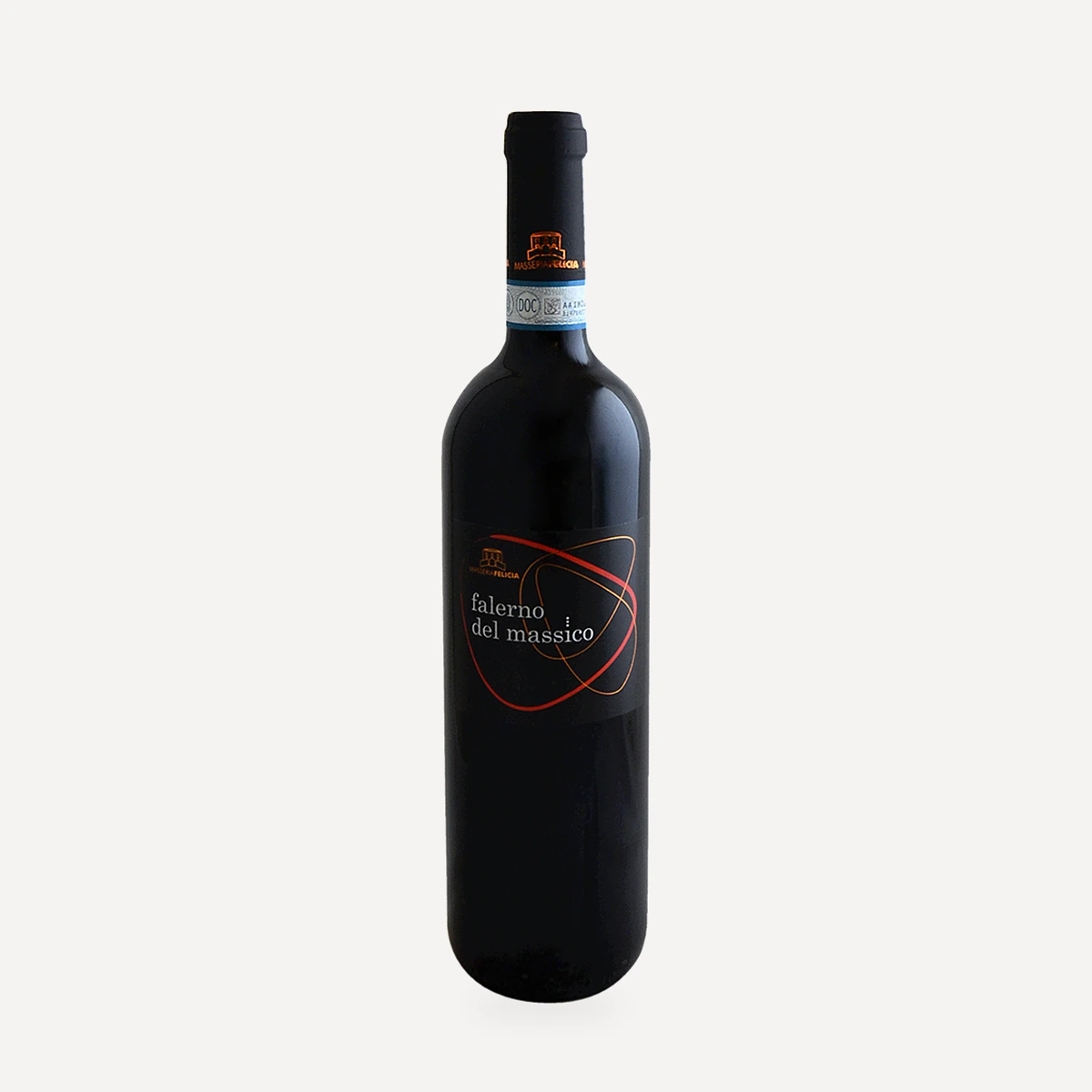
In 2002 the estate released its first commercial label, Etichetta Bronzo, a Falerno del Massico Rosso from the 2000 harvest. Its reception confirmed the viability of a project conceived through the family’s attachment to the land, passion and determination.
Expansion and generational continuity
The vineyards subsequently grew to 5 hectares, with new plantings established alongside the family’s old vineyard. Production remains based exclusively on estate-grown grapes. A new generation now works the same land, combining contemporary perspectives with the project’s artisanal character and its founding belief that wine needs sufficient time to reach its intended quality.
Terroir
Masseria Felicia lies at the foot of Monte Massico in Sessa Aurunca, within the historic area known as Ager Falernus in northern Caserta province. All of its vineyards occupy hilly ground at approximately 200 metres above sea level.
The soils are volcanic in origin and consist predominantly of Tufo grigio campano, pumice and volcanic ash. Their composition reflects the presence of the extinct Roccamonfina volcano and Monte Massico. The landscape is open toward the sea, which is no more than 10 kilometres away.
Aglianico, Piedirosso and Falanghina are cultivated in these conditions. The estate links their local identity to the combination of hillside position, volcanic materials and maritime proximity.
Vinificazione
Masseria Felicia identifies itself as an organic winegrowing and olive-growing farm. Its 5 hectares combine new vineyards with an approximately 90-year-old family vineyard that remains productive.
Only estate-grown fruit is used. Harvesting follows what the family describes as an old method of selection: plants and rows are examined carefully so that only the best bunches proceed to the tanks. This selective approach is intended to preserve the qualities associated with the estate’s volcanic hillside soils and native grape varieties.
Production is deliberately small and relies exclusively on grapes grown in Masseria Felicia’s own vineyards. Fruit is selected during harvest by examining individual plants and rows, with only the preferred bunches entering the tanks.
The estate treats each vineyard separately, allowing it to give rise to its own wine according to the vineyard’s personality and timing. Final evaluation is designed to avoid stylistic standardisation and to retain an individual response to the conditions of each harvest. Patience is central to this approach: the first wine’s structure and reluctance to be consumed immediately established the principle that sufficient time is necessary to attain the desired quality.
Filosofia
Masseria Felicia chose to specialise in Falerno del Massico as a way of expressing the vocation of its land and the deep historical associations of Ager Falernus. Its philosophy connects a wine’s sensory identity closely with the place and the people responsible for it.
The estate seeks to evoke not only flavour but also local history, agricultural labour and the culture of the territory. Native varieties, exclusively estate-grown grapes, separate interpretation of the vineyards and patient development all serve that objective.
A small scale permits the wines to be evaluated individually. The aim is to avoid homogenisation and allow every harvest to produce its own response. The new generation brings modern perspectives while retaining an artisanal approach and the belief that quality requires time.
Wine is also conceived as a reason for people to meet, exchange ideas and participate in cultural and sensory expression—a sincere form of conviviality rooted in the experience of the estate’s first wine and the relationships formed around it.
Vini
Ariapetrina