Storia
The search for a Tuscan property
Jan and Neal Dempsey began looking for a property in Tuscany approximately three years before their eventual purchase. Living in San Francisco, they made several trips to Italy each year and viewed more than 40 properties with almost as many real-estate agents. A friend ultimately led them to the estate that became Podere Erica, combining an extensive farmhouse with vineyards, olive trees, open land and broad countryside views.
2005 — Purchase of Podere Erica
Jan and Neal purchased Podere Erica in 2005. Jan’s longstanding attachment to Italy inspired the project, whose original purpose was both personal and hospitable: to enjoy the Italian way of life and share it with guests.
2009 — Restoration and a new agricultural direction
An extensive restoration of the farmhouse was completed in 2009. The work added modern amenities while retaining the rustic character of the approximately 500-year-old building.
That year, the owners also hired Marco Giordano to manage the farm and its winemaking. His arrival established the estate’s natural-wine direction and the systematic use of organic and biodynamic methods. By the 2019 harvest, Marco had completed ten years at Podere Erica and had transformed the property into a biodynamically managed farm, eliminating herbicides and pesticides and avoiding added chemicals in the cellar.
2016 — Farm animals introduced
Podere Erica began expanding its animal husbandry in 2016. The first additions were hens rescued from a nearby commercial farm. They were given an outdoor life on the property and supplied eggs for guests.
2017 — Mangalitsa pigs and a new white wine
In 2017, the farm began raising Hungarian Mangalitsa pigs. The project was founded around Dante, a boar, and Beatrice, the breeding sow. The pigs were provided with a large fenced section of woodland for foraging, supplemented with corn, grain, beans and kitchen scraps.
Le Rondini, originally conceived as a skin-contact Trebbiano wine, was also introduced around 2017. By the 2019 harvest, its fruit included organically grown Trebbiano sourced from a nearby organic vineyard.
2019 — Experiments, new vines and planned growth
During the 2019 vendemmia, Marco Giordano harvested and began fermenting Il Cardellino, a pét-nat rosé, and an experimental semi-sparkling dry white made from grapes otherwise intended for sweet wine. A separate small harvest of Sangiovese was used for an experimental light red made by carbonic maceration, with entire clusters placed into the tank by hand without destemming.
The principal Sangiovese and Canaiolo harvest took place on three days over one week at the end of September. Filled picking bins were left between the rows, collected by tractor and trailer, and then emptied individually into the destemmer.
New vines were growing on the estate and were expected to begin producing in 2021. At that point, the plan was to double production from approximately 500 cases to 1,000 cases. The estate also announced that it had secured importers for California and New York.
2024–2025 — Recognition of the estate
Podere Erica received Slow Wine’s Chiocciola distinction in the 2024 and 2025 guides. The award recognized the estate across three areas: wine quality and value, authentic expression of terroir, and environmental stewardship through organic and biodynamic vineyard management. Gambero Rosso included Podere Erica in the 2024 edition of Vini d’Italia for the first time.
Terroir
Podere Erica lies in the Chianti Classico area, within the Toscana IGT denomination, roughly halfway between Florence and Siena. The estate occupies more than 12.1 ha and includes vines, olive trees, pastures and woodland.
The vineyard stands at approximately 351 m above sea level on gentle, favorably south-facing slopes. Its soil is a limestone-clay matrix rich in galestro, described as a soft, clay-like material that breaks apart readily. The vineyard and olive grove adjoin a small forest, while the tasting room and terrace overlook the property and surrounding hills.
Vinificazione
Podere Erica combines certified-organic farming with biodynamic practices. Bioagricert certifies the operation as compliant with EU organic regulations. Chemical fertilizers, chemical pesticides, herbicides and synthetic vineyard products are excluded.
Work follows a seasonal cycle. Vines are pruned and trained during winter dormancy. In spring, nitrogen-providing plants are sown between the rows. Fertility and pest management continue through spring and summer using naturally derived resources. The absence of herbicides and pesticides forms part of the estate’s stated objective of sequestering carbon and maintaining healthier soils and surroundings.
Grapes are harvested by hand. During the 2019 harvest, picking extended over three days within one week. Filled bins were placed between the rows, collected by tractor and trailer, and delivered to the winery. The estate has also used hand-selected Sangiovese for its riserva bottling and has worked with organically grown Trebbiano from a nearby organic vineyard for Le Rondini.
Winemaking follows the same organic and biodynamic direction as the vineyard. Fermentations are natural and spontaneous, relying on indigenous yeasts; a grape-derived pied de cuve is used where appropriate to initiate fermentation. No chemical additives are introduced, sulfite levels are kept low, and the currently presented wines are bottled without filtration.
The cellar uses cement tanks, stainless-steel tanks and 500-litre French-oak barrels according to the intended wine. Practices represented across production include co-fermentation, fermentation or maturation on fine lees, direct pressing, short and extended skin contact, the inclusion of some whole clusters, and extended bottle maturation. The winery has also explored carbonic maceration, pét-nat production and semi-sparkling styles.
During the 2019 harvest, whole Sangiovese clusters for an experimental light red were placed into the tank manually without destemming. Fruit for the principal Sangiovese and Canaiolo wines was collected in bins, transported from the rows by tractor and trailer, and emptied into the destemmer. Marco Giordano personally oversees both the vineyard and cellar stages.
Filosofia
Podere Erica’s stated objective is to make balanced natural wines that preserve the character of its grapes and express the estate’s terroir and the winemaking traditions of Chianti. The owners describe their role as custodians: maintaining an established agricultural tradition while replenishing the land and safeguarding it for future generations.
Organic and biodynamic work is treated as a continuous system extending from vineyard to cellar. The approach excludes synthetic vineyard inputs and chemical wine additives, employs natural fermentation and limits sulfites. Environmental care, the health of the farm and transparency for wine drinkers are presented as inseparable from wine quality.
The project also reflects the owners’ desire to share everyday Tuscan rural life. Winegrowing, olive production, animal husbandry, farmhouse hospitality and small-group tastings operate as connected parts of the estate rather than isolated activities.
Vini
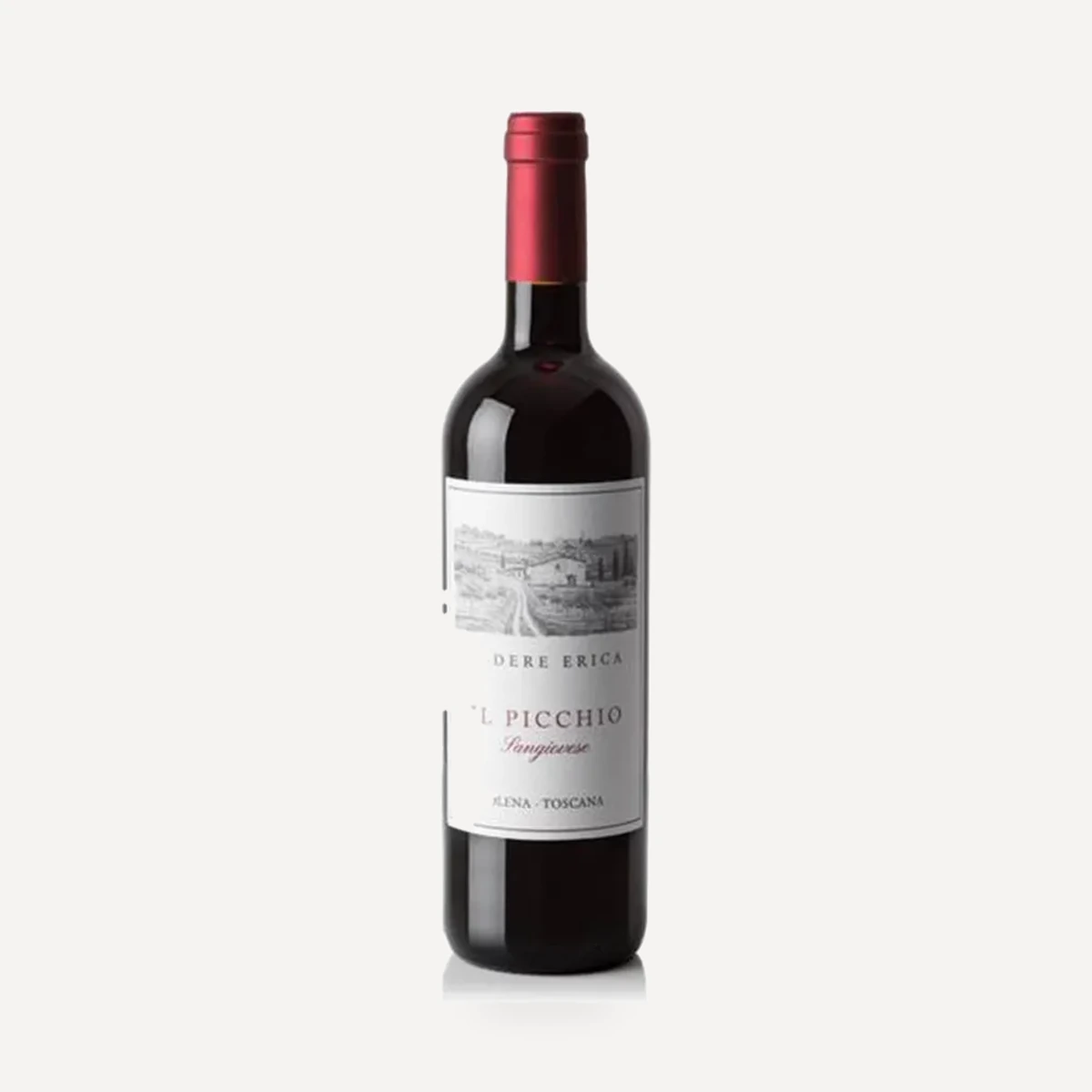
Il Picchio
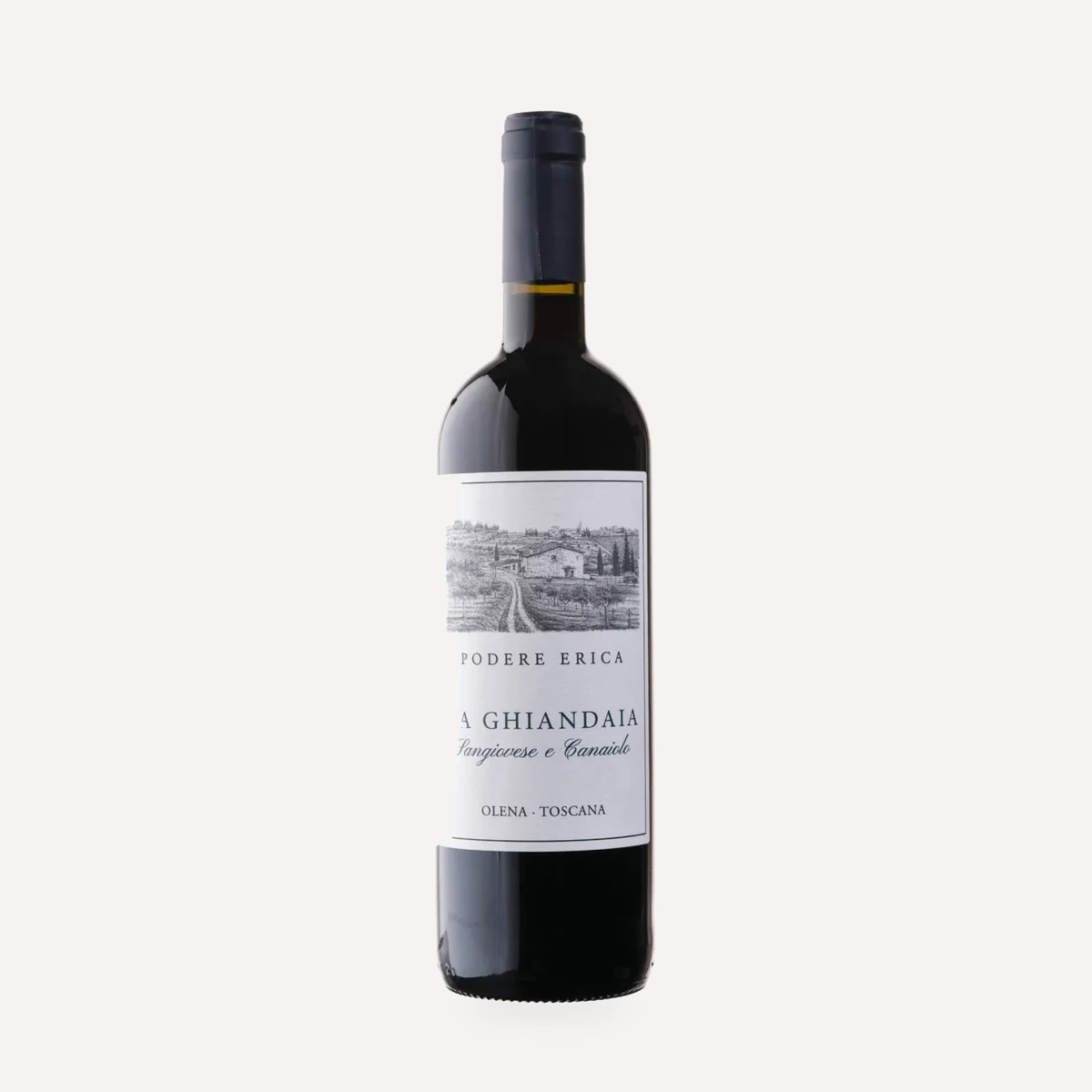
La Ghiandaia