Storia
The Olivetan grancia
Quercecchio's documented history reaches back to the late 14th century. The Chronicon Cancellariae, a record of events concerning the Olivetan order, identifies Quercecchio as a grancia—a convent associated with an agricultural holding—of the Monastery of Monte Oliveto Maggiore from the late 14th century until the late 17th century.
This monastic past remains visible in the estate's built fabric. Several old rural buildings retain the ideogram of the Order of Olivetan Benedictine monks, whose mother house is the nearby Monastery of Monte Oliveto Maggiore at Monte Oliveto, in the commune of Asciano. The estate's former convent spaces include a cloister and rooms now used to receive visitors for tastings.
Five generations of the Salvioni family
Quercecchio subsequently became the property of the Salvioni family and has remained in the family for five generations. Across those generations, experience inherited from the family's predecessors and local winemaking methods have continued alongside the adoption of modern technology.
Maria Grazia Salvioni
The estate is currently owned and personally managed by Maria Grazia Salvioni. Under her direction, Quercecchio's winegrowing vocation has been strengthened. The property now encompasses 150 hectares of vineyards, olive groves, cultivated fields, woodland and pasture, with 16 hectares under vine.
Terroir
Quercecchio lies in the southern part of the commune of Montalcino, in the Province of Siena, Tuscany. The estate occupies a mid-hillside position on terrain descending toward the Maremma. Its vineyards stand at approximately 320 m above sea level.
The vineyard soils are composed of clay and sand. Together with the altitude, southerly location and favourable microclimate, these soils allow the grapes to reach full maturity and develop the complex aromas carried into the finished wines. The combination is associated with grapes suited to structured wines, including Brunello di Montalcino.
The broader 150-hectare property forms a mixed agricultural and natural landscape of vineyards, 10 hectares of olive groves, cultivated fields, open pasture and woodland.
Vinificazione
Quercecchio cultivates 16 hectares of vineyards through a small team of experienced collaborators. Their work extends from the care of the vines to the selection of grapes and the subsequent production stages.
Half of the vineyard surface, approximately 8 hectares, is registered for Brunello di Montalcino. The other half is devoted to grapes for the estate's other local DOC and IGT wines. Vineyard selection is performed before vinification, which is adapted to the intended wine.
A small team of experienced collaborators follows production from vineyard cultivation and grape selection through vinification. The cellar's approach combines modern technology with experience inherited through five generations and the traditional methods of the area. Vinification is adjusted to the particular wine being produced rather than treated as a single uniform process.
Filosofia
Quercecchio places territory and passion at the centre of its identity. Its conception of quality begins in the vineyard and continues through grape selection and wine-specific vinification, with a small team overseeing the successive stages.
The estate presents continuity and technical development as complementary principles: knowledge transmitted across five generations and established local methods are retained while modern technology is incorporated into production. Maria Grazia Salvioni's management has reinforced this emphasis on viticulture and personally supervised estate operations.
Vini
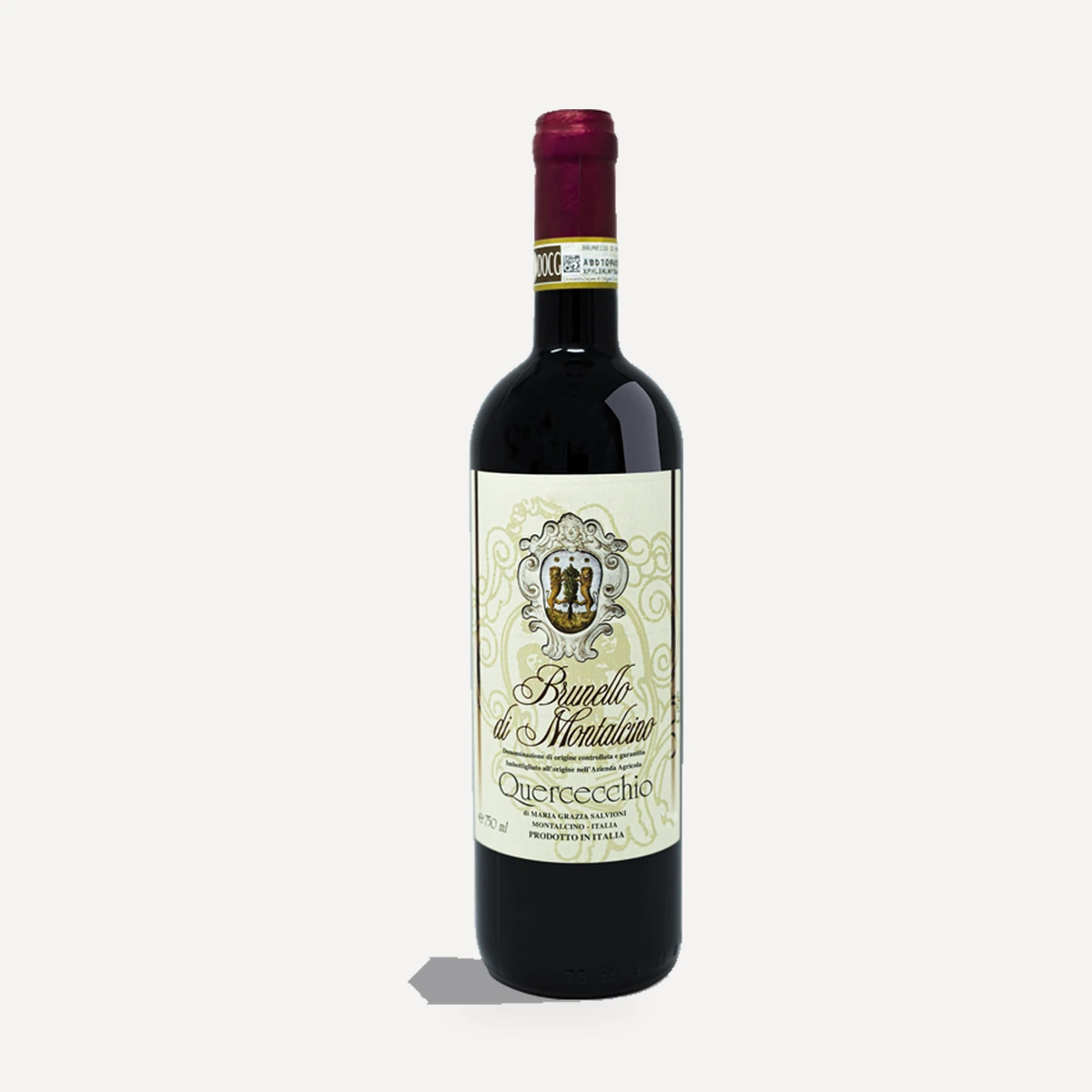
Brunello di Montalcino docg