Storia
Medieval origins and the Renaissance villa
Selvapiana began in the Middle Ages as one of the watchtowers positioned along the Sieve River to defend Florence’s northeastern approaches. During the Renaissance, the building was enlarged and converted into a villa. It subsequently served as a summer residence for Florentine noble families and the bishops of Florence.
The wider Rufina production area, originally associated with the name Pomino, was partly delimited in 1716 by Grand Duke Cosimo III de’ Medici. His decree protected four Tuscan wine-growing areas: Pomino, the historic Chianti area, Carmignano and Valdarno Superiore.
Acquisition by the Giuntini family
In 1826, the estate was acquired by Michele Giuntini, a successful Florentine banker and ancestor of the family that continues to own Selvapiana. An English-language version gives 1827, but the estate’s Italian history and a later historical account use 1826.
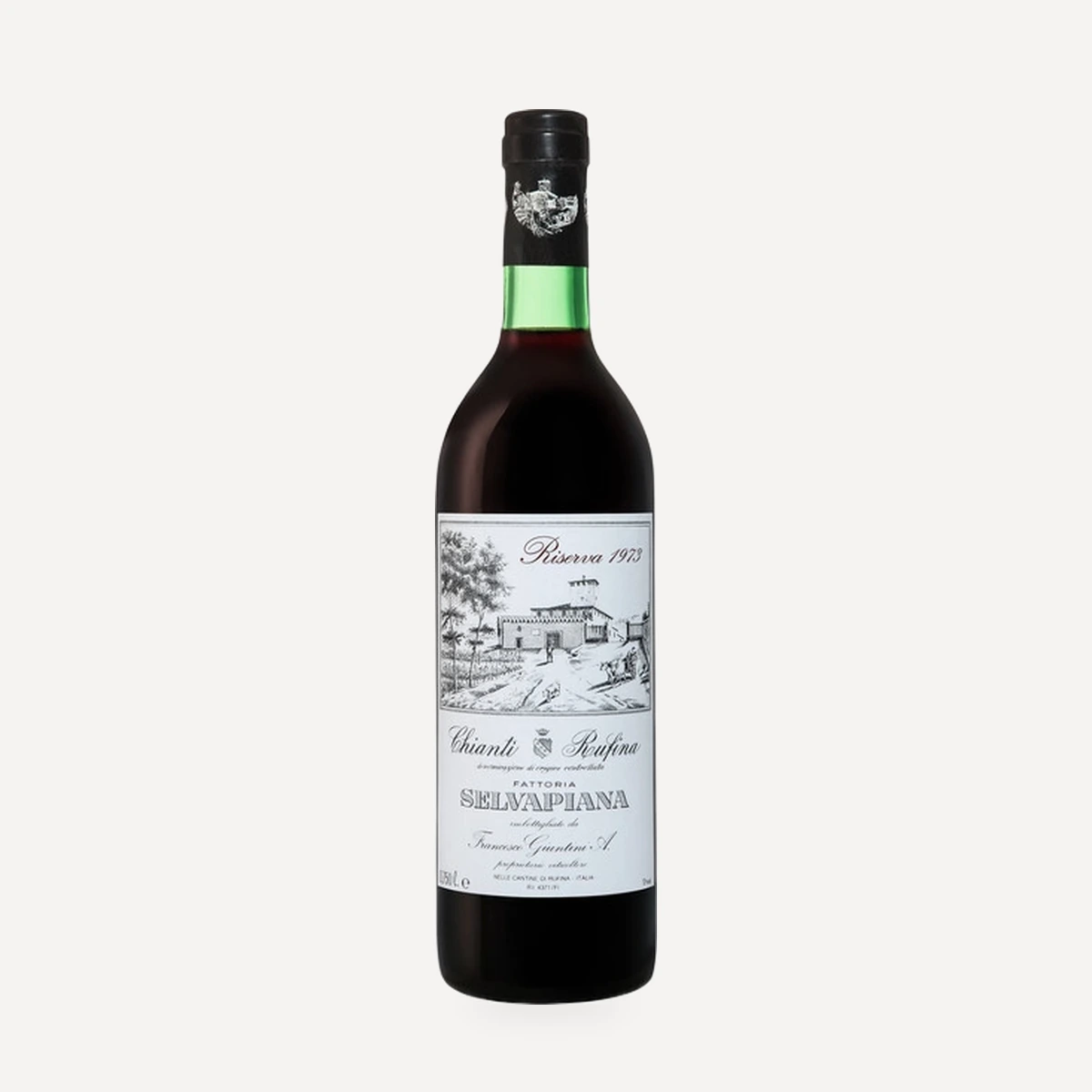
Selvapiana developed an early estate-bottling tradition. Bottling began after the First World War, and in the interwar period its wines were sold in restaurants in Milan and Rome. During the Second World War, occupying German troops emptied the accumulated cellar of older bottles. The 1947 harvest was the first post-war vintage. The surviving historical library begins with the 1948 Riserva and preserves every produced vintage of Riserva and Riserva Vigneto Bucerchiale from that point onward.
Sharecropping and traditional production
During the 1950s and 1960s, Selvapiana still operated within the mezzadria sharecropping system. Some vines were ungrafted, many were very old, and rows were trained to living supports such as maple trees. Harvest normally began after 10 October. Grapes were fermented in open chestnut vats and concrete tanks, while the wines matured for five or six years in old chestnut casks.
Franco Masseti became the estate’s fattore in 1953 and remained in that position until 1990. Francesco Giuntini took charge in 1957, at the age of 21, and directed Selvapiana until 1997. He consistently promoted the potential of Chianti Rufina and made Sangiovese and the expression of individual vineyards central to the estate’s development.
The first parcel of Bucerchiale was planted in 1968. Chianti Rufina obtained DOC status in 1967 and DOCG status in 1984.
The end of mezzadria and the pursuit of single-vineyard Sangiovese
The end of sharecropping in the 1970s forced major changes in the management of the Chianti countryside. Specialized vineyards were planted, chemical fertilizers and crop-protection products became widespread, and a deep rural recession coincided with several difficult harvests. The vintages of the second half of the decade marked a qualitative recovery.
Wine writer Luigi Veronelli encouraged producers to isolate and bottle the strongest expressions of individual vineyards. Francesco Giuntini identified Bucerchiale as Selvapiana’s best podere and pursued a wine made entirely from its Sangiovese, despite contemporary Chianti rules requiring Trebbiano. Trebbiano remained planted because enforcement focused on vineyard composition, but the wine itself was made solely from Sangiovese.
In 1978, Francesco hired the young Franco Bernabei as consulting oenologist. Their work led to the first Vigneto Bucerchiale in 1979, a single-vineyard, 100% Sangiovese Chianti Rufina Riserva conceived for long ageing. The wine retained the Chianti Rufina Riserva designation even before the law permitted a pure-Sangiovese Chianti. The estate initially kept much of the production in its cellar because there was little market for expensive Chianti; exports later helped establish demand.
Technical evolution in the 1980s and 1990s
The wines of the 1980s reinforced Selvapiana’s focus on Sangiovese. The estate declined to adopt the fashionable international varieties then promoted as “improving varieties” for its principal Sangiovese selection. Large old chestnut casks remained in use through the 1985 vintage. A spring frost reduced the 1985 Bucerchiale crop by about 30%, convincing Federico Giuntini Masseti that controlling yields rather than replacing Sangiovese was fundamental to quality.
The estate moved toward barriques in 1986. Federico began working at Selvapiana during the summer of 1987, after high school. He immediately asked Francesco to begin organic farming; the process started with a small number of vineyards. The 1987 vintage was especially difficult because of high yields, harvest rain and Botrytis, despite extensive green harvesting.
Fornace was being cultivated organically by 1990, and the approach subsequently expanded to every vineyard and olive grove. From 1992, fermentations proceeded without selected yeasts. That year was also a particularly difficult vintage, and a second parcel of Bucerchiale was planted. During the 1990s and early 2000s, prevailing practice brought smaller oak vessels, greater extraction and, for some wines, a period of exclusive barrique ageing. The estate later reversed this direction in search of greater purity and less extraction.
Francesco adopted Franco Masseti’s children, Federico and Silvia, in 1994 to ensure continuity. In 1997, after four decades under Francesco, management passed to Federico and Silvia. Silvia assumed responsibility for the office, while Federico concentrated on the vineyards, winemaking and direct sales.
Expansion and a new cellar
The 15-hectare Erchi farm in Pontassieve was purchased in 1998 after a long search for another site capable of showing a distinct expression of Sangiovese within Rufina. Six hectares were planted to Sangiovese in 1999. The family waited for the vines to mature before releasing a separate selection. Erchi became the project of Federico’s generation, complementing Francesco’s work at Bucerchiale.
A younger Bucerchiale parcel was planted in 2001. The original 1968 section was later removed because of vine losses and low planting density; the ground was allowed to rest before replanting.
A new vinification cellar opened for the 2005 harvest, supplementing the historic underground cellars beneath the villa. It introduced temperature-controlled stainless steel while retaining restored concrete tanks from the former winery. Wooden maturation remained divided between the historic cellar and a newer barrique cellar.
The next generation
From the 2018 vintage, the maturation regime for the estate’s principal single-vineyard Sangiovese moved to an equal division between French oak barriques and large casks, with less extraction than in the preceding era. The 2018 Vigneto Erchi Riserva was also among the inaugural Terraelectae wines, a producer-led Chianti Rufina category restricted to single-vineyard Riserva made entirely from Sangiovese.
In 2019, Federico’s eldest son, Niccolò, took full responsibility for the cellar and managed the entire vintage from beginning to end. He subsequently expanded his work into the vineyards while collaborating closely with Franco Bernabei. Federico’s daughter Rebecca began assisting in the wine shop. This gradual transition represents the entry of a new family generation while Federico and Silvia remain responsible for the estate.
Terroir
Selvapiana’s land extends across Rufina, Pontassieve and Pelago, on the foothills of the Apennines where Tuscany meets Emilia-Romagna. Most estate vineyards surround the Renaissance villa and face west. The mountains produce cooler summers, cool nights and a pronounced day–night temperature range. The resulting longer growing season permits slow, balanced ripening without excessive maturity.
Cooling air also moves through the north–south Sieve Valley. The combination of elevation, mountain proximity and night-time cooling preserves acidity and shapes the estate’s emphasis on freshness, finesse, supple tannins and length.
Clay and limestone recur across the estate, but individual sites differ. Bucerchiale lies at approximately 200–220 m, faces southwest and consists predominantly of clay with limestone. Erchi lies between approximately 150 and 200 m in a basin-like setting near Pontassieve; its calcareous limestone contains substantially more iron than Bucerchiale. Sopra Giardino, at approximately 250 m in its English description, has medium-textured clay-limestone soil that is stony, deep, fresh and well drained, with a north to northwesterly exposure. The Villa di Petrognano vineyards lie at the foot of the Apennines near the boundary between Tuscany and Emilia-Romagna.
Vinificazione
Selvapiana’s vineyards and olive groves are certified organic. Federico Giuntini Masseti initiated the transition after joining the estate in summer 1987. Work began in a small number of vineyards; Fornace was under organic cultivation by 1990, and the system subsequently expanded across all vineyards and olive groves. An ICEA conformity certificate issued under operator code IT BIO 006 B2913 covered organic vines and olives under Regulations EC 834/07 and 889/08.
Climate adaptation has reshaped vineyard work. Pruning is delayed to postpone budbreak, reduce exposure to spring frost and delay ripening. Cover crops and manure build organic matter, improve soil microbial life and reduce vine water stress. Winter cultivation works the soil more deeply to prevent compaction.
Canopy management now retains more shade: leaves are no longer routinely removed and hedging has been discontinued. Before severe heat waves, kaolin white clay and algae-based materials are applied to lower leaf temperature. Practices change with each vintage, with the aim of maintaining healthy soils and vines through natural cultivation.
Green harvesting is used when required to control excessive crops; it was extensively employed during the high-yielding 1987 season. Grapes for the documented Sopra Giardino parcel were harvested by hand. Historically, harvest began after 10 October and could extend into late October or early November; warming conditions have moved picking earlier, in some recent seasons to September.
Cellars and fermentation
The vinification cellar inaugurated for the 2005 harvest complements the historic underground rooms beneath the villa. Fermentation takes place in temperature-controlled stainless-steel tanks and restored concrete vessels retained from the former winery.
Selected yeasts have not been used since 1992, and sulfite additions were reduced compared with earlier practice. Fermentation and skin contact generally extend for at least 30 days. For the principal long-macerated Sangiovese, the current working range is approximately 30–35 days without a submerged cap, following earlier experiments with still longer extraction.
Wood maturation is divided between large barrels in the historic cellar and barriques in the newer ageing cellar. The estate has progressively moved away from the highly extracted, all-barrique style adopted during the 1990s and early 2000s. From 2018, the principal single-vineyard Sangiovese used an equal division between French oak barriques and large casks, emphasizing less extraction and greater purity. Chaptalization has ceased, and the concentrator formerly used during the late twentieth-century pursuit of higher alcohol has been taken out of service.
Historical methods
In the 1950s and 1960s, grapes were fermented in open chestnut vats and concrete tanks. Wines then matured for five or six years in old chestnut casks. Large chestnut remained important through the mid-1980s; barriques were introduced in 1986 and later became dominant before the return to a combination of large and small oak.
A separately documented Syrah lot was fermented and macerated with natural yeasts for 25 days in open barriques, followed by 24 months in French oak barriques. This was a specific small-lot method rather than a universal estate protocol.
Filosofia
Selvapiana’s approach is built around the distinct identity of Rufina and the capacity of Sangiovese to transmit differences between individual sites. Francesco Giuntini’s decision to make a pure-Sangiovese wine from Bucerchiale—before contemporary Chianti rules permitted it—placed vineyard identity and quality above prevailing convention and market demand.
Franco Bernabei’s consulting role has been defined as expressing the estate and the individual vintage rather than imposing a recognizable winemaking signature. The evolution away from heavy extraction, excessive new oak, chaptalization and concentration reflects the same pursuit of purity.
Organic cultivation and climate adaptation focus on soil life, vine balance and shade rather than formulaic intervention. Federico Giuntini Masseti describes each vintage as different and considers careful work with soil and vines the principal means of preventing later problems.
Family continuity is another central principle. Francesco’s adoption of Federico and Silvia secured the fifth generation; the gradual transfer of cellar and vineyard responsibilities to Niccolò, with Rebecca beginning work in the wine shop, is intended to prepare the estate without abruptly breaking with the experience of the preceding generation.
Vini

Vigneto Bucerchiale Chianti Rufina Riserva DOCG

Vigneto Erchi Chianti Rufina Riserva DOCG

Selvapiana Chianti Rufina DOCG
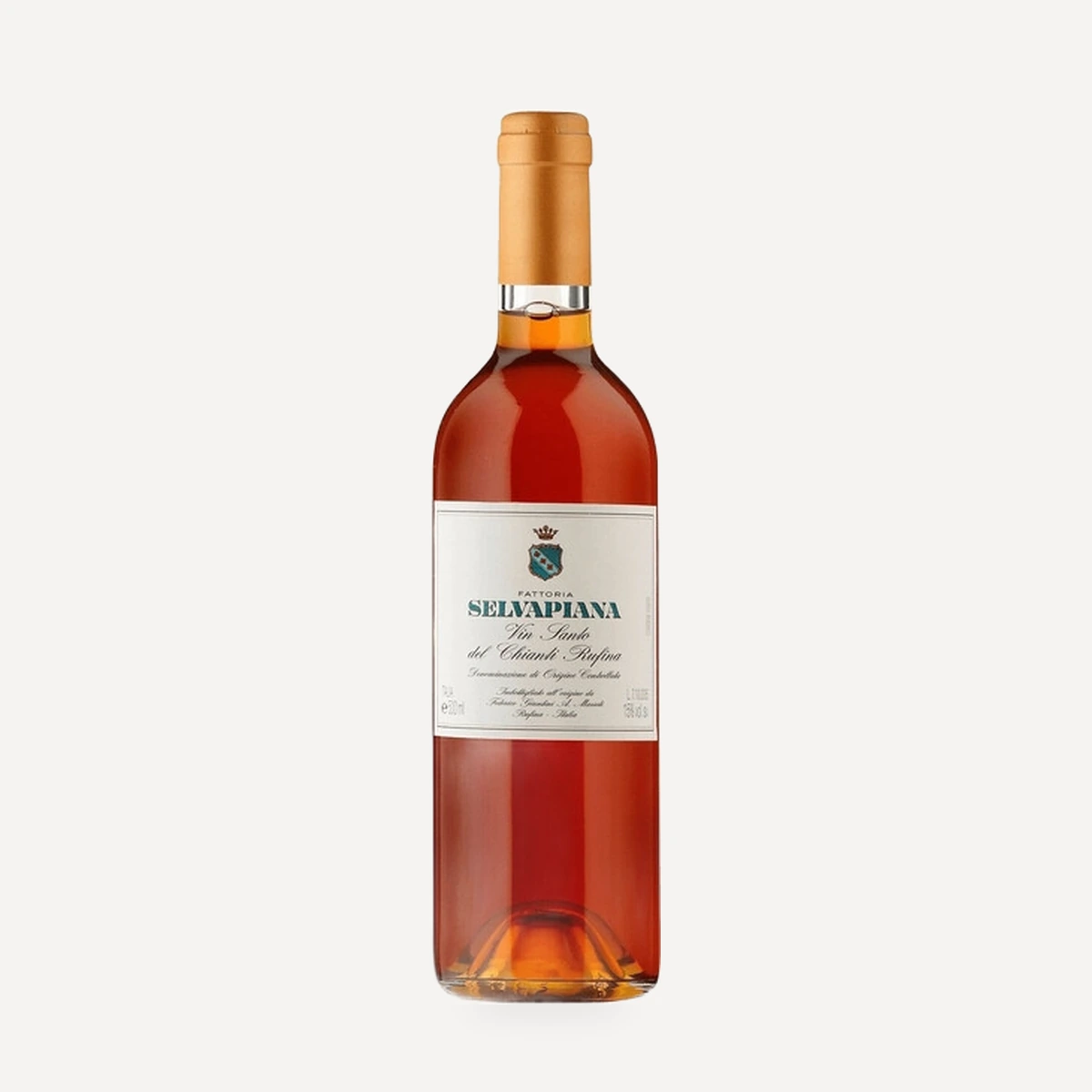
Vin Santo del Chianti Rufina DOC