Storia
The first estate
Tenuta Ficuzza was the first estate in Cusumano’s project and the place where that project began. The property was developed in the hills around Piana degli Albanesi, within the wooded landscape of Ficuzza and at elevations exceeding 700 metres. Rather than clear the entire property, woodland and the area’s Mediterranean scrub were retained, leaving the vineyards arranged as a mosaic within the surviving vegetation.
The estate’s high-altitude direction centred on white varieties. Insolia and Chardonnay were established here, followed by Sauvignon Blanc. Pinot Nero was also planted as an intentionally demanding choice suited to the estate’s mountain conditions; it became the basis of both a rosé and the estate’s bottle-fermented sparkling wine.
The historical inspiration of Ficuzza
In 1800, King Ferdinand IV of Bourbon kept his own wine at the nearby Real Casina di Caccia di Ficuzza. That wine was made from grapes grown in vineyards around the present estate. Its precise composition has not survived in the account, but this local history later inspired an estate project based on indigenous grapes, a single terroir and extended maturation on fine lees.
Salealto 2018
After several years of experimentation, the 2018 vintage of Salealto was created from Insolia, Grillo and Zibibbo. The varieties were vinified separately, then assembled and matured together. It was the first Cusumano white wine made with proprietary yeasts selected through a long research programme.
The development of Sauvignon Blanc
Sauvignon Blanc was planted as an experiment driven by the belief that Ficuzza’s altitude and climate were particularly suitable for white varieties. Mario Ronco followed the vineyard’s development over a number of years. Once the vines had matured and reached the desired balance, its fruit was combined with Chardonnay from the same terroir, creating the revised Angimbé blend. The change joined Chardonnay’s body to Sauvignon Blanc’s varietal character and freshness.
Terroir
Location and landscape
Tenuta Ficuzza lies at Piana degli Albanesi, in the heart of Sicily. Its vineyards occupy hills at approximately 700 metres above sea level, with some blocks extending from 700 to 800 metres. They are surrounded by the woods of Ficuzza. Woodland and Mediterranean scrub have been preserved within the property, so the cultivated blocks form a mosaic among areas of natural vegetation.
Mountain microclimate
The high-altitude setting permits slow, gentle ripening and helps retain freshness. Its microclimate protects the vines from drought and high temperatures. Strong temperature excursions contribute to the aromatic development of Pinot Nero and allow Chardonnay to develop its fruit aromas while retaining freshness.
Soils and exposures
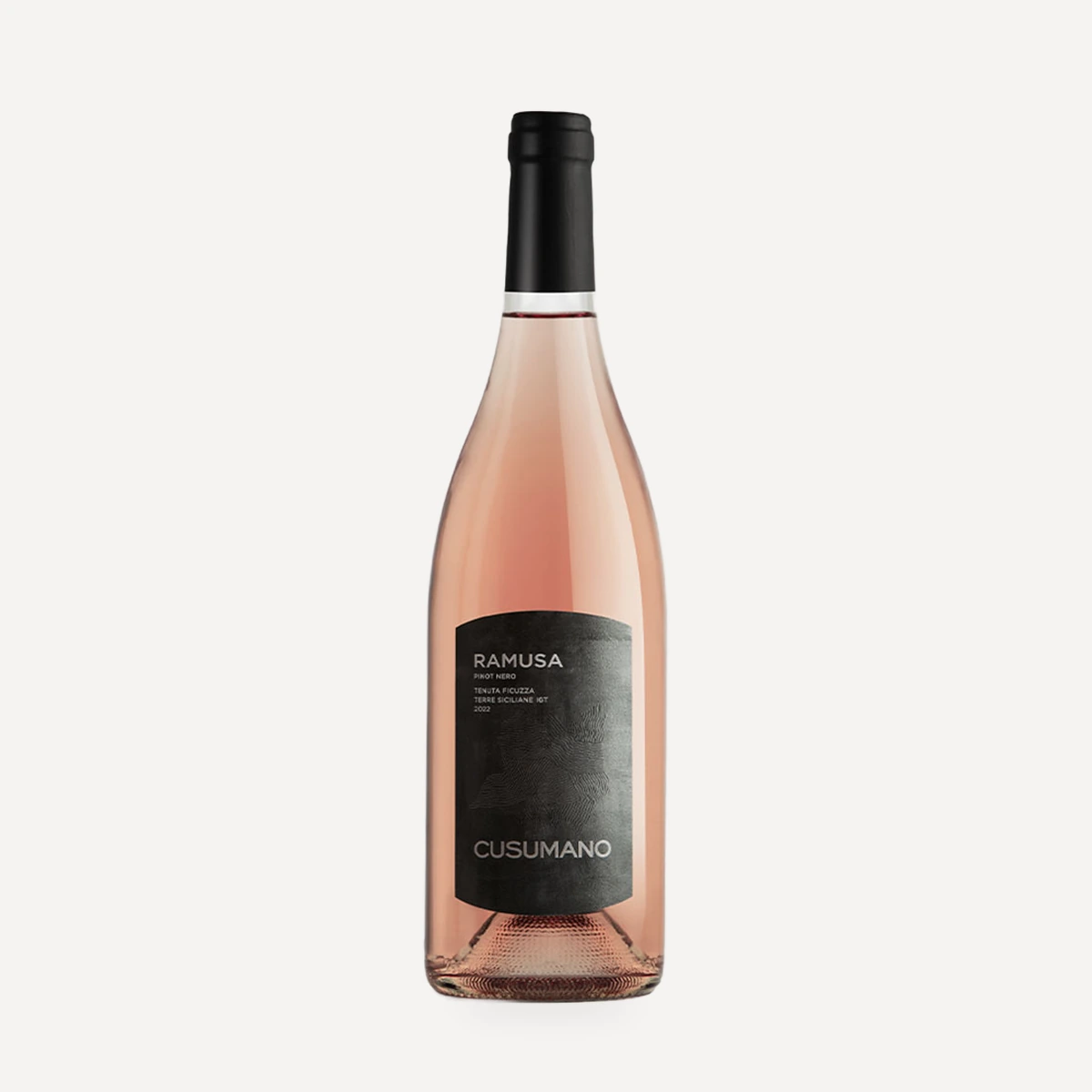
The Pinot Nero and Chardonnay used for 700slm grow on medium-textured clay soil. The associated block has a north-east exposure at 700 metres. Ramusa’s Pinot Nero also occupies north-east-facing hillside vineyards at 700 metres. Vigneto del Ventaglio, the Chardonnay vineyard for Jalé, faces south and lies between 700 and 800 metres. The Salealto vineyards also range from 700 to 800 metres.
Vinificazione
The vineyards are cultivated on high hills, generally between 700 and 800 metres. A substantial part of the property remains under woodland and Mediterranean scrub, integrating viticulture into a mosaic of cultivated and uncultivated land.
Technical records consistently give a density of 5,000 vines per hectare for the documented blocks. Yields vary by parcel and intended use: 50 hl/ha for the Pinot Nero-led Metodo Classico blocks, 60 hl/ha for Ramusa’s Pinot Nero, and 6,000 kg/ha for both Vigneto del Ventaglio and the Salealto blocks.
Harvesting is manual and the grapes are placed in cases or small cases. Vigneto del Ventaglio is harvested in the first ten days of September, while Pinot Nero for Ramusa is collected during the first half of September.
Cusumano’s wines carry SOStain and VIVA sustainability certification. The retained woods and Mediterranean vegetation are the estate-specific expressions of this environmental approach.
Metodo Classico production
For 700slm, whole bunches are pressed and only the first free-run must is retained, limiting unwanted tannins while preserving acidity. The juice undergoes static settling and ferments at a low, controlled temperature. The base wine remains on fine lees for approximately five months and is then filtered. Secondary fermentation takes place in bottle at 13°C, followed by 36 months of bottle ageing before disgorgement.
Salealto
The manually harvested grapes macerate in the press at ambient temperature before static clarification. The component wines ferment separately in stainless-steel tanks at 20°C. After racking they are assembled, remain on fine lees for approximately ten months, and subsequently age in bottle. Salealto was conceived after several years of experimentation and became the first Cusumano white wine produced with proprietary yeasts developed through extended research.
Jalé
Hand-picked Chardonnay from Vigneto del Ventaglio undergoes cold maceration in contact with the skins, followed by static clarification. Fermentation takes place in 225-litre oak barrels. The wine remains in the same barrels for approximately six months before bottling and further bottle maturation.
Ramusa
Pinot Nero is destemmed and cold-macerated for 24 hours. The juice is then drawn off and fermented at a controlled temperature. Maturation continues on the fine lees for six months.
Filosofia
Tenuta Ficuzza expresses a deliberate high-altitude approach to Sicilian viticulture. Its development went against the prevailing direction by concentrating on white varieties and by accepting the challenge of Pinot Nero. The underlying principle is that elevation, temperature variation and the estate’s mountain microclimate can deliver slow ripening, aromatic definition and freshness.
The landscape is treated as more than a continuous area for vines. Existing woods and Mediterranean scrub were retained, leaving vineyards embedded within the natural vegetation.
Curiosity and research are central to the estate’s self-description. The Sauvignon Blanc planting was treated as a long-term experiment and observed until the vineyard reached maturity. Salealto likewise followed several years of trials and a programme to develop proprietary yeasts. Historical inspiration is interpreted through contemporary experimentation rather than through an attempt to reproduce an undocumented old recipe.
Vini