Storia
Medieval origins and early winemaking
The name Torre Alle Tolfe reaches back to the 8th century, when Tolfo dei Gricci, one of Charlemagne’s knights, built a watchtower on the site. During the medieval period, the tower was subsequently used in the defence of Siena against the Florentines. The estate’s earliest written evidence of grape growing and winemaking dates to 1316, establishing a documented wine history of more than seven centuries.
The Castelli family
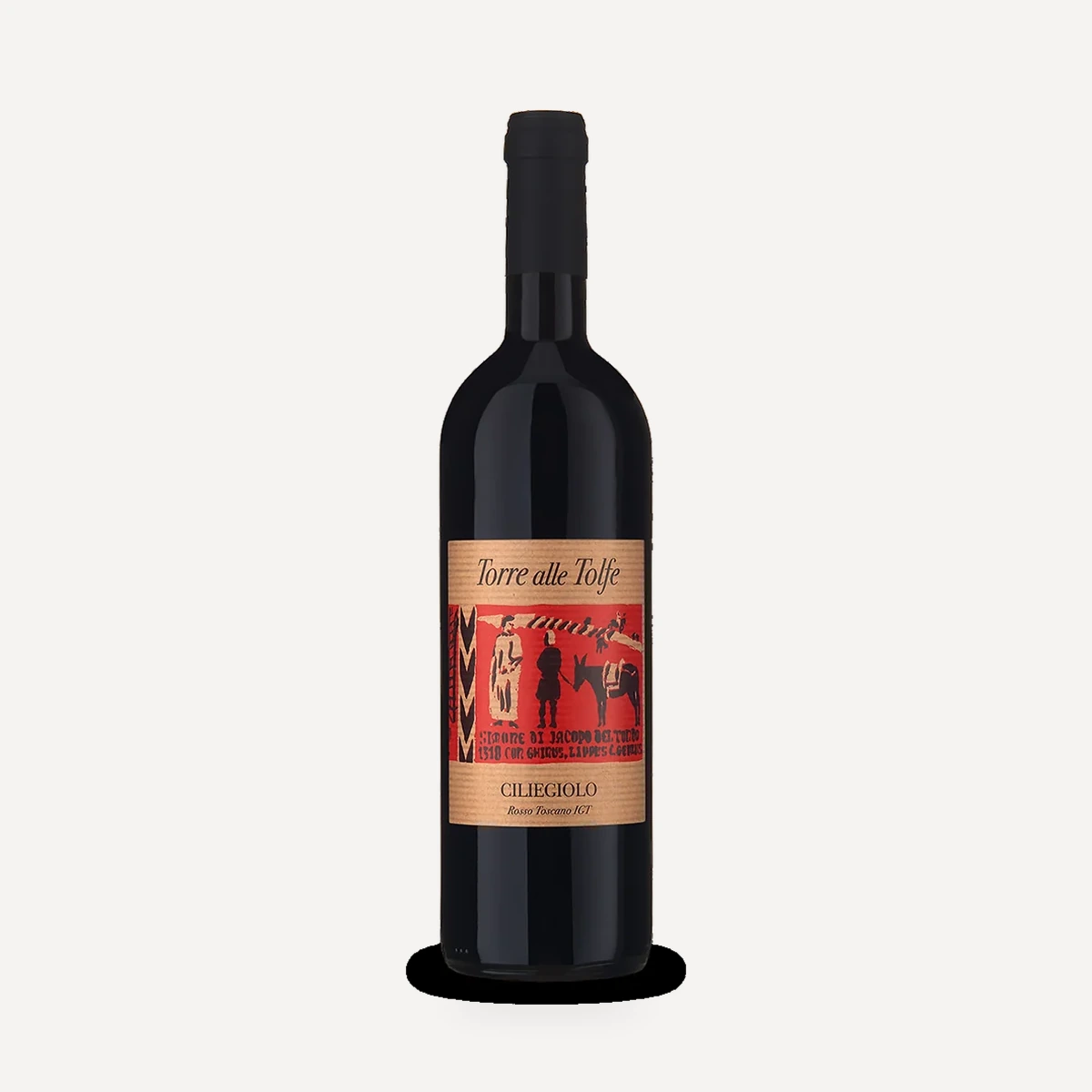
The Castelli family’s connection with the property began in the 1950s, when Luigi Castelli and his wife, Lunella, acquired the villa, the surrounding buildings and the adjoining land. The family collection, architecture and art remain woven into the restored borgo; a painted frieze by Marco Castelli recounts episodes from the history of Le Tolfe and later supplied the imagery for six wine labels introduced in 2019.
Organic farming and a new generation
The diversified estate adopted organic management in 2001, while the vineyards and olive groves have held organic certification since 2004. In 2015, fourth-generation Mania Castelli returned to the property with her family to direct its farming and broader operations. She also began opening the estate to visitors through guest accommodation, tastings and a restaurant.
On returning, Mania found that organic compliance alone had not restored soils depleted of nutrients, ground cover and microbial life. The vineyards were vulnerable to summer drought and winter erosion. This prompted a transition toward regenerative agriculture, with soil rehabilitation, biodiversity and resilience to climate change becoming central priorities.
In 2017, agronomist Stefano Amadeo began annual analyses of soil health and plant, animal and insect diversity. The work developed into detailed monitoring of individual vineyards, their organic fertility and their microbial biomass. It also supplied the foundation for the estate’s later biodiversity certification.
Cellar renewal and “Chianti, Deconstructed”
In 2018, the estate returned to 100% spontaneous fermentation, linking cellar practice to the microbial diversity being cultivated in the vineyards. The same year marked the adoption of the “Chianti, Deconstructed” approach: Sangiovese, Canaiolo, Ciliegiolo and Colorino were vinified separately so that each traditional variety, the soils and the conditions of each harvest could be followed independently. Custom Italian chestnut barrels were also commissioned for the Riserva, reviving a regional material historically used for wine.
The 2019 season brought six new labels based on Marco Castelli’s historical frieze. Ciliegiolo and Canaiolo were made as monovarietal wines, while work continued on Colorino and a Sangiovese rosato refermented on its lees. The estate’s restaurant opened to resident guests and the public, the vegetable garden returned to production, and the villa began accepting room-by-room reservations in addition to whole-property rentals.
In 2020, the 2018 Chianti Colli Senesi Riserva became the first estate Riserva bottled after maturation in the commissioned chestnut barrels. Colorino was bottled for the first time after ageing had softened its rustic structure. The year also brought the return of Mania’s brother Giotto and his partner Emanuela from the United Kingdom to assist Mania and Mark Spalding with estate management.
Regenerative expansion and current winemaking team
Teresa Castellani joined in 2022 as assistant winemaker after gaining vineyard and cellar experience in Piemonte, California, Australia and France. In 2023, Sascha Osterle joined to broaden regenerative work in both vineyards and olive groves. The expanded programme introduced cultured indigenous microorganisms, estate-made compost and compost teas, more diverse cover crops and rational, multispecies grazing among the vines. The vineyards and olive groves received Diversity Ark certification in the same year, following monitoring work begun in 2017.
In 2025, Teresa Castellani assumed the lead winemaking role, strengthening the operational connection between vineyard management and cellar decisions while continuing the estate’s monovarietal-focused programme.
Terroir
The estate occupies rolling hills immediately outside Siena, extending toward the heart of Chianti. Its hilltop vineyards stand at approximately 330 metres above sea level and look toward Siena and the surrounding Tuscan countryside.
Between three and five million years ago, during the Pliocene epoch, the land formed part of an ancient shoreline. Although the property now lies more than 60 kilometres from the coast, its sandy soils retain oyster shells, other marine fossils and rounded pebbles shaped by wave action. These freely draining marine soils and the elevated position are associated with the saline, fresh profile sought in the wines.
Drainage is both an asset and a farming constraint. The soils can lose water during the height of the summer dry season, while heavy winter rain can cause erosion. Lower vineyard areas may collect early-morning mist and can also be more exposed to frost. The contrast between drought stress and erosive winter rainfall was a principal reason for adopting permanent ground cover and wider regenerative soil management.
Detailed monitoring of individual vineyards is gradually building a map of the estate’s micro-terroirs, including differences in organic fertility and microbial biomass.
Vinificazione
The property is managed as a diversified certified-organic farm without pesticides or intensive agrochemicals. Organic management began across the estate in 2001, and the vineyards have been certified organic since 2004.
Regenerative work developed in response to soils depleted of nutrients, protective vegetation and microbiology. Annual assessment began in 2017, covering soil condition and the diversity of plants, animals and insects. Individual-vineyard studies now track organic fertility and microbial biomass, allowing management to respond to the strengths and weaknesses of each site. Diversity Ark certification, obtained in 2023, evaluates insects, plant communities and soil health in both vineyards and olive groves.
Soil-building measures include targeted organic manure, permanent grass cover, nitrogen-fixing green manures, diversified cover-crop mixtures, homemade compost and compost teas. Active indigenous microorganisms are cultured and applied, while rational grazing by multiple animal species brings livestock into the vineyard system. Some leguminous cover crops are allowed to self-seed, reducing the need for mechanical intervention and reseeding. Permanent cover is also used to control erosion.
Canopy and crop work is carried out manually and vineyard by vineyard. Shoots are guided around support wires instead of being topped, respecting the plant’s natural growth cycle and avoiding unnecessary stress. Teams manage shoot choice, bunch positioning and vine development by hand. Cluster selection is adjusted to the balance and ripening pattern of each vineyard.
Harvesting is selective and manual. Timing may be adjusted within individual vineyards to accommodate differences in ripeness and changing weather. Grapes are picked only when dry where possible. Mating disruption has been used successfully against grapevine moth, while protective nets have been employed against wildlife, although wild boar, badgers, foxes and roe deer have still reached parts of the vineyards.
The estate treats the vineyards as ecosystems rather than isolated crops. Increasing organic matter, structural stability, native plant diversity, insects, animals and microbial life is intended to improve resilience to drought, erosion and the growing climatic variability observed across recent seasons.
The cellar follows a low-intervention programme conceived as a continuation of the work in the vineyards. Selectively hand-harvested grapes undergo spontaneous fermentation, a practice applied to the entire range since 2018. Fermentations take place in vitrified cement vats or stainless-steel tanks without direct temperature control.
Sangiovese, Canaiolo, Ciliegiolo and Colorino are vinified separately. This “Chianti, Deconstructed” approach, adopted in 2018, makes it possible to observe each traditional variety independently and then follow how the soil and conditions of a particular harvest shape it. The programme supports both monovarietal bottlings and the estate’s Chianti wines.
Technology and chemical additives are kept to a minimum to avoid standardising the wines. Tight filtration is avoided where possible because it is considered capable of diminishing the expression of fruit, soil and vine. Wood is used sparingly: selected wines mature in neutral oak tonneaux, while Chianti Colli Senesi Riserva is aged in custom handmade Italian chestnut barrels. The chestnut was selected as a revival of an older regional winemaking tradition.
The chestnut-barrel programme began with vessels commissioned in 2018 from third-generation cooper Signor Sannibale, who selected and harvested the wood himself. The 2018 Riserva, bottled in 2020, was the first estate Riserva matured in these barrels.
The 2019 fermentations began rapidly but slowed toward completion, allowing malolactic fermentation to overlap with the final phase of alcoholic fermentation. The cellar responded with closer monitoring to keep volatile acidity controlled. In 2020, differences between grapes harvested before and after cooler nights and intermittent rain provided contrasting lots for blending: earlier vats showed the fuller fruit, alcohol and firmer tannins of a hot season, while later vats offered lower potential alcohol, floral and spicy notes and finer tannins.
Filosofia
Torre Alle Tolfe links its regenerative agriculture and low-intervention cellar work to three priorities: its long documented history of winemaking, the distinct character of traditional Tuscan varieties grown in marine-derived soils, and the need to make the farm more resilient in the face of climate change.
The estate’s farming philosophy begins with soil rehabilitation. Its objective is to return more nutrients, structure and microbiological life than agriculture removes. Vineyards are managed as ecosystems whose native plants, insects, animals and microorganisms are integral to long-term productivity.
In the cellar, intervention is deliberately limited. Excessive technology, additives and restrictive filtration are regarded as forces that can standardise wine and obscure differences among varieties, soils and harvests. Separate vinification and spontaneous fermentation are intended to let those differences remain perceptible.
Across the wider property, the Castelli family’s stated goal is to allow the landscape to flourish both culturally and naturally, carrying traditional values into a sustainable future for succeeding generations. Hospitality, food production, livestock, vineyards, olive groves and woodland are treated as interconnected parts of a living agricultural estate.
Vini
Chianti Colli Senesi DOCG