History
The castle and the recognition of Pomino
Castello Pomino traces its estate history to 1500, when the castle from which it takes its name was built in the Florentine mountains.
In 1716, Grand Duke Cosimo III de’ Medici identified Pomino as one of the four Tuscan territories most suited to the production of quality wine, together with Chianti, Carmignano and Val d’Arno di Sopra. The grand-ducal notice is regarded as a precursor of the modern controlled designation system.
Leonia and the nineteenth-century transformation
In 1855, Leonia, a Frescobaldi family ancestor, returned from an extended stay near Champagne and planted French varieties at Pomino. Chardonnay and Pinot Nero are specifically associated with these plantings. She vinified the grapes in what is described as Italy’s first gravity-fed cellar, establishing a combination of imported varieties and technically innovative winemaking that would shape the estate’s later identity.
Pomino’s wines received awards at the 1873 Vienna World’s Fair. At the 1878 Paris World’s Fair, they were awarded a gold medal, then the highest level of international recognition cited for the estate. Experiments continued after the Paris award and probably included early trials in traditional-method sparkling-wine production.
Benefizio and white-wine innovation
In 1973, the estate created the Benefizio cru from Chardonnay grown at approximately 700 metres. It became the first Italian white wine to be both fermented and aged in barriques. The project connected Leonia’s nineteenth-century Chardonnay plantings with a modern approach to barrel-fermented white wine.
From the 2005 vintage, the wine became Benefizio Riserva. The 2023 vintage marked 50 years since its creation.
Renewing Leonia’s work
More than a century after Leonia’s experiments, Lamberto Frescobaldi continued her work by creating Metodo Classico Leonia in her honour. The project developed both white and rosé traditional-method expressions from the high-altitude varieties historically associated with Pomino.
Twenty-first-century stewardship
The estate forms part of the Frescobaldi family’s 30th-generation management. Since 2012, the family estates have held the Regione Toscana’s AgriQualità certification for Integrated Production and Sustainable Agriculture. Castello Pomino and Castello Nipozzano were also the first estates in Toscana to receive PEFC certification for sustainable forest management.
Terroir
Castello Pomino lies in the Florentine mountains around Pomino and Rufina, near the first slopes of the Apennines. The vineyards climb from approximately 450 to 730 metres, although individual sites occupy narrower elevation bands. The landscape changes from the familiar hills and cypresses of Toscana to steep slopes, high-altitude vineyards and extensive woodland.
The estate is surrounded by chestnut trees, firs, ancient sequoias and conifer forest. Its hospitality area is immersed in the vineyards and woods of the National Park of the Foreste Casentinesi. Cooler summer temperatures and winter snow distinguish Pomino from lower Tuscan sites. The high vineyards combine strong luminosity with marked freshness, while stored soil moisture can sustain vine growth during hot, dry summers.
Soils vary across the estate. The broad Pomino Bianco source area was historically described as deep, slightly acidic brown soil with fine material over sandstone-and-marl substrates. Pinot Nero vineyards have been recorded on acidic sandy-silty soil. The Benefizio site is predominantly sandy, while the high late-harvest selection area was described as very deep, acidic and schistous. South and south-west exposures predominate.
The juxtaposition of exposed mountain vineyards and forest is especially clear at the 700-metre Leonia Éternelle and Benefizio sites, close to the conifer boundary on the lower Apennine slopes.
Winemaking
Viticulture follows the principles of Integrated Production and Sustainable Agriculture. Since 2012, the family estates have carried the Regione Toscana’s AgriQualità certification, which covers environmentally compatible agricultural techniques intended to protect the natural setting.
The vineyards are managed within a mountain-and-forest ecosystem. Castello Pomino and Castello Nipozzano were the first estates in Toscana to receive PEFC certification, guaranteeing sustainable management of their forests. Wood residues from certified forest management supply a pyrolysis system that produces renewable energy and an organic soil improver used for fertilisation.
Estate records document the use of sown green-manure plants to raise soil fertility. Their growth also helps maintain soil cover, while regular rather than violent rainfall can limit erosion. Vineyard work has included canopy management, abundant leaf removal where required, thinning and pruning to regulate concentration, and pest-management measures during seasons with elevated fungal pressure.
Harvest practices vary by intended production, but the high-altitude Chardonnay, Pinot Nero and traditional-method parcels are picked manually. Grapes for the sparkling-wine cellar are harvested into 15 kg crates during the coolest hours of the day. Benefizio Chardonnay is also hand-picked into crates with particular care.
Castello Pomino’s historic cellar was designed around gravity, allowing Leonia’s nineteenth-century grapes to be vinified in what is described as the first gravity-fed winery in Italy.
White-grape handling emphasises gentle extraction and protection from oxidation. Pomino Bianco grapes and musts are processed with oxygen contact reduced as far as possible, followed by soft pressing. Fermentation takes place mainly in temperature-controlled stainless steel, with a smaller part in French oak barriques, and the assembled wine receives further bottle maturation.
Benefizio follows a barrel-focused route developed at the estate in 1973. Hand-picked Chardonnay is softly pressed, and the clear juice is refined through cold settling. Fermentation takes place in French oak barriques, divided between new and previously used barrels; malolactic fermentation is only partial. Maturation continues in wood on the lees, with bâtonnage according to need, before bottle ageing. This made Benefizio the first Italian white wine fermented and aged in barriques.
Pinot Nero is fermented at controlled temperature in 60 hL truncated-conical oak vats. Manual punch-downs, particularly early in fermentation, regulate the extraction of anthocyanins and polyphenols. Maceration has lasted approximately two weeks in the current approach. Malolactic fermentation and subsequent maturation take place in French oak barriques, followed by bottle ageing.
For the Leonia traditional-method wines, hand-picked grapes arrive in 15 kg crates and undergo slow, delicate pressing. A 12-hour cold clarification precedes fermentation in temperature-controlled stainless steel, with a portion fermented in wood. Separate cuvées are blended, followed by tirage, secondary fermentation in bottle and extended maturation on the lees. Remuage brings the fine-lees deposit into the bottle neck; dégorgement removes it, and further bottle maturation completes the process. The rosé assemblage is carried out in March and receives several additional months in bottle before release.
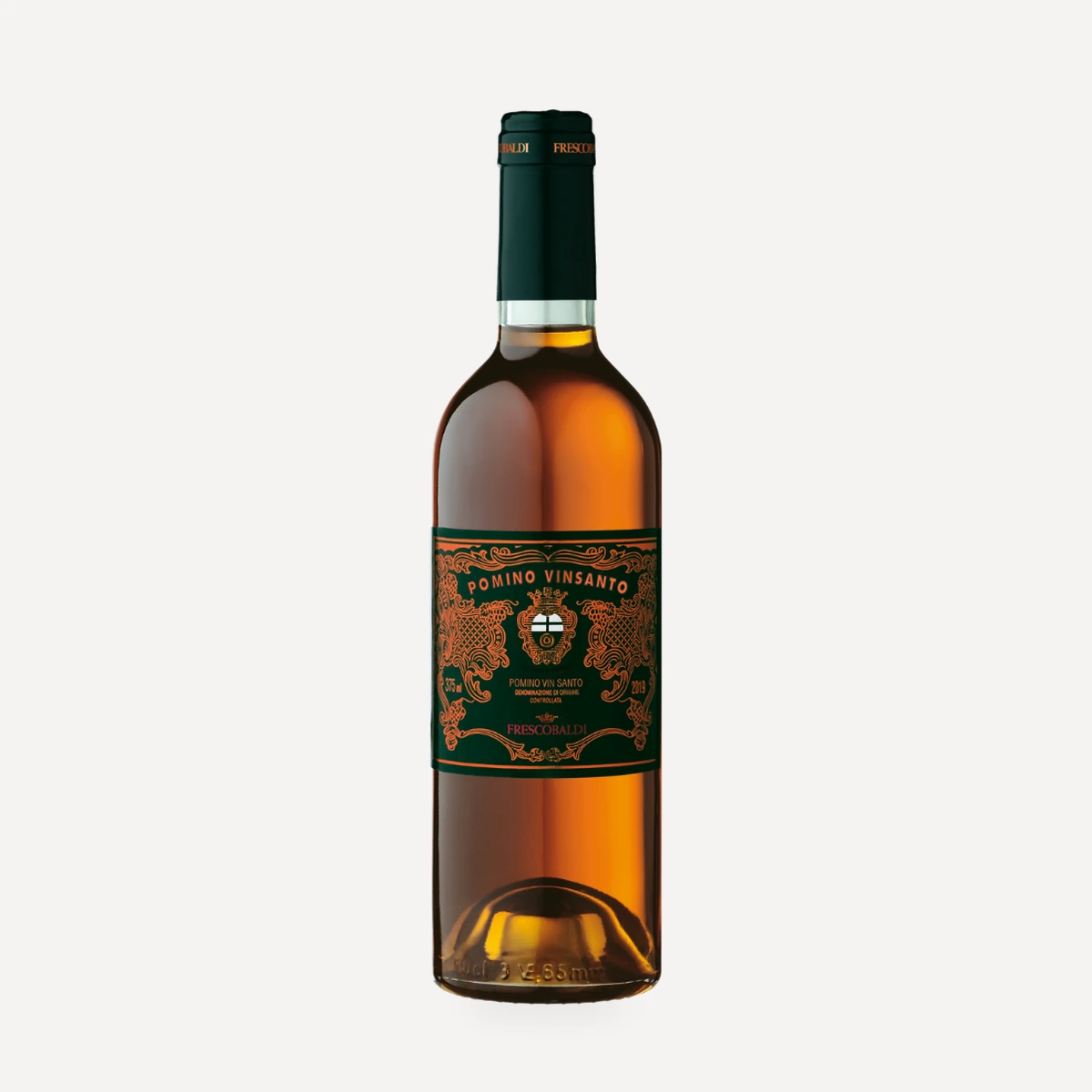
Vin Santo production retains a separate historical process. The selected grapes are hung on wooden racks in the vinsanteria from October and dry for several months. The wine then matures for seven years in small wooden vessels. The estate’s late-harvest white follows another pathway based on later-picked Chardonnay, Traminer Aromatico, Pinot Bianco and Pinot Grigio.
Philosophy
Castello Pomino’s identity is framed around high-altitude luminosity and minerality, interpreted with an emphasis on elegance. The vineyard landscape—steep mountain slopes enclosed by firs, sequoias, chestnuts and the Apennine forest—is treated as the defining context for its wines.
The Frescobaldi family’s stated objective is for each family estate to express the diversity of its own terroir while respecting its nature and authenticity. At Pomino, this principle joins tradition to technical experimentation: Leonia’s nineteenth-century introduction of French varieties and gravity-fed vinification, the creation of barrel-fermented Benefizio in 1973 and the later revival of traditional-method sparkling production all follow the same willingness to pursue new approaches without severing the estate’s historical continuity.
Environmental stewardship extends beyond the vines to the surrounding forest. Integrated and certified sustainable agriculture, PEFC forest management, renewable energy, lighter bottles and the reuse of forest residues are presented as parts of a long-term responsibility to pass the family’s estates to future generations.
Wines