Dionysus.
ExploreWines
🍾Bottle photo coming soon
WhiteIGT Toscana; some vintage sheets use IGT Bianco Toscana

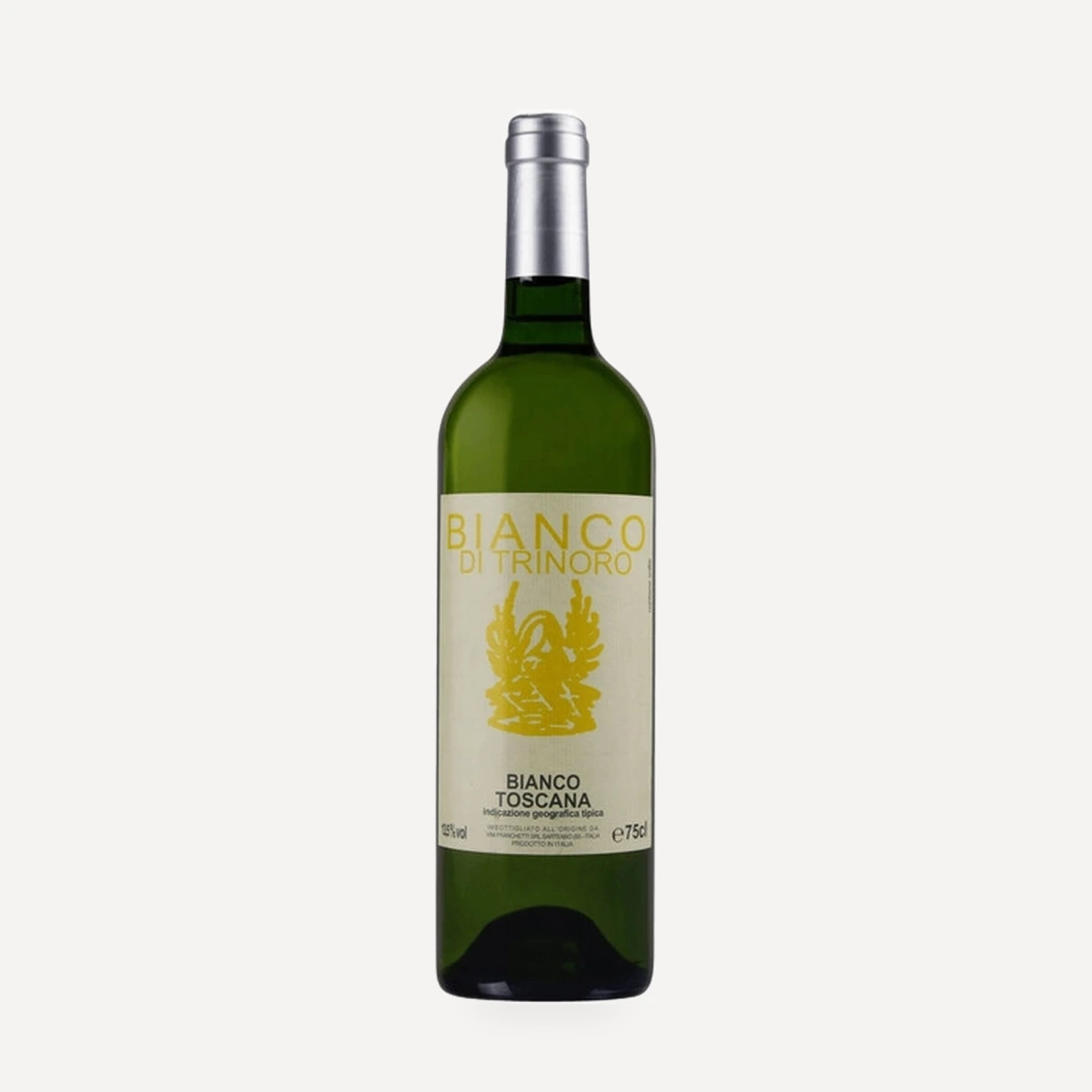
Bianco Trinoro

by di Trinoro · Tuscany, Italy

TypeWhite
AppellationIGT Toscana; some vintage sheets use IGT Bianco Toscana
Grapes100% Semillon
VineyardA single sandy parcel of approximately 0.5 ha in one of the highest parts of Tenuta di Trinoro; the main Italian page gives a precise area of 5,140 m². Surrounded by forest and planted with 5,000 vines from Bordeaux stock between 2001 and 2006.
LineTenuta di Trinoro
Vintages2017, 2018, 2019, 2021, 2022, 2023

About this wine

Vineyard and terroir

Bianco Trinoro comes from a single Semillon parcel near the highest part of Tenuta di Trinoro in Val d’Orcia, Tuscany, where the regions of Tuscany, Umbria and Lazio meet. The vineyard covers approximately 0.5 ha; its more precise stated measurement is 5,140 m². It lies at approximately 630 m above sea level, is surrounded by forest and enjoys a comparatively cool habitat. The soil is sandy and is described in the 2023 material as being dominated by pure sand.

The first section was planted in 2001 and the vineyard was completed in 2006 with Bordeaux vine material. It contains around 5,000 vines, planted at a density of 10,000 vines/ha with spacing of 1 m × 1 m. Recorded vineyard ages were 16 years in 2017, 17 years in 2018, 18 years in 2019 and 20 years in 2021.

Sheep manure was used for fertilization in 2017–2019; the 2021 material refers more generally to manure. Vineyard treatments recorded for 2017 and 2018 were clay, propolis and grapefruit-seed extract. Copper and sulphur were added to that list in 2019 and 2021. The 2019 specification also records a yield of 18 hl/ha, compared with 25 hl/ha in both 2017 and 2018. The 2021 yield was 30 q/ha.

Grapes

100% Semillon. The wine has been made intermittently since 2008, while 2017 became the first vintage released to the public.

Vinification

Vinification has evolved by vintage. In 2017 the whole clusters were pressed by hand in a small vertical press. The juice fermented in stainless steel for ten days at 22°C, was racked and transferred to glass demijohns. The 2018 whole clusters were also pressed before a ten-day stainless-steel fermentation. Both the 2019 and 2021 wines fermented in stainless steel for ten days.

The 2022 Semillon fermented for approximately ten days, divided between stainless-steel tanks and small oak casks. In 2023 the grapes were gently pressed and the must fermented in French-oak barriques for approximately ten days.

Ageing

The 2017 wine spent seven months on its lees in glass demijohns. It was bottled during the waning moon in July 2018 and held in bottle until the following February.

The 2018 remained on its lees in cement for one year, followed by eight months in bottle before release. The 2019 and 2021 wines also matured in cement tanks; the 2019 was bottled during the waning moon in February 2021, while the 2021 was bottled during the waning moon in July 2022.

The 2022 aged in concrete tanks, with several rackings used to remove fine lees, and was bottled during the waning moon in July 2023. The 2023 refined in cement tanks for nine months before bottling.

Technical data

The classification is given as IGT Toscana for 2022 and 2023 and as IGT Bianco Toscana in the 2019 and 2021 specifications.

Production was approximately 1,000 bottles in 2017, 2,100 in 2018, 2,446 in 2019, 1,789 in 2021, 1,660 in 2022 and 2,900 in 2023.

Tasting profile

Across vintages, Bianco Trinoro is an aromatic, ripe-fruited Semillon whose richness is balanced by freshness and acidity. This balance gives it substantial ageing potential.

The fully dry 2017 had a deep golden colour and a ripe golden-apple aroma accented by jasmine-like flowers. Its full body was cut by bright acidity, while the palate combined round, ripe texture with tension and a tightly knit structure. Published reviews additionally found stone and tropical fruit, pastry-like notes, butterscotch, peach and spice within a creamy texture.

The 2018 was crisp, dry and bracing, with energy and an unusually taut, nervous profile for Semillon.

The 2019 showed a smooth, silky and rich texture with sustained flavour. Its fruit profile included orchard fruit, pear, apricot and fleshy apple, followed by a mild mineral or crushed-stone note.

The 2021 had a pale golden colour and a crisp citrus profile, with tart and sour accents in its youth. Grapefruit, pear, quince and minerality accompanied a notably crunchy, textured quality. Further notes included sliced apple, lime, light mango and a nutty finish. It was medium- to full-bodied, tangy and fruit-led.

The hot 2022 season brought pronounced ripeness and explosive fruit while retaining the natural freshness of high-altitude Semillon. Citrus aromas were joined by ripe yellow-fleshed fruit. The palate was decisive, lively and persistent. Additional published notes described apricot, lemon curd and beeswax, a full body, elevated aromas and a waxy, texturally firm profile capable of further bottle development.

The 2023 is vertical in profile, with aromatic citrus and white-flower scents. Fresh, pronounced acidity drives an energetic palate and supports its capacity to age.

Vintage notes

2017. A drought year produced grapes with density and concentration. Harvest took place on 31 August. The Semillon retained a sweet-fruited character despite fermenting completely dry. Production was approximately 1,000 bottles, also expressed as 85 cases.

2018. Cooler and more regular conditions followed the torrid 2017 summer. By late August the clusters were larger than usual, relatively low in sweetness and unusually soft, while fruit and tannin maturity advanced earlier than normal. Cool, damp weather arrived as autumn approached. The Semillon was harvested on 13 September and whole-cluster pressed. Production reached 2,100 bottles.

2019. A cold spring included frost on 7 May, and more than 9,000 candles were lit in the lower vineyards to protect flowering. Prolonged cold delayed flowering, particularly for the early-ripening Semillon, and produced sparse clusters, small berries and thick skins. Extreme August heat temporarily stopped vine activity, followed by another temperature drop late in the month. The Semillon was hand-selected in three passes on 14, 18 and 26 September. Production was 2,446 bottles.

2021. February snow followed a very short winter. Warm March conditions advanced vine development by at least 15 days, but an easterly cold spell from 7 to 9 April required 4,000 frost candles. Record heat and an absence of rain followed. Irrigation and a severe green harvest helped the remaining clusters ripen, while foliage was retained to prevent sunburn. Cool air descending from Monte Amiata moderated the nights during a hot September. The half-hectare Semillon parcel was hand-harvested on 9 September. Production was 1,789 bottles.

2022. A severe, below-average winter prolonged dormancy. Budbreak was regular, and spring rain supported berry growth and cluster closure. The summer was extremely hot, but stored water and autumn fertilization helped prevent vine stress. Leaves were retained to shade the clusters, and green harvesting began early. Rain in mid-August changed the trajectory of the season. The Semillon was handpicked on the cold morning of 7 September. Production was 1,660 bottles.

2023. January snow gave way to a wet winter that restored water reserves. Warm March weather encouraged an early start before a cool spring slowed development. Weekly rain continued through May and early June, and 500 mm fell during spring and early summer. Summer arrived abruptly in late June and temperatures regularly exceeded 30°C through mid-September. A careful green harvest reduced the crop in late July, while foliage remained to shade the small clusters. The parcel was handpicked in two passes on 13 and 16 September. Thick skins reflected the intense summer heat, while the season's rain preserved generous, fresh pulp. Production reached 2,900 bottles, the largest stated volume among the vintages presented.