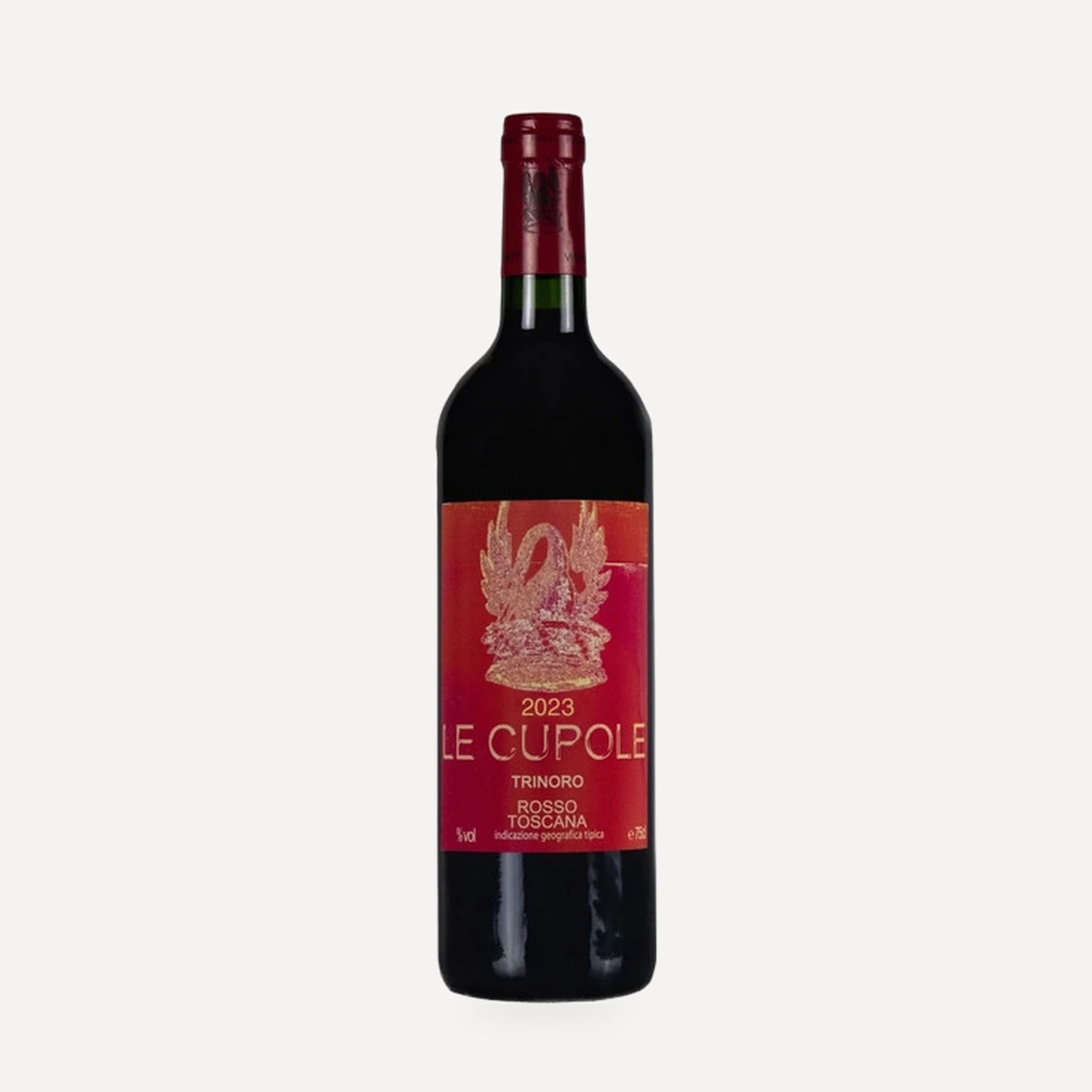
About this wine
Vineyard and terroir
Le Cupole is the second wine of Tenuta di Trinoro. Its fruit comes from younger vines rooted in deeper soils than those selected for the estate’s flagship wine. The vineyards lie at Tenuta di Trinoro in Val d’Orcia, near the meeting point of Tuscany, Umbria and Lazio. Recent sheets give an elevation of 450–600 m and a density of 10,000 vines per hectare; older records generally give 400–600 m. The 2017 vineyard area was 22 ha.
The work is highly parcel-specific. Forty-one parcels were brought to the cellar in 2023, 50 in 2022 and 45 in 2021. Earlier examples include 36 separate selections in 2011 and 2014, 40 in 2012, 32 in 2013, 54 in 2008–2009 and 52 in 2005. Manual selection is recorded for 2019–2021. Older vineyard treatments included clay, propolis, grapefruit-seed extract and copper, with sulphur also named in 2020–2021. Sheep manure was used in several vintages from 2015 onward; some earlier vintages received no fertilizer.
Grapes
The usual components are Merlot, Cabernet Franc, Cabernet Sauvignon and Petit Verdot, with the proportions adjusted to the vintage. The 2023 blend is 41% Merlot, 39% Cabernet Franc, 14% Cabernet Sauvignon and 6% Petit Verdot. Merlot contributes plush, silky texture, while Cabernet Franc supplies vibrant fragrance. The 2005 composition was exceptional in also containing 4% Cesanese d’Affile and 2% Uva di Troia.
Vinification
Current production ferments each parcel in stainless-steel tanks for 10–15 days at controlled temperature. Detailed records for 2008–2012 describe complete destemming, automatic selection of individual berries by density in a sugar solution and fermentation in 40-hl steel tanks. Those lots remained on the lees for three days before separation from the skins and received two pump-overs and three cap-submersions daily. In 2005, fermentation lasted ten days with one or two pump-overs and three or four punchdowns per day.
For 2008–2012, one-third of the malolactic fermentation occurred in contact with the skins before racking and two-thirds in second-, third- and fourth-use French-oak barriques. In 2005 it occurred spontaneously in spring.
Ageing
The 2022 and 2023 parcels spent eight months in 225-litre barriques of different ages. The final blend was then assembled in concrete and refined for another 12 months. The broader house description refers to one- to three-year-old barriques, while the Italian overview specifies second- and third-use barrels. Older vintages generally spent eight months in used French-oak barriques followed by ten or eleven months in concrete. The 2008–2010 wines were bottled without filtration.
Technical data
IGT Toscana; several sheets use the fuller designation IGT Rosso Toscana. The latest published composition is 41% Merlot, 39% Cabernet Franc, 14% Cabernet Sauvignon and 6% Petit Verdot for 2023. Planting density is 10,000 vines/ha. Production varied substantially, from 47,000 bottles in 2013 to 100,000 in 2021. Bottling dates were frequently chosen during the waning moon: March 2023 for the 2021 wine, March 2022 for 2020, March 2021 for 2019, March 2020 for 2018, February 2019 for 2017, April 2018 for 2016, March 2017 for 2015 and May 2015 for 2013.
Tasting profile
Le Cupole combines a rich colour with fleshy, bright fruit and extracted yet soft tannins. It is velvety, immediately approachable and marked by balsamic aromas. The 2022 is exuberant and open, with crisp fruit and Mediterranean balsamic notes. Its shape is slender and vertical, the tannins gentle, and the finish savoury and fresh. Bottle ageing is expected to add balance and elegance. The 2023 wines are described as explosive and exuberant, with Merlot bringing silky breadth and Cabernet Franc a vivid aromatic lift.
Published vintage reviews add further distinctions. The 2020 shows very ripe dark cherry, plum, espresso, incense and chocolate, alongside black fruit, spice and leather. The 2017 is dark and concentrated yet energetic, with ripe fruit and subdued, velvety tannins. The 2015 brings black cherry, sweet spice and earthy, tarry notes with a rich texture. The 2014 combines cherry, mulberry, herbs, sweet spice and firm tannins, with other notes of dark fruit, spice and tobacco. The 2011 is expansive and generous, with raspberry preserve, pomegranate, clove and new leather. The 2009 is bright ruby with violet tones, blackberry, cassis and wild raspberry, a full tannic palate and a savoury, persistent finish. The 2007 is perfumed and silky, finishing long and polished.
Vintage notes
2023. A wet winter and 500 mm of spring and early-summer rain replenished the ground but created heavy downy-mildew pressure. Heat arrived at the end of June and continued into September. A late-July green harvest reduced the crop while leaves were retained to shade the bunches. Merlot began on 18 September; Cabernet Franc followed on 4–6 October, Petit Verdot on 17 October and Cabernet Sauvignon on 19 October. Morning teams began before sunrise to work in cooler conditions. Forty-one parcels were harvested, with good yields despite the difficult season. The blend is 41% Merlot, 39% Cabernet Franc, 14% Cabernet Sauvignon and 6% Petit Verdot.
2022. One of the driest recent seasons followed the already arid 2021. Canopy management and thinning reduced stress on the vines. Heavy September rain slowed what had initially appeared to be an early harvest. Merlot arrived at the end of September, followed by Cabernet Franc; Cabernet Sauvignon and Petit Verdot reached maturity in early October. Fifty parcels were kept separate. The wine is 57% Merlot, 26% Cabernet Franc, 11% Cabernet Sauvignon and 6% Petit Verdot, fermented for 10–15 days and aged for eight months in 225-litre barriques plus 12 months in concrete.
2021. February snow was followed by damaging cold from 7 to 9 April, when 4,000 frost candles protected the vineyards. Record heat and drought necessitated irrigation, severe thinning and a deliberately wild canopy to shade the grapes. Rain on 17 September revived the Merlot, harvested 21–24 September. Cabernet Franc was gathered on 12, 14 and 16 October; the later Cabernet Sauvignon and Petit Verdot followed on 16 and 21 October. The resulting wine has firm tannins, lively aromas and a dense yet energetic, fresh body. The blend is 56% Merlot, 26% Cabernet Franc, 11% Cabernet Sauvignon and 7% Petit Verdot. Vines were 28–30 years old, yield was 50 q/ha, and production reached 100,000 bottles.
2020. A warm southerly wind began to shrivel some bunches before rain and cooler conditions ended summer. Merlot picking extended from 18 September into early October, with Cabernet Franc ripening rapidly around 8–10 October as the teams moved higher up the slope. Fruit was separated by parcel in the cellar. The blend is 49% Merlot, 36% Cabernet Franc, 12% Cabernet Sauvignon and 3% Petit Verdot. Vines were 25–28 years old; yield was 50 q/ha. The wine was bottled during the waning moon in March 2022.
2019. Frost on 7 May required more than 9,000 candles at Campo di Magnacosta. Small berries and tough skins followed, with late harvests for Cabernet Sauvignon and Petit Verdot on 23–24 October. The season produced a fresher, less dense style. The blend is 47% Merlot, 30% Cabernet Franc, 15% Cabernet Sauvignon and 8% Petit Verdot. Vines were 25–27 years old, yield was 50 q/ha, fermentation lasted 12–15 days in steel, and maturation used one- to three-year-old French barriques followed by concrete.
2018. Cooler conditions advanced fruit and tannin maturity, while the unusually large bunches were challenged by a sudden cold wind before rain and sun restored ripeness. The blend is 40% Cabernet Franc, 37% Merlot, 13% Cabernet Sauvignon and 10% Petit Verdot. Vines were 25–27 years old; yield was 50 q/ha. Fermentation lasted 12 days in steel, followed by one- to three-year-old French barriques and concrete. Production was 70,000 bottles.
2017. A dry winter, spring frost and three months of daytime temperatures reaching 40°C produced tiny, thick-skinned berries and dark, concentrated wines. Merlot was picked 1–15 September, Cabernet Franc from 15 September to 13 October, Cabernet Sauvignon from 23 September to 24 October and Petit Verdot from 17 to 23 October. The blend is 60% Merlot, 17% Cabernet Sauvignon, 16% Cabernet Franc and 7% Petit Verdot. Fermentation lasted 12 days in steel, followed by eight months in French oak and 11 months in concrete. Production was 69,226 bottles.
2016. The blend is 42% Cabernet Franc, 40% Merlot, 14% Cabernet Sauvignon and 4% Petit Verdot. Vines were 23–25 years old and yield was 50 q/ha. Fermentation lasted 12 days in steel; ageing comprised eight months in one- to three-year-old French barriques and 11 months in concrete. Production was 58,100 bottles.
2015. A hot early season gave way to cool ripening from August through October with intermittent light rain. Cabernet Franc dominated the blend at 58%, with 32% Merlot, 6% Cabernet Sauvignon and 4% Petit Verdot. Vines were 23–25 years old and yield was 50 q/ha. The wine fermented for 12 days in steel and aged for eight months in one- to three-year-old French barriques plus 11 months in concrete. Production was 57,000 bottles.
2014. Warm rain in winter brought early budbreak and flowering. One-third of the crop was dropped, and repeated rain required intensive vineyard work. Thirty-six selections were harvested from 29 September to 28 October. The blend is 48% Merlot, 42% Cabernet Franc and 10% Cabernet Sauvignon. Production was 55,500 bottles.
2013. Thirty-two separate selections were harvested from 28 September to 27 October. The blend is 62% Cabernet Franc, 24% Merlot, 8% Cabernet Sauvignon and 6% Petit Verdot. Vines were 21–23 years old, yield was 50 q/ha, and fermentation lasted 12 days in steel. Ageing comprised eight months in one- to three-year-old French barriques and 11 months in concrete. Production was 47,000 bottles.
2012. Following a second rainless winter, the vines developed slowly. Harvest began on 28 September and comprised 40 separate selections. The blend is 55% Cabernet Franc, 27% Merlot, 17% Cabernet Sauvignon and 1% Petit Verdot. The wine aged for eight months in second- to fourth-use French oak and ten months in concrete. Production was 55,000 bottles.
2011. Heat and drought caused some Merlot to shrivel, and damaged fruit was repeatedly removed. Picking began on 5 October. A mid-October storm cooled the vineyards and refreshed Cabernet Franc before the late-month harvest. Thirty-six lots were vinified. The blend is 66% Cabernet Franc, 20% Merlot, 7% Cabernet Sauvignon and 7% Petit Verdot. Production was 70,000 bottles.
2010. The blend is 45% Cabernet Franc, 35% Merlot, 15% Cabernet Sauvignon and 5% Petit Verdot. Vines were 21 years old and yield was 30 Hl/ha. The wine underwent complete destemming and berry selection, followed by fermentation in 40-hl steel tanks, eight months in second- to fourth-use French oak and ten months in concrete without filtration. Production was 75,000 bottles.
2009. The blend is 40% Cabernet Franc, 30% Merlot, 20% Cabernet Sauvignon and 10% Petit Verdot. Fifty-four lots were separately harvested and vinified. Production was 75,000 bottles after eight months in second- to fourth-use French oak and ten months in concrete, without filtration.
2008. The blend is 45% Cabernet Franc, 25% Merlot, 25% Cabernet Sauvignon and 5% Petit Verdot. Fifty-four separate selections were completely destemmed and individually sorted. The wine spent eight months in second- to fourth-use French oak and ten months in concrete and was not filtered. Production was 80,000 bottles.
2007. A dry winter suggested an early harvest, but picking was delayed: Merlot came in after September, Cabernet Franc on 16–19 October, and Cabernet Sauvignon and Petit Verdot at the end of the month. The blend is 40% Cabernet Franc, 30% Merlot, 22% Cabernet Sauvignon and 8% Petit Verdot. The wine continued fermenting in barriques after separation from the skins. It spent eight months in second- to fourth-use French oak and ten months in concrete. Production was 85,000 bottles.
2006. Mild conditions prolonged maturation into late autumn. The clay soils and cool finish retained freshness and acidity. The published components are 47% Cabernet Franc, 32% Merlot, 13.5% Cabernet Sauvignon and 9.5% Petit Verdot. The wine aged for eight months in French barriques and ten months in concrete. Production was 96,000 bottles.
2005. October rain interrupted the season, but early-ripening Merlot and Cabernet Franc formed the core of the wine. Fifty-two separate picks began at the end of September and continued through November. The blend is 47% Cabernet Franc, 32% Merlot, 12% Cabernet Sauvignon, 3% Petit Verdot, 4% Cesanese d’Affile and 2% Uva di Troia. The wine spent eight months in used French oak and ten months in concrete. Production was 70,000 bottles.
Label / history
First produced in 1995, Le Cupole is the estate’s second wine. It is intended to retain the character of Tenuta di Trinoro while remaining velvety and approachable upon release.