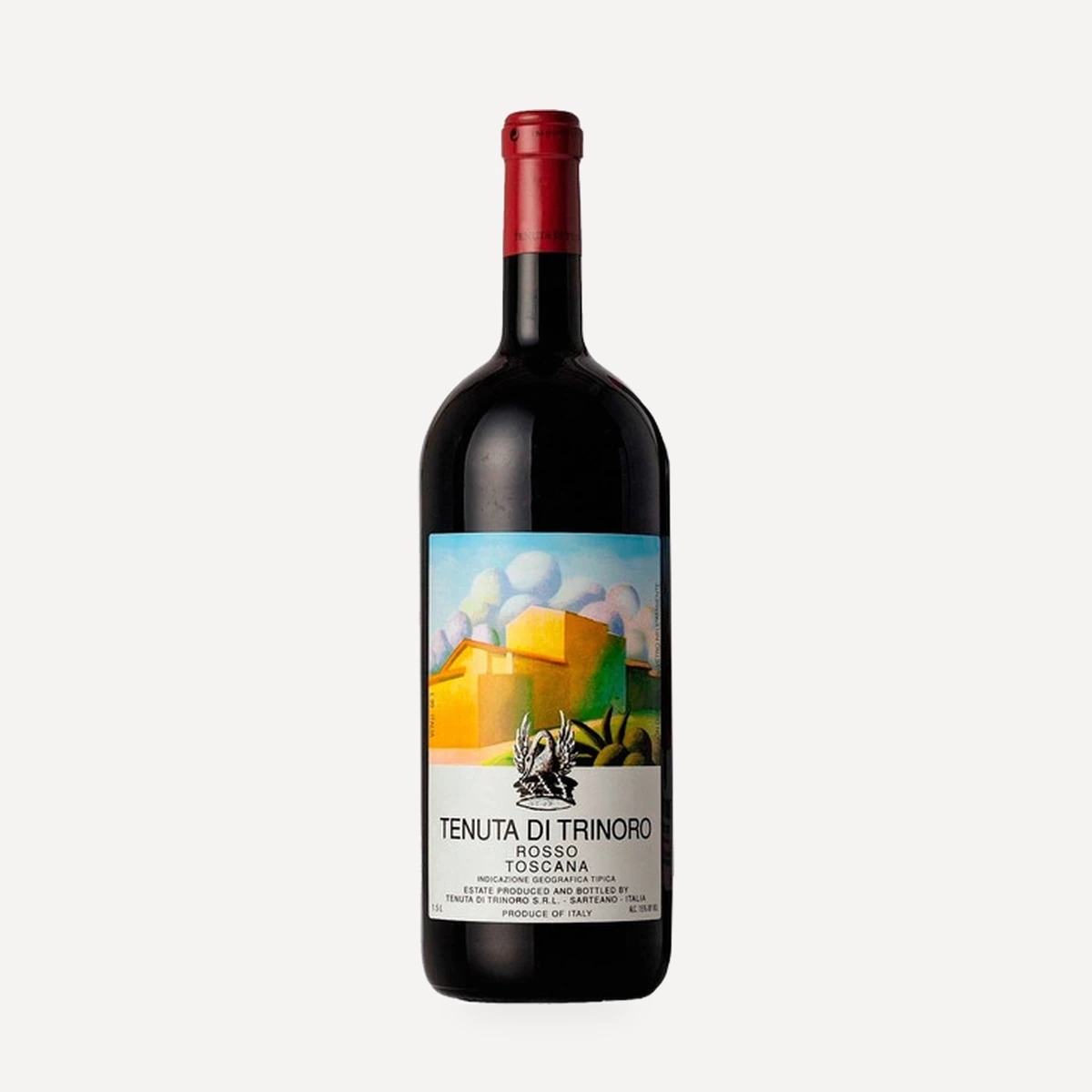
About this wine
Vineyard and terroir
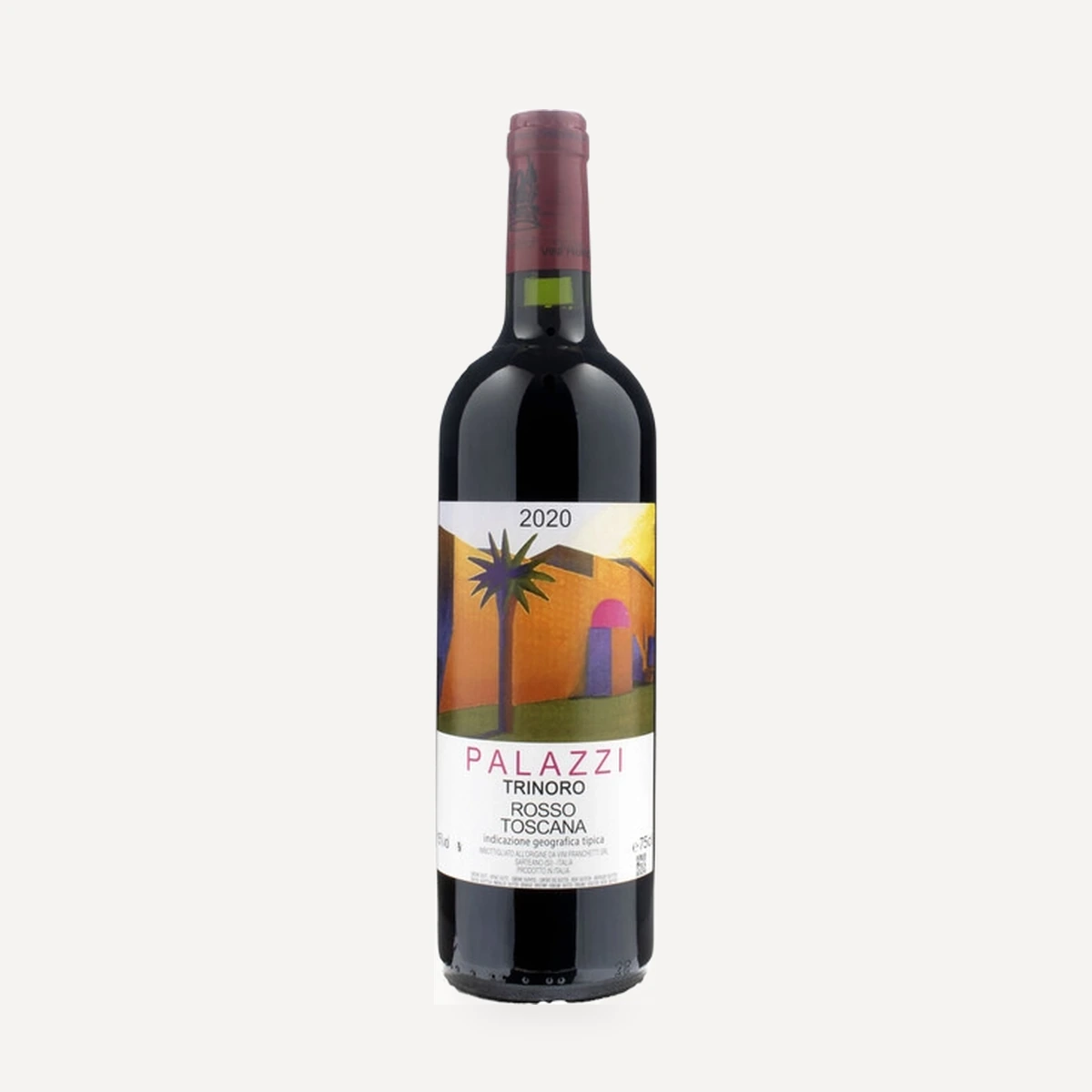
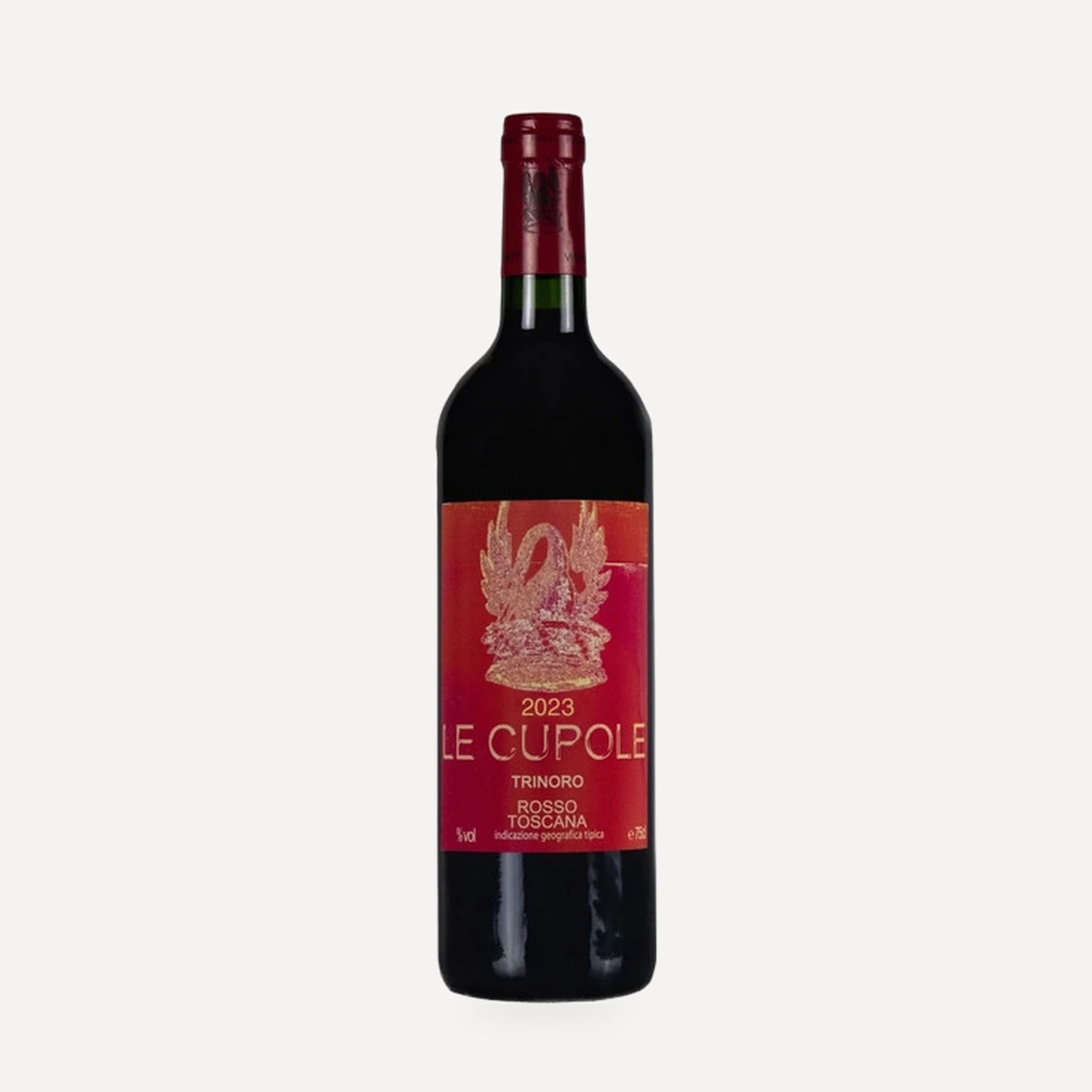
Tenuta di Trinoro is the estate’s Premier Vin and flagship red. Its composition is determined anew after tasting the best lots of each harvest. Cabernet Franc, Merlot, Cabernet Sauvignon and Petit Verdot are drawn from selected parcels in the Val d’Orcia near Sarteano, where vineyards occupy high hills on limestone, clay and alluvial formations. The leanest sites contain clay mixed with limestone-rock debris; some high parcels have thin, hard soils rich in quartz and limestone.
The vineyards are normally described at 450–600 m above sea level and are planted at 10,000 vines per hectare in a 1 m × 1 m pattern. Vines represented in recent editions ranged from 25 years old in 2016–2017 to 29 years in 2021. Earlier records give 20 years for 2009–2012 and 10–15 years for 2007–2008.
Parcel separation is central to the wine. Forty-five lots entered the cellar in 2021 and 50 in 2022. Earlier editions also document the progressive selection of individual vats and parcels: the 2009 blend combined 15 wines from about 5 hectares, while the 2020 blend was narrowed to four Cabernet Franc vats and two Merlot vats.
Grapes
The blend changes with the character of the year. All four varieties returned in 2022, in a symmetrical core of 44% Cabernet Franc and 44% Merlot, completed by 6% Cabernet Sauvignon and 6% Petit Verdot. The 2021, 2020, 2019 and 2018 editions relied only on Cabernet Franc and Merlot. Cabernet Franc dominated 2020 at 92%, while Merlot led 2021 and 2019 at 60%.
The most Cabernet Sauvignon-led edition in the published sequence is 2012, with 66% Cabernet Sauvignon, 26% Cabernet Franc and 8% Petit Verdot. The 2011 wine moved in the opposite direction: 90% Cabernet Franc, 6% Cabernet Sauvignon and 4% Petit Verdot. Earlier four-variety blends include 2009, with equal 42% shares of Cabernet Franc and Merlot, and the technical composition for 2007 of 40% Cabernet Franc, 30% Merlot, 20% Cabernet Sauvignon and 10% Petit Verdot.
Vinification
The fruit is handled parcel by parcel in stainless steel. In 2022, the 50 hand-harvested parcels fermented for 10–15 days at controlled temperature. The 2019 wine also fermented for 10–15 days in steel. The 2018, 2017, 2015 and 2014 technical sheets specify separate vinification and 13 days of alcoholic fermentation; 2016 specifies 12 days and 2013 specifies 11 days.
The 2010 lots were run off their skins when fermentation finished, and selected vats underwent bleeding. In 2009, about one fifth of the weight was bled from newly filled vats. The 2007 and 2008 wines fermented for 12–16 days in 40 hL stainless-steel vats. Malolactic fermentation for those two vintages took place in new French-oak barriques. Some browned stems were added to selected 2012 vats.
Ageing
The 2022 wine spent 8 months in 225 L barriques of various passages and 12 months in concrete. The 2021 sequence was 8 months in French barriques and another 12 months in concrete. The 2019 wine spent 5 months in French oak and 1 year in concrete.
The technical regime for 2013–2018 was generally 8 months in new French-oak barriques followed by 11 months in concrete. The 2012 technical sheet gives 8 months in new French oak and 10 months in concrete. The 2009 and 2010 specifications also give 8 months in new French oak followed by 10 months in concrete; the 2010 barriques were made from well-seasoned, lightly toasted wood. In 2007 and 2008, malolactic fermentation and 6 months of maturation took place in new French-oak barriques before transfer to concrete.
The 2020 vintage inaugurated an additional 12 months of bottle maturation before release.
Technical data
Toscana IGT / Rosso Toscana IGT. Planting density is 10,000 vines/ha. Recorded yields range from 15 hL/ha in 2019 to 25 hL/ha in 2013–2018, 18 hL/ha in 2009–2012 and 21 hL/ha in 2007–2008. The only alcohol figure attached to a vintage on the wine pages is 15% vol. for 2020.
Recent production was 8,483 bottles in 2022, bottled during the waning moon in early March 2024; 8,590 bottles in 2021, bottled during the waning moon in May 2023; and 6,000 bottles in 2020. Published quantities for the earlier dedicated pages are 7,000 bottles in both 2018 and 2017, 6,000 in 2016, 8,400 in 2015, 4,200 in 2014, 7,200 in both 2013 and 2012, 5,800 in 2011, 8,400 in both 2010 and 2009, and 9,600 in both 2008 and 2007.
Tasting profile
The 2022 has fragrant red fruit that remains on the fresh side of ripeness. Its gentle, lively opening develops into a dynamic and savoury palate, with integrated tannins and a lightly spicy edge. The summer heat gave substance through thicker skins, while September rain restored energy, aroma and freshness.
The 2021 is powerful and enveloping, with dark fruit and graphite-like notes. It is dense and full on the palate, with sweet, compact tannins, concentration and persistence. Cabernet Franc brings crispness and length, while the cold harvest nights contribute freshness, verticality and an energetic profile suited to ageing.
The bright-coloured 2020 shows redcurrant and sour cherry with delicate floral, herbal and balsamic tones. Initial breadth and richness give way to a long, compact palate, soft but ageworthy tannins and a saline finish. The vintage’s structure, freshness and restrained ripeness distinguish it from more opulent editions.
The 2019 is comparatively streamlined and fresh, with black fruit, spice, tobacco, smoke and crushed-stone nuances, a velvety texture and a very long finish. The 2018 is fuller and more opulent, combining blackberry and dark cherry with spice, herbs and fine, persistent tannins. The 2017 is dark, concentrated and tightly woven, with blue fruit, iron, wild herbs and silky tannins. The 2016 sought lightness and floral lift through its near-equal Merlot and Cabernet Franc blend.
The 2015 is dark, rich and full-bodied, with ripe cherry and blackberry, violet, graphite, spice and tobacco over polished tannins. The cooler 2014 is more restrained and medium-bodied, showing dark blue fruit, flowers, lavender, chocolate and spice. The 2013 is linear and detailed, with blackberry, dried cherry, redcurrant, leather, spice and tobacco, plus the more pronounced acidity of a cool season.
The 2012 is dense, powerful and texturally deep, yet without hard edges. The 2011 is ripe, viscous and full-bodied, with bitter chocolate, espresso, blackberry, herbs, violet, mint and clove over broad tannins. The 2010 is a brighter, more understated vintage with cherry, plum, espresso, liquorice and fresh red-fruit character. The 2009 combines wild cherry, plum, spice, mineral and liquorice notes on a silky frame, with salinity, firm tannins and a long future. The 2008 is aromatic and bright, with layered fruit, violet, spice and mineral notes. The 2007 is dark and richly textured, with ripe fruit, leather, spice, grilled herbs and mineral tones supported by a firm structure.
Vintage notes
2022. One of the driest recent years followed the already arid 2021. Canopy management and severe crop thinning helped the vines ripen a small number of bunches. Heavy rain at the beginning of September slowed an apparently early harvest and brought freshness to a concentrated year. Merlot entered the cellar at the end of September, then Cabernet Franc; Cabernet Sauvignon and Petit Verdot achieved maturity in early October. All 50 parcels were hand-harvested separately.
2021. February snow was followed by freezing nights on 7–9 April, when 4,000 frost candles protected the buds. Record heat and drought led to irrigation, rigorous green harvesting and light trimming so foliage could shade the fruit. Rain on 17 September revived the vines and heightened Merlot aromatics. Merlot was picked on 21–24 September, Cabernet Franc on 4–7 October and the later varieties on 16–21 October. Yields were extremely low.
2020. Hot southerly winds caused some Merlot to shrivel before late-September rain broke the season and cooled the valley. Merlot was picked as the vineyards dried, followed by Cabernet Franc from the higher sites on 8–10 October. The finished blend came from four Cabernet Franc vats and two Merlot vats. Production was roughly half a normal year.
2019. A cold spring culminated in frost on 7 May; more than 9,000 candles were lit in the lower vineyards. August heat and a second late-summer cooling slowed maturation, producing small bunches and thick skins. Hand-selected Merlot was brought in on 25 September and 5 October, followed by Cabernet Franc on 17–18 October. The final wine is 60% Merlot and 40% Cabernet Franc.
2018. Late-spring rain helped the vines recover from 2017, while mixed summer weather and cool nights preserved balance. September was clear and dry; a cold spell and wind were followed by misting and then rain, enabling a long autumn hang time. Merlot was harvested on 16–21 September and Cabernet Franc on 10, 13 and 14 October.
2017. A dry winter, spring frost and three months with daytime peaks around 40°C caused severe water stress. The berries were tiny and dominated by skins and seeds. Selected parcels gave a dark, compact wine led by Cabernet Franc, with dense texture, silky tannins, blue fruit, iron and wild herbs.
2016. Rain repeatedly refreshed fruit affected by August heat. Merlot from Cavalli Nord was picked on 27 September, and Cabernet Franc from Camagi Nord and Sotto Cocceto on 10 October. Two Merlot vats and two Cabernet Franc vats formed the blend, seeking the vintage’s lightness and floral character.
2015. Heat was concentrated early in the season, while August through October became markedly cooler. Light, intermittent rain allowed an unhurried harvest of exceptional Merlot and diverse Cabernet Franc, followed by Cabernet Sauvignon and Petit Verdot at the end of October.
2014. A mild, rainy winter preceded early budding on 9 April and flowering from 15 May. Some parcels were harvested a record 140 days after flowering. Merlot was picked from 29 September through 8 October; Cabernet Franc followed on 10–12 October and again on 17, 18 and 21 October after heavy rain. Cabernet Sauvignon and Petit Verdot were harvested on 28 October.
2013. The growing season was calm and cloudy, with little rain and summer temperatures averaging about 26°C rather than the usual 36°C. Forty healthy, firm, relatively low-sugar pickings entered the cellar. Lots were kept on their lees for an extended period, and the final selection came from higher vineyards where bunches had hung longest.
2012. A second rainless winter and another hot summer left the vines conserving energy. Small berries, sparse foliage and low sugars developed slowly without the complete shutdown often caused by August heat. Merlot was harvested from 12 September to 3 October, Cabernet Franc on 12–21 October, and Cabernet Sauvignon and Petit Verdot on 22–23 October.
2011. Heat waves and drought caused part of the Merlot crop to shrivel. The fruit was picked in six passes, and remaining dried berries were removed by hand at sorting tables. A mid-October storm cooled the vineyards and revived Cabernet Franc. Fermentations proceeded very slowly, continuing to consume residual sugars into spring.
2010. Heavy winter rain and snow were followed by a late, wet spring and uneven flowering. The later varieties struggled, while patient harvesting yielded fresh, clear Merlot and Cabernet Franc. Some vats underwent bleeding; the wines were transferred from the skins to new barriques as soon as fermentation finished.
2009. Winter rain restored fertility after the lighter 2008 season. Part of the canopy was removed in late June, and the berries shrank without the vines shutting down. Approximately one fifth was bled from newly filled vats. Fifteen wines from about 5 hectares between 450 and 600 m formed the final blend.
2008. A wet winter and a cold, rainy spring produced uneven flowering and fruit set before a hot Val d’Orcia summer. The vines resisted stress through August but stalled in September. The resulting wine was unusually aromatic, bright, powerful and expansive.
2007. Winter drought depleted the water reserves, while irregular spring weather caused uneven flowering. Water was misted above the vineyards for a week from 15 September. The later varieties benefited from autumn dew and gave the best wines. Fermentation continued for months after the wine had been run into barriques, and the initially hard, impenetrable wine gradually gained breadth and fruit.
Label / history
Founder Andrea Franchetti acquired the estate in the 1980s and began planting in the early 1990s after studying the importance of terroir in Bordeaux. Suitable sites were reclaimed from scrub and planted densely with material from old Pomerol properties. Tenuta di Trinoro is presented as a proprietary, vintage-specific flagship rather than a wine made to a fixed formula: richness, structure, depth and complexity remain the stylistic constants while the varietal composition changes.