History
Agricultural roots in Impruneta
Fattoria Villa l’Olmo entered the Giannotti family in the mid-18th century, beginning a long agricultural tradition in Impruneta. Another account traces the family’s work with vines to 1787. The estate combined vineyards and olive groves, while Villa L’Olmo became both the family residence and an enduring historical and emotional landmark.
Toward the end of the 19th century, the fattoria installed its first olive mill. Oxen turned its stone grinders, oil was extracted with manual presses, and water was separated by natural settling in large terracotta basins. The traditional stone mill remains part of the property.
The Galleria Filtrante was carved into stone in the mid-19th century as an underground aqueduct for the natural purification of rainwater. It was later adapted as a maturation cellar whose naturally stable conditions—14°C and 95% humidity—require no artificial climate regulation.
2002–2004: creation of Diadema
Alberto Giannotti conceived Diadema as a meeting of Tuscan wine, visual art and meticulous craftsmanship. The first Diadema wine came from the 2002 vintage, while 2004 marks the formal birth of the project.
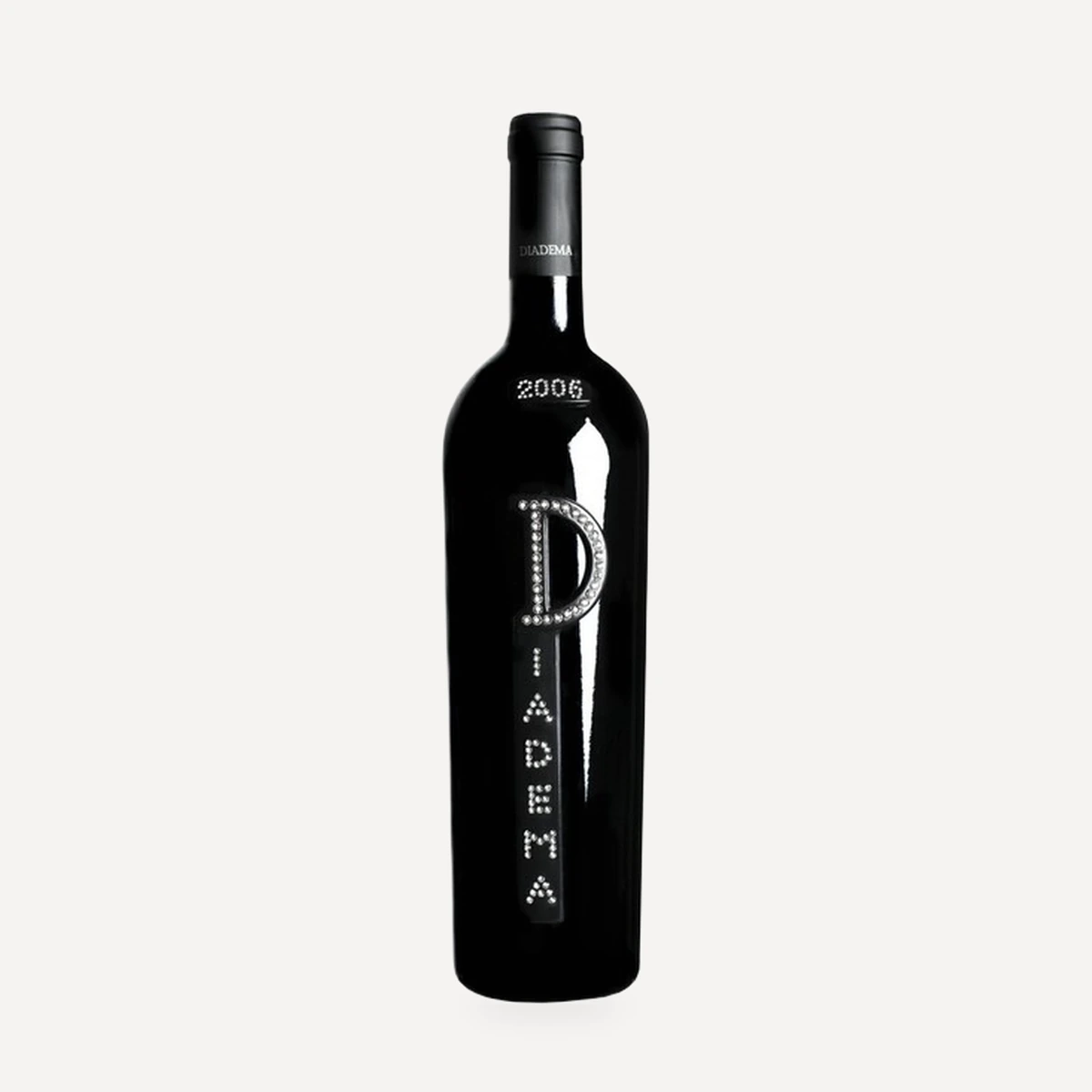
At the time, Alberto considered conventional paper labels—typically illustrated with villas, castles or vineyards—too uniform. His alternative was to make Swarovski® crystals integral to the label rather than simply attach them as decoration. Developing it required experimentation with suitable materials and collaboration with specialist artisans. The crystals continue to be set by hand by Florentine craftspeople, and a bottle is rejected if even one crystal is missing.
2007: first recognition
Five years after the first vintage, Diadema Rosso received its first awards and critical recognition. The achievement confirmed the direction of the project and the work carried out in the vineyard, cellar and finishing of each bottle.
2010: the Damare range
Diadema introduced Damare in Rosso, Bianco and Rosato versions. The IGT range was conceived as a more direct, accessible and youthful expression of Tuscany, focused on freshness, balance and immediate enjoyment.
Terracotta and the Candegli project
Candegli developed from a desire to revisit ancient winemaking practices associated with the Etruscans and reconnect the winery with its family and territorial origins. Its name preserves the traditional name of the Impruneta hill where the old fattoria stood and where Relais Villa L’Olmo, the winery and the historic stone olive mill are now located.
Diadema commissioned five individually designed, unglazed terracotta amphorae, each with a capacity of 6 hl. Their design drew on an 18th-century drawing, while production was entrusted to M.I.T.A.L., the oldest kiln still operating in Impruneta, run by the Mariani brothers. The project extended a local craft tradition documented through an artisans’ guild in 1308 and exemplified by Filippo Brunelleschi’s selection of Impruneta terracotta for the dome of Florence’s Cathedral of Santa Maria del Fiore in 1419.
2020: Giulia and Livia
In 2020, Alberto’s daughters Giulia and Livia took the Diadema project forward, combining their own ideas and vision with the legacy received from their father. Alberto continued to contribute his experience, while Francesco Bellini—associated with Diadema from its beginning—remained closely involved. The transition established the second generation of the Diadema project while preserving its family character.
Villa L’Olmo and the Galleria Filtrante
Diadema subsequently developed Villa L’Olmo as a tribute to the family residence, Impruneta and the Giannotti family’s local history. Following research into suitable maturation conditions and duration, 2,520 bottles were placed in the historic Galleria Filtrante for six months. Before entering the gallery, the wine matured for 18 months in French oak barriques and four months in terracotta amphorae. Villa L’Olmo became available in January 2025, with the family villa depicted on its label.
Continuing collaborations
The Diadema–Torrini limited edition arose from the lifelong friendship of Alberto Giannotti and Fabrizio Torrini. It brings together the Giannotti family’s agricultural and winemaking heritage with the Torrini family’s goldsmithing tradition, documented from 1369. Swarovski crystals touched with gold and a handcrafted bronze medallion bearing the date 1369 connect the two crafts in a single presentation.
Terroir
Diadema is based in Impruneta, among the Tuscan hills in the Chianti area. The family property encompasses historic vineyards and olive groves around the hill traditionally known as Candegli.
The varieties used for Diadema Rosso are associated with two soil profiles: Sangiovese grows on medium-textured soils containing limestone, while Cabernet Sauvignon and Syrah are grown on gravel-rich ground.
Impruneta’s local identity is closely tied to terracotta. The area’s clay has sustained a documented ceramic tradition for centuries and provides the material for Diadema’s unglazed maturation amphorae.
The Galleria Filtrante forms a second, highly specific maturation environment. Carved into local stone in the mid-19th century, it maintains a natural temperature of 14°C and humidity of 95%. These stable underground conditions permit maturation without mechanically controlled heating, cooling or humidity.
Winemaking
Harvesting is performed by hand. Fruit for the principal red wines is picked at full or optimal ripeness and selected before vinification. Diadema Rosso follows a variety-specific harvest sequence: Sangiovese in late September, Syrah in early October and Cabernet Sauvignon in mid-October. Damare Bianco harvesting begins in September, while Sangiovese for Damare Rosato is collected in early September.
An organic vegetable garden forms part of the hospitality estate alongside the vineyards, garden, cellar and olive groves.
Harvest and fruit handling
The principal Tuscan wines are harvested by hand. Diadema Rosso receives careful grape selection, gentle destemming and soft pressing. White and rosé fruit is also gently pressed, while the timing of harvest is adjusted by variety.
Fermentation and extraction
Natural or spontaneous fermentation is a recurring method for the red wines. Diadema Rosso ferments in temperature-controlled vessels with indigenous yeasts from the grape skins. Skin contact lasts approximately four weeks, with daily pump-overs. After pressing, malolactic fermentation starts spontaneously, partly in stainless steel and partly in barrique.
Villa L’Olmo is spontaneously fermented and given a long maceration. Candegli ferments spontaneously at controlled temperature without selected yeasts and remains on its skins for two weeks. Damare Rosso and D’Vino undergo natural fermentation and three weeks of maceration before malolactic fermentation.
The white and rosé processes emphasize controlled-temperature stainless steel. Damare Bianco ferments at low temperature, is blended in February and then receives a short period in bottle. Damare Rosato ferments in stainless steel at 16°C and matures for five months on its lees.
Maturation vessels
French oak barriques, stainless steel and Impruneta terracotta are all used. Diadema Rosso’s varieties mature separately for about 15 months in French oak barriques; the stated overall barrel-aging period is 16–18 months. Villa L’Olmo matures for 18 months in French oak barriques, four months in terracotta amphorae and at least six months in the Galleria Filtrante. Damare Rosso spends 14 months in French barriques, while D’Vino matures in oak.
Candegli is raised in five unglazed, handcrafted Impruneta amphorae of 6 hl each. The porous terracotta provides natural micro-oxygenation intended to build structure and complexity while retaining aromatic purity. Its stated amphora maturation is nine months, while the vinification description characterizes the period as approximately one year; it is followed by at least six months in bottle.
Underground maturation
The Galleria Filtrante is a stone-carved, mid-19th-century underground aqueduct repurposed for maturation. Its naturally constant 14°C temperature and 95% humidity allow Villa L’Olmo to rest for six months without artificial climate regulation. Research was used to determine the maturation period.
Finishing
Diadema Rosso and D’Vino are neither fined nor stabilized. Diadema Rosso receives at least six months of bottle maturation after its component varieties are aged and assembled. D’Vino and the Damare wines receive at least three months in bottle, while Candegli receives at least six months.
Philosophy
Diadema presents wine and olive oil as a union of tradition, beauty, family identity and craftsmanship. Its declared values are authenticity, creativity and excellence, with innovation understood as a way to renew inherited practices rather than detach them from Impruneta.
The family’s approach joins established materials and methods with contemporary interpretation: indigenous fermentation, French oak and careful fruit handling coexist with locally made terracotta and the reuse of a 19th-century underground aqueduct as a maturation cellar. The Candegli project explicitly looks back to ancient practices, while Villa L’Olmo connects technical research with family and territorial history.
Alberto Giannotti distinguishes a passing dream from a vision realized through persistence and dedication. His crystal-label concept was intended to recognize the work behind the wine—from vineyard and cellar to the artisans finishing each bottle—not merely to provide decoration. The refusal to release a bottle missing even one crystal expresses this attention to detail.
Giulia and Livia frame Diadema as both home and family. Their objective is to combine their own ideas with the legacy entrusted to them, maintaining continuity while developing a new generation’s vision.
Environmental restraint is most clearly expressed in the Galleria Filtrante, where naturally stable temperature and humidity replace mechanical climate control. Across the red-wine range, spontaneous fermentation and, for selected wines, the avoidance of fining and stabilization reflect an emphasis on preserving aromatic and organoleptic character.
Wines