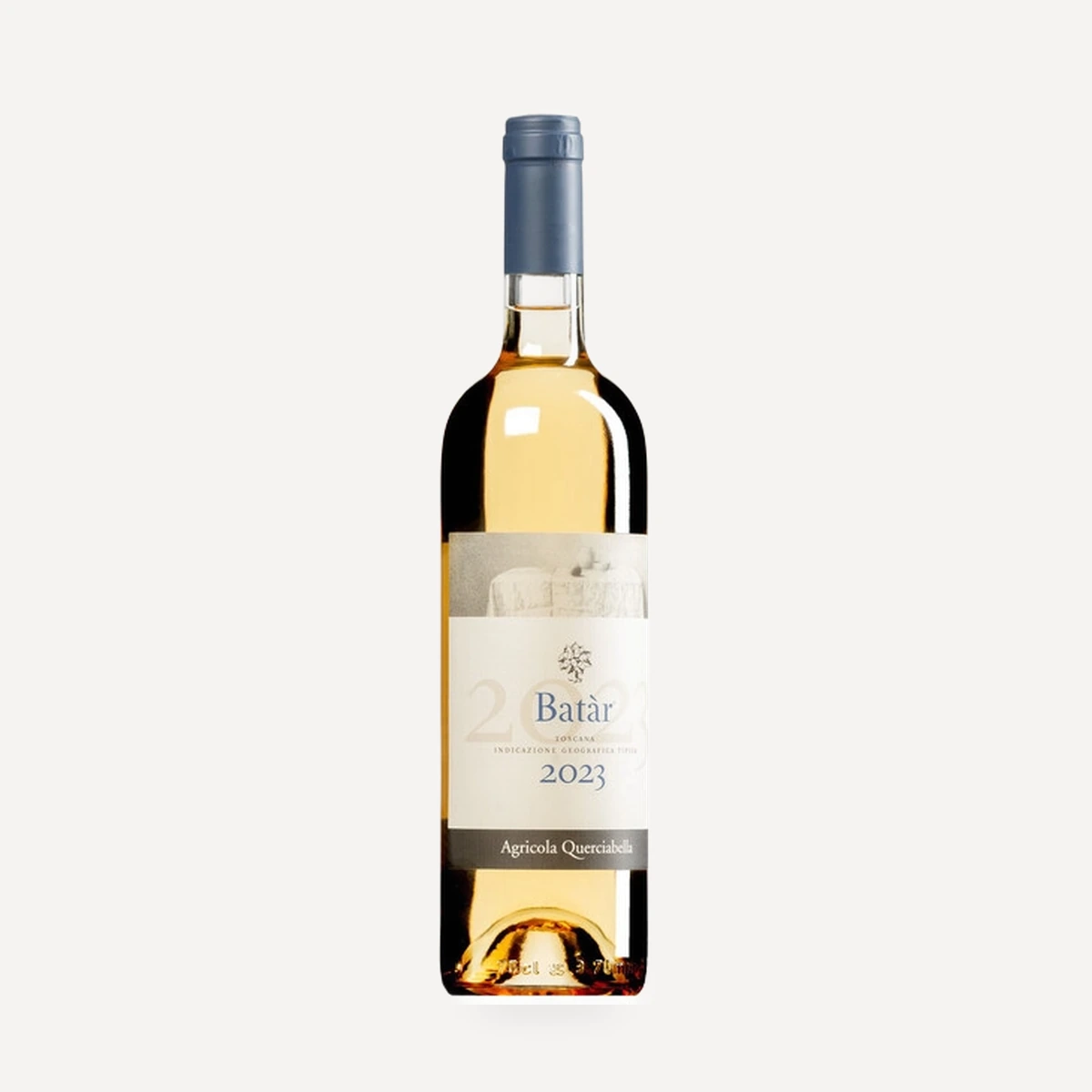
About this wine
Vineyard and terroir
Batàr comes from high-elevation vineyards surrounding the winery on the slopes of Ruffoli, Greve in Chianti, at 350–600 m above sea level. Its Chardonnay is drawn from two south-facing sites. Casaocci Sud lies at approximately 350 m, where hardened, flaky, schist-rich galestro clay encourages fruit concentration and pronounced floral expression. Il Pallonaio reaches 600 m and contains a substantial sandstone component, contributing flinty, gun-smoke nuances, lime-like freshness and tension.
Pinot Bianco grows at around 400 m on cooler, north-facing plots beneath the cellar: Vigna del Dottore, La Lama, Il Bosco, La Collina, Vigna Chiara and Vigna il Diavolo. Here, galestro has weathered into denser clay-and-schist soils associated with textural richness, creaminess, volume and citrus character. The vineyards are farmed organically and managed individually, and the wine is certified organic and vegan.
Grapes
Blend proportions vary by vintage. Latest published composition (2022): 50% Chardonnay and 50% Pinot Bianco. Grapes are selected by hand, and the separate vineyard lots undergo individual micro-vinification.
Vinification
The individual lots are vinified in fine- and extra-fine-grained 228 L French oak barriques. For the 2022 vintage, 20% of the barrels were new. The final blend is assembled only after extensive sampling at the end of élevage.
Ageing
Batàr matures for more than nine months on its own yeasts in French oak barriques, with minimal bâtonnage. Since 2010, gentler lees contact and less new oak have been used to reinforce freshness. Further maturation in bottle before release helps develop its layered texture.
Technical data
Toscana IGT; the 2022 release is designated Bianco di Toscana IGT. First vintage: 1988. Average yield: 25 hL/ha. The 2022 analytical profile is 14% alcohol, pH 3.33, total acidity 5.21 g/L and residual sugar 1.5 g/L. Production for 2022 was 20,000 bottles.
Tasting profile
The wine opens with lemon zest, tangerine and flowers over creamy undertones, followed by mineral nuances and subtle salinity. Its smooth, broad texture is held in balance by fresh acidity. Pear, almond, saffron and ginger spice lead into a fragrant, refreshing and persistent finish.
A published tasting note describes a medium yellow-straw colour, a waxy and herbal nose, substantial structure and a rich opening on the palate. Density is counterbalanced by acidity, with lime emerging on the finish. The wine is broad, long and suited to further bottle development.
Serving and pairing
Serve at 6–8 °C. Decanting is beneficial. Creamy sauces complement the wine’s richness, while saffron, cinnamon, ginger, thyme and tarragon echo its spice and slightly nutty aroma. With maturity, deeper umami tones make it particularly suitable for mushrooms, truffles, sun-dried tomatoes and roasted squash, parsnips or turnips.
Suggested dishes include risotto alla Milanese, white-truffle tagliolini, pumpkin ravioli with brown butter and crispy sage, scallops with beurre blanc, Dover sole with lemon and capers, lobster roll with lemon aioli, porcini and Fontina tart, and miso-glazed eggplant with roasted root vegetables. Cheese pairings range from Comté, Parmigiano Reggiano and Pecorino di Pienza to Robiola Bosina, Tomme de Savoie and aged Mimolette.
The wine may be enjoyed young for its vibrancy or cellared for at least 20 years to develop additional depth and nuance.
Vintage notes
The 2022 growing season combined a warm winter and early vine development with the threat of late spring frost, which the high-altitude sites narrowly escaped. Record summer heat and very little rain placed the vines under considerable stress. Timely rainfall in August restored their condition before an excellent white-grape harvest from 14 to 20 September. Despite the season’s intensity, the finished wine retained notable vivacity.
Label / history
The wine debuted in 1988 under the name Bâtard-Pinot, then a blend of Pinot Bianco and Pinot Grigio. From 1992 through 1994 it was called Bâtard after Chardonnay entered the blend. The name became Batàr in 1995 to prevent confusion with Burgundy appellations containing the word “Bâtard.”
The label carries an original drawing by Italian painter Bernardino Luino. Its proprietary Simona typeface was designed exclusively for Querciabella by Jane Patterson and John Downer.