About this wine
Vineyard and terroir
Camartina comes from vineyards clustered around the winery at Ruffoli, on the hillsides of Greve in Chianti. Cabernet Sauvignon is drawn from Casaocci Sud and Poggerino. South-facing Casaocci Sud has galestro soils and gives a refined expression with lighter, lifted notes. Cooler Poggerino has denser, more clay-rich soils, contributing structural backbone, intensity and depth for ageing.
Sangiovese comes from selected blocks at Montoro, Solatio and Tinamicaio, spanning 350–600 m a.s.l. and orientations from south to south-west. At lower elevations, galestro and clay favor elegance; sandstone becomes more prevalent higher on the hillside and contributes greater juicy vitality.
The vineyards are organically farmed according to plant-based biodynamic principles. Camartina is certified organic and vegan, and no animal-derived products are used from vineyard to bottle. Average yield for the 2020 vintage was 30 hL/ha.
Grapes
Blend proportions vary by vintage. The latest published technical vintage, 2020, comprises 70% Cabernet Sauvignon and 30% Sangiovese.
Vinification
Cabernet Sauvignon and Sangiovese are fermented independently, with each vineyard lot handled separately. For 2020, harvest ran from 18 September to 16 October. The finished base wines are blended in cement after maturation. Production is restricted to favorable vintages and employs small-batch micro-vinification.
Ageing
The individual wines mature for 18 months in fine- and extra-fine-grained French oak barriques, no more than 20% of them new. After assembly in cement, Camartina receives at least another year of bottle ageing and is not released until a minimum of 30 months after harvest.
Its mature development begins to become evident approximately 6–7 years after harvest, followed by the capacity to evolve for a further 20 years.
Technical data
The 2020 analysis records 14% alcohol, pH 3.46, total acidity of 5.88 g/L and residual sugar below 1.0 g/L. The current presentation gives 14.5% alcohol. Production figures are 12,000 bottles for 2020 and 10,000 bottles as the current annual figure.
Available packaging comprises 750 ml bottles in cases of three or six, 1.5 L and 3 L bottles in individual wooden cases, and large formats. The 2020 sheet includes a 6 L format; the current presentation reserves 6 L and 12 L bottles for exceptional vintages.
Tasting profile
A supple, firmly structured red built around blackcurrant, blackberry and plum, with Mediterranean herbs, leather and earthy savory tones. Its fruit has fine intensity, while lively structure provides definition and length. The 2020 vintage is characterized by vivid color, pronounced intensity and silky tannins.
Serving and pairing
Serve at 15–18 °C. The wine’s weight, firm structure, finesse, spices and savory complexity suit mushroom-based dishes as well as Pasta alla Norma, eggplant caponata, king trumpet mushroom steak, veal chops with salsa verde, Beef Wellington, wild-mushroom polenta with thyme, vegan cassoulet, bistecca alla Fiorentina and lentils with cavolo nero.
Its intensity can also balance bittersweet cocoa: flourless dark-chocolate cake or a dark-chocolate tart with sea salt are proposed as less conventional matches.
Vintage notes
The 2020 growing season followed a mild, dry winter that encouraged early budbreak. A cold spell at the end of March interrupted this progression, while wetter spring weather increased disease pressure and required close vineyard attention. Water availability and favorable ripening conditions followed; despite a drier summer, the harvest delivered a good quantity of high-quality fruit. The resulting wines showed bright, vibrant colors, exceptional intensity and silky tannins.
Label / history
First produced in 1981, Camartina was created during the period when experimental Tuscan producers moved beyond the established Chianti Classico conventions, working with international varieties and new techniques. It began as a Sangiovese-led blend with Cabernet Sauvignon and a small amount of Merlot; the balance later shifted toward Cabernet Sauvignon as the variety adapted to Ruffoli’s dry sandstone slopes. It is made only in suitable vintages.
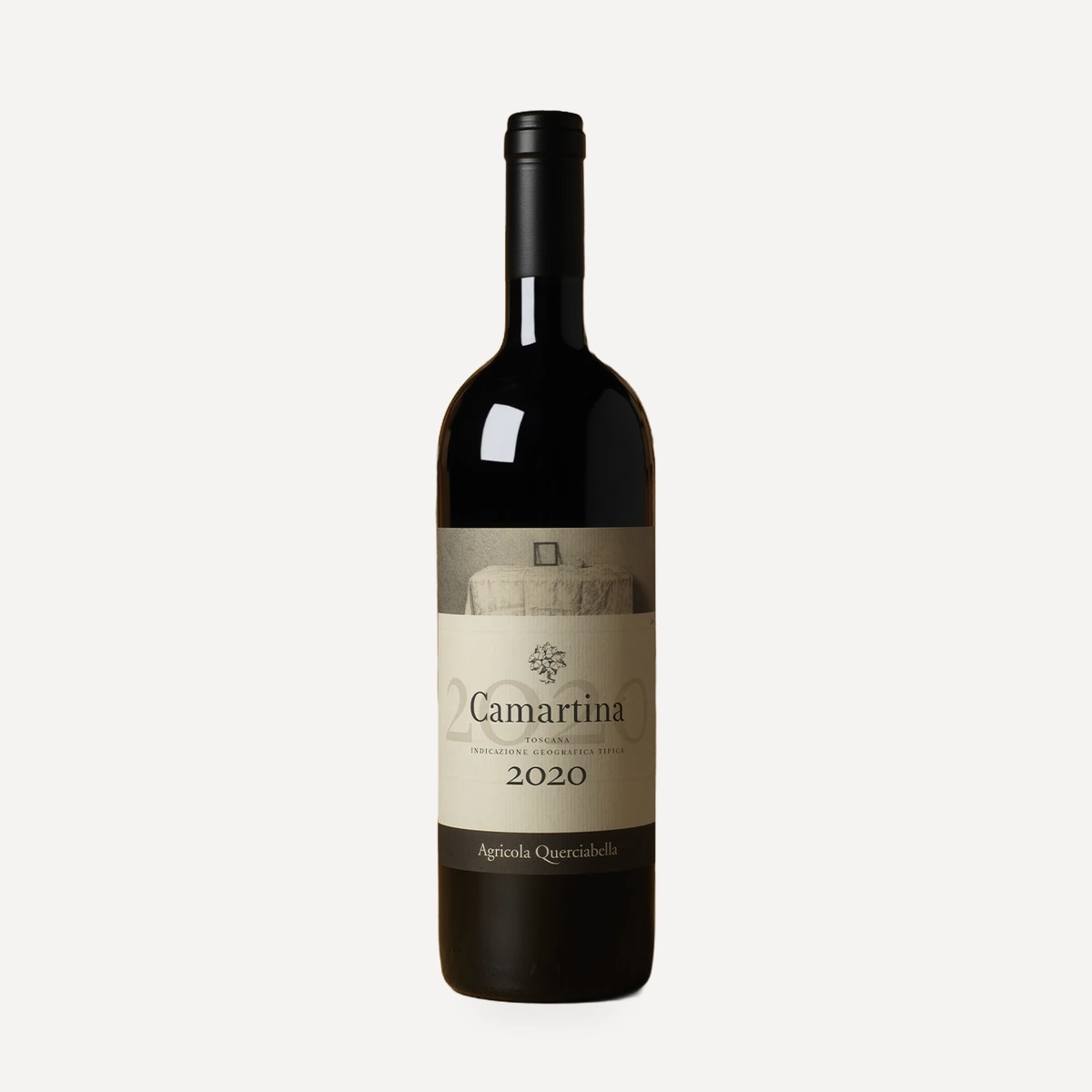
The name combines Casaocci—the winery’s first office and the name associated with its first hectare of vineyard—with Martina, the younger daughter of Giuseppe Castiglioni. The label carries a drawing by Italian painter Bernardino Luino. Its proprietary Simona typeface was created for Querciabella by Jane Patterson and John Downer.