History
Medieval origins
Castello di Velona occupies a strategic hilltop above the valley followed by the ancient Via Clodia, which connected southern Etruria with Rome. The castle was established as a military fortress between the 11th and 12th centuries. Its original organization was unusual: rather than functioning as a feudal holding governed by a lord, it was a Consorzio di Arti e Mestieri, administered by the master artisans who lived and worked within its walls.
The fortress was enlarged during the 12th century, when the Aldobrandeschi counts were rising to prominence in Val d’Orcia. The Watch Tower survives from this phase and recalls the historical rivalry between Siena and Florence. Other structures at the rear of the castle belong to the late medieval period.
Medici, Cervini and Martelli periods
In the 15th century, the property passed to the Medici, who converted the military complex into a noble residence. The main Loggia dates from the Renaissance transformation. The name “Velona” also appears in geographical maps frescoed in the Vatican by the Perugian cosmographer, geographer and mathematician Ignazio Danti.
The Cervini family succeeded the Medici in the 18th century. By the end of the 19th century the castle had passed to Count Martelli, whose insignia remains visible on the central tower.
Revival and thermal transformation
Following a largely silent 20th century, the Piermartini family revived Castello di Velona in 1997, restoring the ruined complex as a residence while preserving its historic fabric. A natural thermal spring was subsequently discovered among the estate’s vineyards, changing the future of the property.
Podere Castello 1997 SRL purchased the property in 2003. Renovation and expansion were carried out under the supervision of engineer Fabiani, integrating the thermal spring into the development of Castello di Velona Resort, Thermal SPA & Winery. The restored complex now combines the historic castle, an estate cantina, hospitality, thermal facilities and agricultural production.
Terroir
Castello di Velona lies in the south-western sector of the Montalcino winegrowing territory, approximately 9 km from Montalcino. The property occupies a hilltop overlooking Val d’Orcia and is surrounded by more than 100 hectares of privately held vineyards, ancient olive groves, woodland and rolling hills.
The vineyards are exposed to air currents arriving from the sea while receiving protection from the higher hills behind the estate. Their soils are clay-based and of medium texture, with a substantial proportion of coarse skeletal material. The six parcels face different cardinal directions, creating distinct site identities within the compact five-hectare vineyard holding. The Brunello vineyard position is additionally characterized as hilly and south-east-facing.
A natural thermal spring flows beneath the estate. Its water has deep underground volcanic origins, emerges naturally at 36 °C and supplies both the thermal spa and selected guest suites.
Winemaking
The five-hectare vineyard holding is divided into six small parcels, each treated as a distinct site. The estate combines modern viticultural techniques with an expressed commitment to respecting nature and local tradition, directing its work toward quality rather than scale. Each vine is tended as a source of Brunello.
The vineyard cycle includes winter pruning, spring canopy growth and the vendemmia in September. Brunello is produced from carefully selected estate-grown Sangiovese. The vines are trained to spurred cordon at a density of 7,800 plants per hectare, with yield set at 40 quintals per hectare, equivalent to 4 metric tonnes per hectare.
The winemaking operation remains entirely within the property, taking the fruit from the estate vineyards through vinification, maturation and service at the castle.
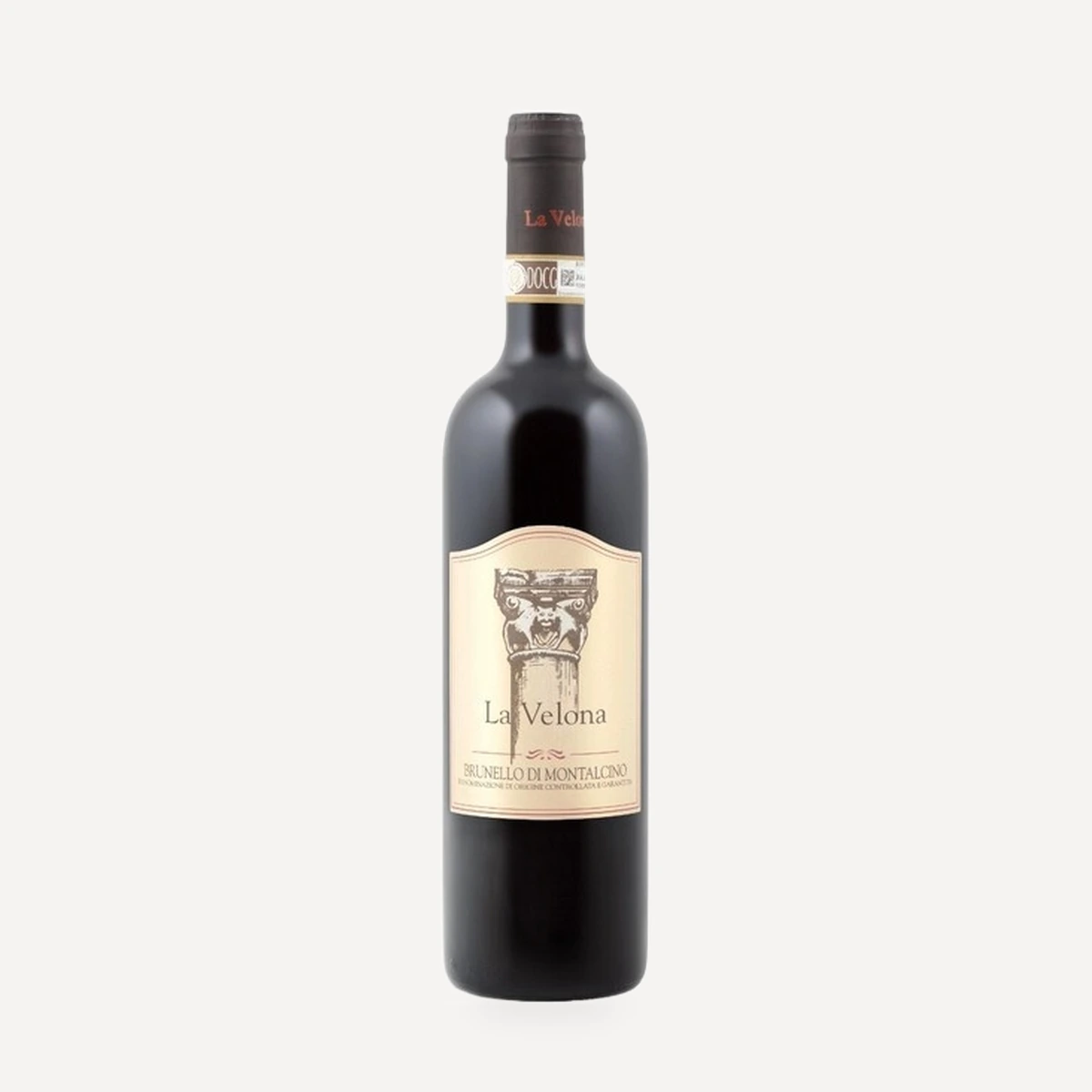
Brunello is made from 100% Sangiovese selected in the estate vineyards. Vinification and alcoholic fermentation take place in stainless steel, with approximately three weeks of skin maceration. Malolactic fermentation is carried out in 30-hectolitre oak casks.
The wine then matures for 36 months in 30-hectolitre Slavonian oak casks, followed by at least 12 months of bottle ageing before release. Production is deliberately limited, and the estate presents the wine as a handmade, small-volume product available to guests through its cantina, restaurants and hospitality experiences.
Philosophy
Castello di Velona defines itself as a small-scale agricultural estate whose limited vineyard area permits close attention to individual vines and parcels. Its approach joins respect for nature and tradition with the techniques of modern viticulture, with the stated objective of pursuing the highest possible quality rather than volume.
Wine is conceived as an expression of its territory. Parcel variation is preserved through six separately recognized vineyard sites, each with its own orientation, character and personality. Sangiovese is treated as the vehicle for expressing both the Montalcino terroir and the balance of power and elegance sought in the estate’s Brunello.
Agriculture is also presented as a continuous seasonal cycle shared with guests: winter pruning, spring growth, September harvest and the later olive harvest connect the wine estate, the castle and its hospitality activities. Production remains on the property from grape to glass.
Wines
Brunello di Montalcino