Questo vino
Vineyard and terroir
The estate vineyard was planted in 2002 with vines spaced 3.00 × 1.00 m and trained to Guyot. It stands at 300 m on the Rocca Ripesena hill near Orvieto. The mainly volcanic, sedimentary and clay-rich soil overlies volcanic rock associated with the formation of Lake Bolsena. The vines are grown without irrigation and cultivated organically.
Grapes
Grechetto, Chardonnay and Procanico (Trebbiano Toscano). A background description presents Albaco as a contemporary Orvieto Classico Superiore based on 60% Grechetto and 40% Chardonnay, while the current technical sheet and individual wine-page text also name Procanico without percentages.
Vinification
The grapes are lightly pressed and remain in contact with their skins for 12–18 hours at controlled temperature. The must is then separated and clarified by cold settling. Alcoholic fermentation proceeds in stainless-steel tanks at no more than 16°C, using varietal and aromatic yeasts.
Ageing
Only the Chardonnay component spends two months in new French sessile-oak casks; the components are blended afterward. The current technical sheet specifies eight months of bottle maturation, while the individual wine-page text gives a range of six to eight months.
Technical data
Grape yield is 70–80 q/ha, producing 55–60 hl/ha of wine. Harvest is by hand from mid- to late September.
Tasting profile
Brilliant straw yellow with golden highlights. The broad, fine bouquet combines fresh fruit and acacia blossom with a suggestion of sweet wood. The palate is dry yet soft, complex and elegant, with ripe-fruit and spice notes. Its broader style is also characterized as fresh, mineral and savoury, with added structure from the briefly oak-aged Chardonnay.
Serving and pairing
Serve at 12°C. Pair with vegetable soups, grilled vegetables, white meats, grilled fish, fried dishes and cheeses.
Label / history
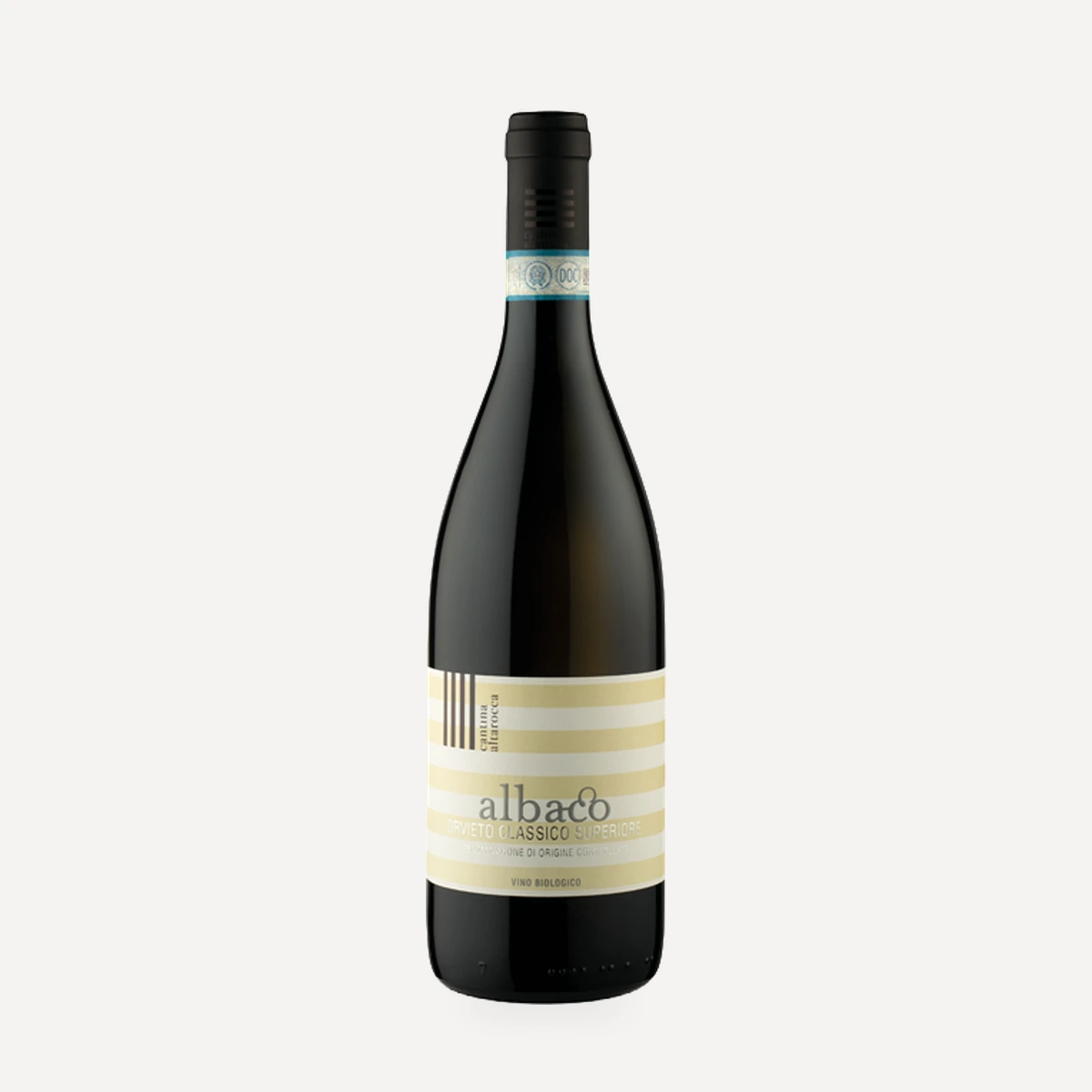
Albaco is conceived as the more contemporary of the estate's two Orvieto Classico interpretations. Its name derives from the Latin albus, meaning white, evoking the pale travertine that alternates with dark basalt on Orvieto Cathedral's exterior and appears in its internal structural elements.