Storia
Orlando and the Groppone vineyard — 1930
The family’s documented viticultural story begins in 1930, when Camillo Donati’s grandfather Orlando planted a small vineyard for household consumption at Arola. The site was known as Groppone, a name referring to its exceptionally steep terrain.
Orlando’s brother-in-law, Oreste Cavalli, grafted a remarkably broad collection of cultivars there. They included Barbera, Bonarda, Sangiovese, Lambrusco Maestri, Lambrusco Grasparossa, Malvasia Aromatica di Candia, Sauvignon and Moscato Giallo, as well as varieties that subsequently disappeared locally, such as Uva Rara and Terra Promessa. Other vines survived in family memory only under dialect names, including al Besmén.
Orlando pressed the different cultivars together, separating only white grapes from red. His informal experimentation with many varieties later became an important reference for Camillo when choosing cultivars and rootstocks for new plantings. The vineyard also had a practical role in the household economy: daily wine contributed calories at a time when diets could be deficient.
Antonio carries on the vineyard — 1964
Orlando’s only son, Antonio, followed a professional career outside agriculture. After studying at the Osservanza boarding school in Bologna, he joined the accounting centre of Banca Commerciale Italiana in Parma. He nevertheless continued cultivating Groppone with Orlando until Orlando’s death in 1964, and subsequently maintained it by himself.
Antonio transmitted to Camillo a view of each vine as an individual living organism. Vineyard work—particularly pruning—was approached as a process of observing each plant, assisting weakened vines and accommodating the vigour of stronger ones.
Camillo learns the cellar — 1990
Antonio preferred the vineyard and open air to cellar work. Camillo therefore learned vinification from Antonio’s friend Ovidio, born in 1923. Beginning around 1990, Ovidio passed on the technical knowledge and practical judgement accumulated over a long working life. His lessons became a foundation of Camillo’s own approach to winegrowing and cellar work.
The developing enterprise was supported by an extensive family network: Camillo’s mother Rosetta; his parents-in-law Gabriella and Francesco; his wife Francesca; his sister Cristina; his brothers-in-law Moreno and Davide; and his nieces Morena and Monia. Monia later joined the winery on a permanent basis. Friends Luigi and Ruggero also contributed regular practical help.
New vineyards and wines — 2004–2009
In 2004 Camillo began renting Ovidio’s vineyard, a site planted in 1968 that included Trebbiano Toscano with a smaller component of Trebbiano Romagnolo. He vinified its Trebbiano for the first time that year. The result led the family to plant approximately one additional hectare of Trebbiano in 2005.
Following Rosetta’s death in 2006, Camillo sought to create a wine dedicated to her. The first Malvasia Rosa was produced in 2009 by adding 5% red grapes to Malvasia Aromatica di Candia. Different red cultivars were used in 2009, 2010 and 2011 while the character associated with the Malvasia remained consistent.
Malvasia Rosa and climatic adaptation — 2014–2021
Research later led the family to the distinct Malvasia Rosa cultivar, a spontaneous pink mutation of Malvasia Aromatica di Candia identified and studied by Professor Fregoni during the 1950s. The cultivar had attracted little commercial planting, and only one nursery maintained mother vines. After several years of searching, the estate obtained planting material and established approximately 1.5 hectares.
The 2014 season stood apart as a cooler year recalling conditions of roughly two decades earlier. By 2016, another hot and dry season reinforced the family’s concern about a long-term shift in local growing conditions. Over approximately 40 years, harvest had moved forward by around 50 days, turning grapes from an autumn crop into a predominantly summer one. This prompted experimentation with earlier-picked Barbera and the creation of Ribelle.
From the 2021 harvest, Malvasia Rosa was made with the estate-grown Malvasia Rosa cultivar rather than relying solely on the earlier blending concept.
The present generation
Camilla, Ginevra and Mattia now also assist the family, alongside Camillo, Francesca and Monia. The estate continues to frame its work around a lesson inherited from the previous generations: nature requires time.
Terroir
Location and elevation
The owned vineyards occupy approximately 15 hectares on the hills of Sant’Andrea di Barbiano, within the municipality of Felino, at roughly 300 metres above sea level. The winery itself is at Località Barbiano and is reached after a climb of approximately 2 km from San Michele Tiorre.
Rows run directly with the fall of the slope. The hill setting has substantially lower fertility than the plains and offers no possibility of irrigation, naturally limiting the productivity of cultivars such as Lambrusco Maestri.
Climatic change
Growing conditions have shifted markedly. Over approximately 40 years, harvest has advanced by about 50 days, changing grapes locally from an autumn fruit into a predominantly summer crop. A succession of hot, dry seasons has widened the interval between technical maturity—measured through sugar and acidity—and full phenolic maturity. Barbera has been among the cultivars that struggle most with this change: waiting for complete phenolic ripeness can produce potential alcohol levels of 15–16%, complicating natural bottle refermentation.
The 2014 season was a notable exception, recalling conditions experienced at least 20 years earlier.
Vinificazione
All work directly involving the vines is manual, including pruning, tying, shoot removal and harvest. The estate treats soil structure and its microbiological life as central concerns, seeking to keep human intervention as limited as the site permits.
Ground cover develops spontaneously and comprises more than 70 species of herbs. Vineyard protection is restricted to small amounts of copper and sulfur. Fertilizer is not normally used after the first years following planting; mature manure may be applied when required.
The vines are trained on a simple vertical trellis. Rows follow the slope, with one Guyot fruiting cane and a planting density of approximately 3,500–4,000 vines per hectare. Lambrusco Maestri receives particularly severe pruning, leaving only 7–10 buds on the fruiting cane. The hill’s lower fertility and lack of irrigation reduce the naturally high productivity associated with that cultivar.
Viticultural decisions are made plant by plant where possible. Pruning is used to support weakened vines while accommodating those in full vigour, following Antonio’s view of each vine as a living organism with its own requirements.
Fermentation
Grapes are vinified with their indigenous yeasts, supported by separately prepared pied de cuve starters. Fermentation is neither temperature-controlled nor thermally forced. The cellar does not use selected yeasts, enzymes, chemical fermentation aids, clarification, acidification or deacidification. Potassium metabisulfite is added at crushing at 5 g per 100 kg of grapes.
Almost all grapes undergo red-wine-style vinification, with skin-contact duration adjusted according to cultivar and vintage. After separation from the skins, the must completes fermentation in an open-topped stainless-steel vessel. All cellar containers are stainless steel.
Once fermentation is complete, racking separates the wine from its heavy sediment. It is then transferred to a closed stainless-steel vessel, where it remains until bottling unless another racking becomes necessary.
Natural bottle refermentation
Partially fermented musts are preserved for bottle refermentation. Ovidio called these musts the “kings of the cellar” because they supply fermentable sugar and other components to wines that consumed all their sugar during primary fermentation. Sweet Malvasia must is used for white wines and sweet Bonarda must for reds.
Bottling normally takes place in the spring following harvest, usually during the waning moon in March or April. Refermentation then begins spontaneously in bottle. It is not forced and occasionally does not occur; even when successful, natural variation means that individual bottles may differ.
Filosofia
Camillo Donati defines natural wine as inseparable from its territory: a territorial wine must also be a natural wine. The objective in both vineyard and cellar is to preserve what nature has provided rather than reshape it through technical correction.
The approach rests on observation, patience and acceptance of variation. Each vine is treated as an individual living organism, while fermentation is allowed to proceed without temperature control, selected microorganisms or chemical adjustment. Natural bottle refermentation is likewise accepted as inherently variable; the possibility that it may proceed differently—or occasionally fail to occur—is part of the method rather than a defect to be eliminated through force.
Tradition is transmitted through people as much as through formal technique. Antonio taught Camillo to listen to the vine, while Ovidio contributed the practical craft of the cellar. Their shared lesson is encapsulated in the family maxim that nature requires time.
The family regards this work as a way of life lived in close contact with nature, the annual cycle of the vine and the succession of the seasons. Its language also reflects a strong Christian faith, with nature understood as a gift to be respected and protected.
Vini
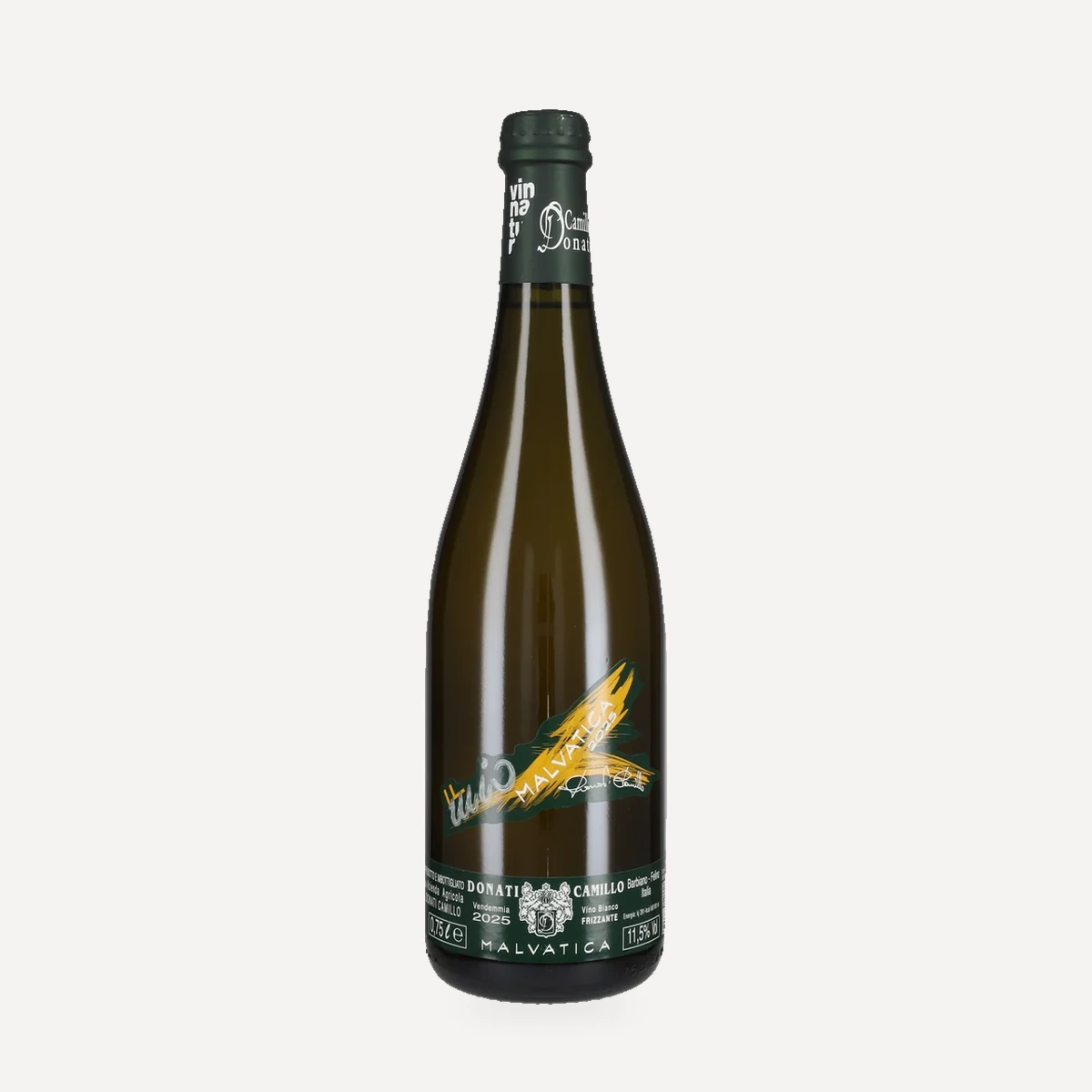
Malvatica