Storia
Family roots: 1881
The Loreti family’s winegrowing history at Zagarolo begins in 1881, when Nicoletta Loreti’s ancestors built the farmhouse and hand-dug its cave into the local tuff. A Pizzutello vine dating from that period still survives as a living link with the estate’s beginnings. The same farmhouse now stands above the vineyards and the underground cave used for sparkling-wine maturation.
Earlier generations made wine as a livelihood and supplied a Roman market that favored light, low-alcohol wines. Carters travelled from the countryside by horse to sell the wine in Rome’s squares and osterias. Chestnut casks, characteristic of the area, were taken into the cave to protect the wine from the summer heat.
Claudio and the first traditional-method sparkling wine: 1981–1983
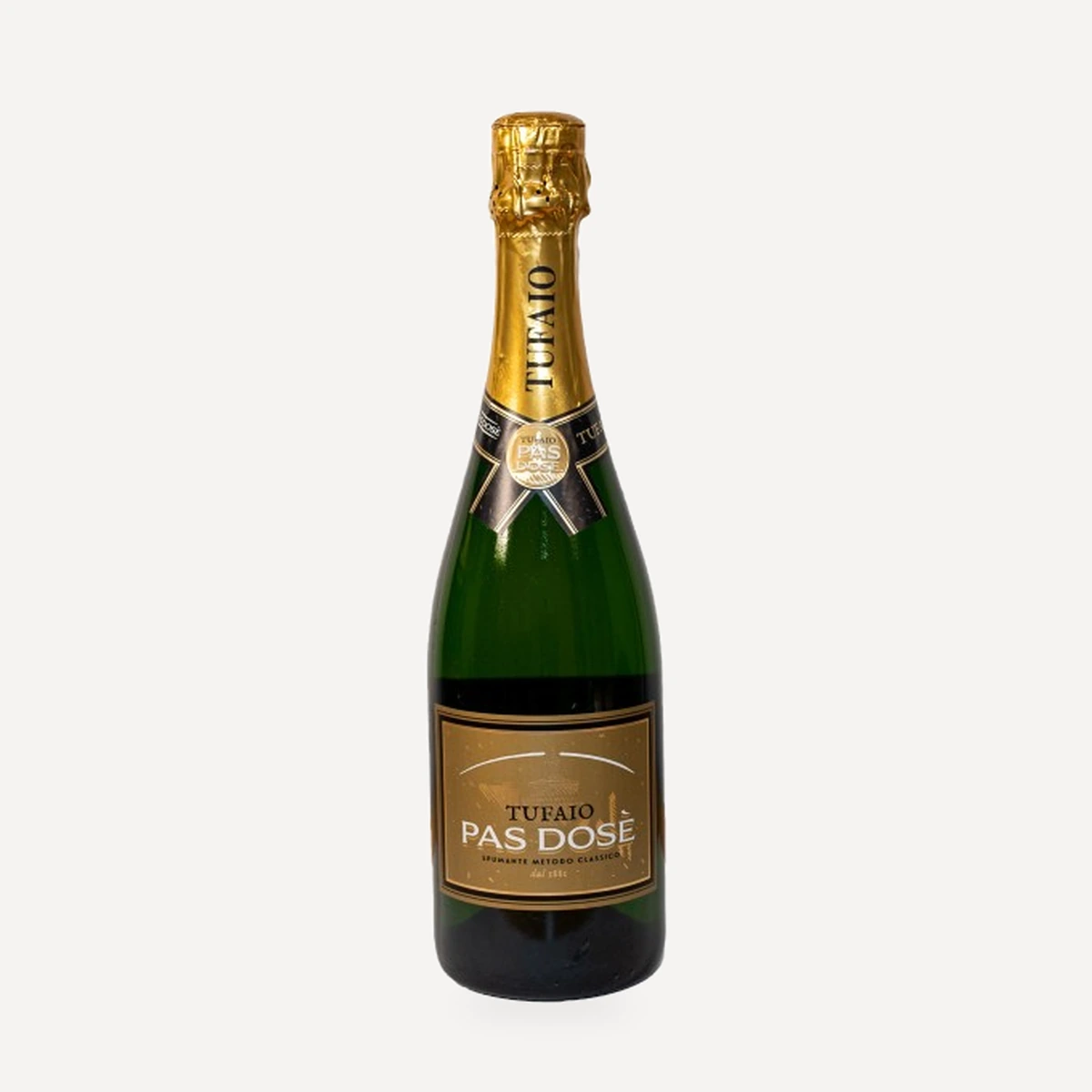
In 1981, Claudio began experimenting with traditional-method sparkling wine, going against the prevailing local emphasis on Romanella. What began as a playful challenge to his father developed into a period of research and study. In 1983 he completed a first lot of 120 bottles. The wine spent 36 months on its lees in the tuff cave at 12–14°C, underwent about one month of manual remuage on pupitres and was disgorged by hand à la volée. This work established the approach later associated with Tufaio Pas Dosè.
Foundation of Cantina del Tufaio: 1994
Nicoletta’s grandfather, a fourth-generation farmer and artist remembered as Luigi, Gigi or Giggi, died in 1994, when she was six. That same year Claudio and Mariella took over part of the farmhouse and founded Cantina del Tufaio as the present enterprise. They redirected production from volume toward quality, reducing yields from roughly 300 q/ha to no more than 75 q/ha, with still lower yields for certain wines.
The transition also marked a gradual evolution from modern enology toward spontaneous fermentation and a less interventionist interpretation of the estate’s fruit.
Nicoletta returns: 2015
At the end of 2015, after work had taken her away from the estate, Nicoletta chose to return and follow the path established by her parents. She represents the family’s sixth generation. Her contribution combined the experience she observed in Claudio and Mariella with new experiments and a renewed interest in older family methods.
Organic farming: 2017
The vineyards have been managed under an organic regime since 2017. Biodynamic practices were subsequently introduced as the family began applying preparation 500 to increase organic matter and biological activity in the soil.
The Sei Gemme project: 2018
Nicoletta created Sei Gemme in 2018 as her personal sixth-generation project. Its name has three connected meanings: her position as the sixth generation of family winegrowers; the ancestors she regards as the family’s precious “gems”; and the six fruiting buds retained when pruning old vines planted by her grandfather in the 1940s.
The project arose from curiosity, experimentation and an intergenerational dialogue with her parents, particularly Claudio. It also gave Nicoletta a distinct voice within a farming family historically led by men. The original project brought together a skin-macerated white from old Malvasia and Trebbiano vines, a bottle-refermented ancestral sparkling wine inspired by her grandfather’s method, and a red matured in ceramic amphora. The range has since expanded to include Anike.
Terroir
The estate lies in the countryside of Zagarolo, 35 km from Rome, between the Castelli Romani and the Monti Prenestini. Its vineyards occupy the slopes of the former Grande Vulcano Laziale, whose activity began about 600,000 years ago. A pyroclastic flow from an eruption identified in the estate history as occurring 20,000 years ago reached the ground now occupied by the farmhouse and vines.
The soils are volcanic and dark to intensely brown, with vineyard descriptions alternating between two principal analytical profiles: 60% clay and 40% silicon, or 75% silicon and 25% clay. Tuff and pozzolana are part of the wider volcanic formation. The dark volcanic ground supports both the white varieties historically associated with the property and red grapes, which are less usual in the immediate area.
The soil is credited with preserving high acidity and pH conditions suited to sparkling-wine production while also supporting the phenolic ripeness required for red and skin-macerated wines. The name Tufaio celebrates the tuff banks on which Zagarolo stands and the mineral character associated with the vineyards’ ground and exposure.
Sixteen metres beneath the farmhouse, the hand-dug tuff cave remains dark and naturally stable at approximately 12–14°C throughout the year. These conditions allow slow bottle refermentation and maturation of the sparkling wines.
Vinificazione
Organic vineyard management began in 2017. The family also incorporates biodynamic practices and applies preparation 500, made from high-quality manure rich in beneficial microorganisms, with the aim of increasing soil organic matter. Biodiversity and the natural cycle of the vine are treated as integral to the farming approach.
All vineyard work is carried out within a small family operation. Green pruning manages the balance between vegetative growth and fruit production, distributes foliage more evenly, improves bunch ripening and creates a healthier microclimate around the grapes. The operations include scacchiatura, removing unproductive or badly positioned shoots; spollonatura, removing suckers from the base of the trunk; and sfemminellatura, removing unproductive lateral shoots from leaf axils.
Canopy opening increases light and air circulation, reduces humidity and the risk of fungal disease, and improves the contact effectiveness of copper- and sulfur-based treatments. Some bunches may remain partly shaded to protect them from the hottest sunlight and possible sunburn. Exposure to light and wind also supports phenolic ripening, especially for red and skin-macerated wines.
Later in the season, bunch thinning removes excess fruit so that the vine concentrates its resources on the selected clusters. This yield reduction is part of the estate’s quality strategy. Preventive treatments are kept to the minimum considered necessary within the organic approach.
Harvesting is manual and follows careful selection. Healthy fruit, the quality of work in the vineyard and the season’s conditions are considered decisive because fermentations rely on the indigenous, season-specific yeasts present on the berries.
Production follows a deliberately hands-on, estate-based chain: the family cultivates its vines, vinifies its own fruit and bottles at origin. Manual work extends from pruning through bottling. Sulfur dioxide is kept below 50 mg/L, at a level intended to protect stability without obscuring the wine.
Musts are monitored daily and generally ferment spontaneously through indigenous yeasts carried on the grapes, without selected-yeast assistance. The estate regards each fermentation as the result of a full year’s vineyard work, fruit health and seasonal conditions, and intervenes as little as possible.
Traditional-method sparkling wine
Pinot bianco is harvested by hand and vinified as a fresh, clean, relatively low-alcohol base wine. Although the conventional method uses a liqueur de tirage of sugar and selected yeast, the estate has for several years replaced externally sourced sugar and yeast with its own must, held at 0°C to prevent premature fermentation. This must initiates the second fermentation after bottling.
Bottles are closed with crown caps and bidules, stacked horizontally and matured in the tuff cave at a stable 12–14°C. Tufaio Pas Dosé spends at least 24 months on its lees; Claudio’s first experimental lot spent 36 months. The slow cave ageing develops aromatic complexity, fine bubbles and a creamy texture.
After lees ageing, bottles are placed on pupitres and turned daily by one quarter or one eighth of a rotation, right and left, so the deposits move into the neck. Manual remuage can last up to one month. Disgorgement is performed by hand à la volée. The Pas Dosé style receives no final sugar dosage.
Ancestral bottle refermentation
The ancestral method completes a single fermentation in bottle and is normally neither disgorged nor filtered, leaving its sediment. Prima Nicchia uses Trebbiano giallo and completes its prise de mousse through its own yeasts and sugar, assisted by a small addition of temperature-controlled Pinot bianco must. Its individual production description specifies 12 days of fermentation without skins at 18°C and up to 48 months in bottle; a later general account describes at least 24 months on lees.
Other cellar vessels and techniques
The wider production includes short and extended skin maceration, unfiltered wines, lees ageing in the cave, oak tonneaux and barriques, ceramic Tava amphora and bottle maturation. These vessels and durations vary by cuvée rather than forming one uniform recipe.
Filosofia
The family’s central quality decision was to sacrifice volume: yields once reaching about 300 q/ha were brought down to no more than 75 q/ha and, for some wines and blocks, considerably less. Quality is understood as the result of direct family responsibility from pruning through bottling.
The farming philosophy is to accompany the vine rather than force it. Canopy work, restrained preventive treatments, organic and biodynamic practices, manual selection and lower yields are intended to deliver healthy, balanced grapes while preserving biodiversity and seasonal expression.
In the cellar, indigenous yeast and minimal intervention make the finished wine a synthesis of the entire agricultural year. Vintage conditions, vineyard work and fruit health are allowed to shape fermentation instead of being erased by a standardized recipe.
Sei Gemme adds Nicoletta’s personal perspective to this family continuity. It deliberately joins old vines and remembered methods with ceramic amphora, skin maceration and renewed experimentation. The project also embraces productive disagreement between generations: Claudio’s experience and caution act as a counterweight to Nicoletta’s curiosity, determination and desire to define the sixth generation in her own voice.
Vini
Tufaio Pas Dosè