Storia
Historical origins
The farmhouse predates the eighteenth century. After acquiring it in the early 1700s, Ignazio Corte transformed the older building into a country manor, adding stucco decoration, small vaults and arches, oval windows, coffered ceilings, decorated doors and overdoors, and enlarged staircases. Corte was born in Dogliani and pursued a career at the royal court in Turin, where he became Grand Chancellor.
A map dating from the middle of the eighteenth century identifies the property as “Cascina Corte.” This historical designation was later revived by the present owners and is probably connected with Ignazio Corte.
Post-war vineyards
The farm’s older vineyards were planted immediately after the Second World War. The previous farmers had managed them for high-volume grape sales, and by the time the property changed hands many vines were missing, while posts and wires required replacement. Although the old vines were naturally low yielding, their fruit persuaded the new owners to restore them painstakingly instead of uprooting them or radically remaking the plots. The surviving historic plantings include vines from 1946 and 1951.
2001–2003: acquisition and restoration
After searching the area for several years, Sandro Barosi and Amalia Battaglia bought the San Luigi property in 2001. The large farmhouse, vineyards, fields and woods had been abandoned for more than 30 years. Their project combined the restoration of an authentic rural property, the creation of a new professional activity, a move from the city to the countryside and the opening of their home to guests.
Work began in 2002. The priorities were to rehabilitate the old vineyards, build a functional winery and then restore the house. As newcomers to winegrowing, Barosi and Battaglia placed the vineyard and cellar work under the supervision of agronomist Giampiero Romana and oenologist Beppe Caviola.
An application for organic certification was submitted in 2002. Following a three-year conversion, certification was obtained in 2005.
In 2003, approximately 1.5 hectares in front of the farmhouse were replanted, half with Barbera and half with Nebbiolo. These well-exposed fields had historically been vineyards but had been converted to sunflowers after the former vines were removed. Different rootstocks were selected according to the soils. The new plantings expanded a production that had initially been limited to Dolcetto.
A new cellar
The original farmhouse had only a very small cellar. After completing the initial vineyard work, Barosi and Battaglia excavated a hillock beside the house and built a simple, equipped cellar designed to maintain a constant temperature. The original cellar was preserved during the excavation and became the tasting room.
The vineyard rehabilitation took two years and construction of the cellar another two. Until the new facility was ready, the wines were made in space provided by Beppe Caviola at his Dogliani cellar. After four years of work, vinification could finally take place at Cascina Corte.
Expansion and life at Cascina Corte
After 2003 the owners added further vineyards and introduced Riesling and Nascetta, followed later by Freisa and Pinot Nero. Restoration of the residence continued for roughly another two years, and Barosi and Battaglia moved to Cascina Corte in September 2008.
Guest accommodation was completed gradually within the restored farmhouse. Old family furniture was reused to give the rooms the character of a private home rather than anonymous lodgings.
Amphora production
In 2015, to mark Sandro Barosi’s sixtieth birthday, the owners bought two Tuscan terracotta amphorae and began experimental vinifications. Encouraged by the results, they acquired additional amphorae with a capacity of 850 litres and established an amphora-aged range.
Terroir
Cascina Corte stands in Borgata Valdiberti on the San Luigi hill, a few kilometres from Dogliani and about 6 km from Monforte d’Alba. The vineyards, meadows and woods surround the farmhouse. San Luigi is described as the broad hill extending between Dogliani and Monforte.
The property looks towards the Carrù plateau, the Maritime Alps and Monviso, as well as the hills around Monforte and the mountains behind Mondovì. Estate vineyard elevations documented for individual blocks range from approximately 400 to 480 metres. The separate Perno source vineyard at Monforte d’Alba is at 350 metres.
Limestone and tuff define the principal soils. The Dolcetto blocks include limestone and blue tuff, while Pirochetta also contains clay. The Freisa site is described as limestone with exceptionally white tuff. Barbera soils combine limestone, blue tuff and clay; the Pinot Nero site has limestone crossed by clay veins. The steep Perno vineyard has limestone, sand and stones.
Varieties are matched to different aspects. Dolcetto and Freisa occupy eastern positions; Barbera and Nebbiolo are principally on southern exposures. Nascetta and Riesling are planted to the west, where the delayed arrival of morning sunshine creates a pronounced day–night temperature range associated with freshness and acidity. Pinot Nero occupies a cooler northeastern position.
Vinificazione
Organic management was chosen at the beginning of the project. The certification application was filed in 2002, and the estate obtained certification in 2005 after three years of conversion.
Chemical fertilisers are excluded. Soil nutrition relies on manure, while vineyard protection is based on copper and quarried sulphur. Soil fertility is a central concern and is supported through green manuring. Sandro Barosi and Amalia Battaglia do not present the farm as doctrinaire biodynamics, but they adopt selected principles from organic and biodynamic agriculture.
Technical profiles consistently describe Guyot training at a density of 5,500 vines/ha across the estate blocks. Mechanical weed control is used in the documented estate vineyards; the steep Perno source vineyard is weeded manually. Grapes are harvested by hand, with timing extending from early September for Pinot Nero through late September or early October for Nebbiolo. Historical estate yields are given as approximately 30–35 q/ha, compared with the 90 q/ha ceiling cited for Dolcetto di Dogliani, while individual blocks and selections range from 35 to 70 q/ha.
The modern cellar was excavated beneath a hillock adjoining the farmhouse to provide a simple, functional and well-equipped environment with a naturally constant temperature. The original small cellar was preserved and converted into a tasting room.
Grapes are harvested by hand. Fermentations are natural and use indigenous yeasts without added commercial cultures. Red-wine technical profiles describe manual pumpovers, while amphora fermentations use manual punch-downs. The wines are neither filtered nor fined, and sulphur additions are kept to a minimum.
The cellar works with stainless steel and cement, large oak vessels and tonneaux, and terracotta amphorae. Some white production receives light pressing before fermentation in stainless steel. Depending on the lot, maturation may take place in steel, cement or oak and continue in bottle.
The amphora programme began in 2015 with two Tuscan terracotta vessels. Further 850-litre amphorae were acquired after the initial trials. The documented amphora process combines natural fermentation in terracotta, manual punch-downs, approximately 11 months in amphora and two months in bottle.
Sparkling production uses the Martinotti method in autoclave, with more than seven months of maturation on the lees and minimal dosage.
Filosofia
Cascina Corte grew from Sandro Barosi and Amalia Battaglia’s plan to combine work, rural life and hospitality in an old property restored without erasing its history. Their priorities were the recovery of the existing vineyards and historic building, the creation of a functional cellar and a move from the city to the countryside.
The decision to retain the low-yielding post-war vines, despite recommendations to uproot them, expresses a preference for patient restoration over wholesale replacement. In the vineyard, the owners place soil fertility at the centre of their approach, using organic methods and selected biodynamic principles without presenting themselves as doctrinaire practitioners.
In the cellar, hand-picked fruit, indigenous fermentation, the absence of filtration and fining, and restrained sulphur use define a low-intervention approach. The adoption of terracotta amphorae reflects a willingness to experiment within that framework.
Hospitality follows the same domestic outlook: guest rooms were designed as part of the owners’ home, furnished with family pieces and intended to create a personal, informal atmosphere.
Vini
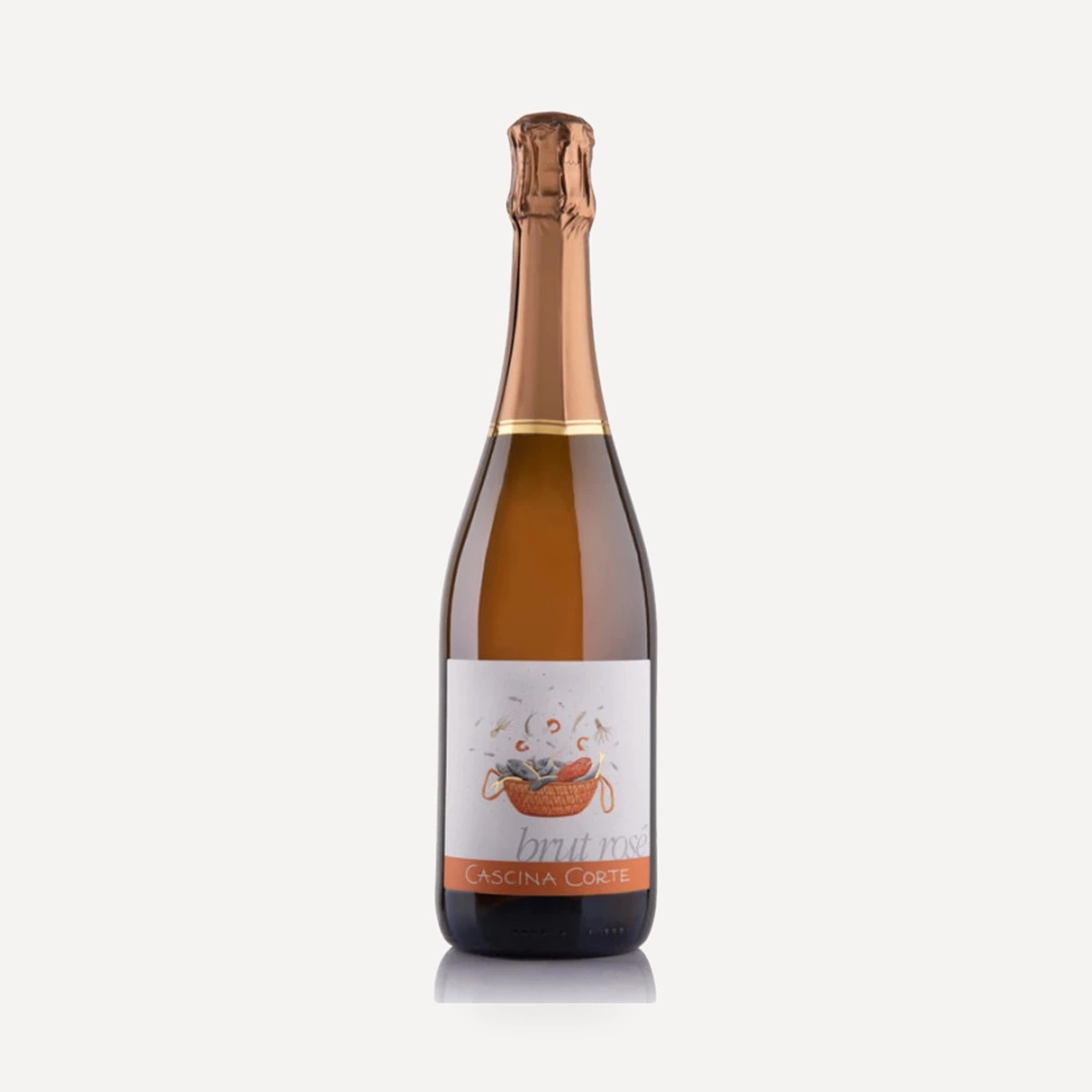
Vino Spumante Brut Rosé