Storia
The watchtower and the family estate
The country residence developed around a watchtower erected in 1483 by Caterina Sforza to defend her territory. Successive custodians enlarged, reinforced and embellished the building over the centuries, creating its present irregular structure. The Drei Donà Counts have owned and occupied Tenuta La Palazza since 1923. The estate was already associated with Sangiovese production, while the house, farmyard, stables, vineyards and belvedere became the centre of family life.
Claudio Drei Donà and the modern project
Count Claudio Drei Donà took charge of the family estate in 1980. Venetian by birth and Romagnolo by adoption, he abandoned his legal career in the early 1980s to devote himself fully to wine. In a symbolic gesture, he removed the nameplate from his law office and fixed it to the cellar door.
At that time, the property produced Sangiovese grapes that were partly sold in bulk and partly vinified and bottled. Claudio began replanting the vineyards and renovated the cellar so that the fruit could be vinified at the estate. Self-taught and strongly influenced by the château model of Bordeaux, he sought to prove that Romagna could produce wines of international stature while also demonstrating the potential of pure Sangiovese from Predappio.
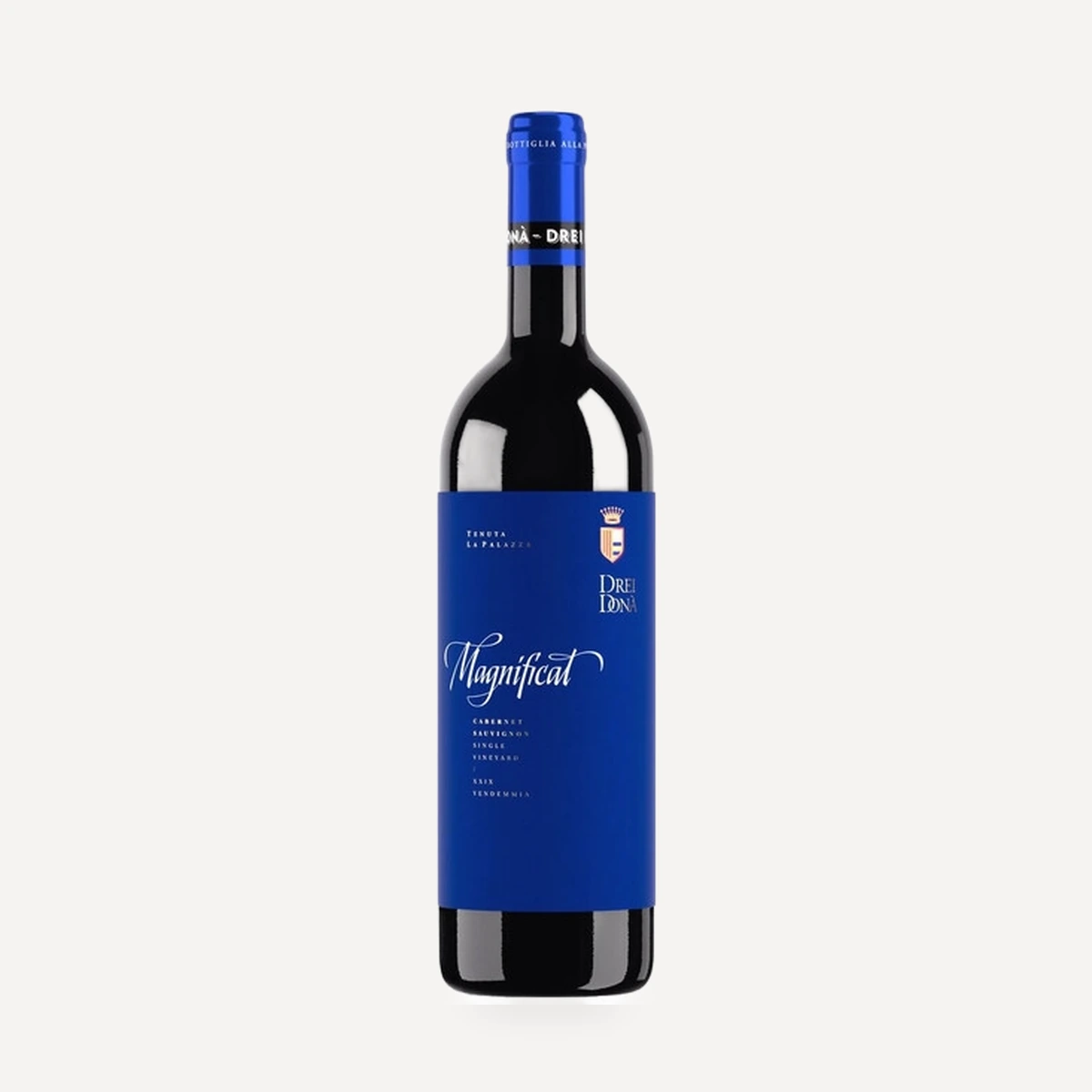
In 1984 he planted Romagna’s first polyclonal Cabernet Sauvignon vineyard. It began as an experimental planting because the variety was not yet permitted under regional rules. He also established Chardonnay and Riesling Renano vineyards. These decisions led to Magnificat from Cabernet Sauvignon and Il Tornese from white varieties, while Notturno and Vigna del Pruno embodied his work with Sangiovese. Notturno was the first wine made at La Palazza under Claudio’s new direction and began the family custom of naming wines after its horses.
Claudio created the first Il Tornese in 1988 as a pure Chardonnay fermented and matured in French oak. The harvest date for its inaugural vintage was reportedly prompted by the horse Tornese, which escaped among the young Chardonnay vines and began eating grapes that were not yet scheduled for picking. Analysis showed that the fruit was ripe, and Claudio chose to harvest immediately.
Environmental development and international recognition
In 1987 Claudio founded Agricoltura Viva within Confagricoltura Forlì to promote sustainable agriculture. In 1992 the vineyards adopted integrated pest management, sharply reducing phytosanitary inputs and eliminating chemical weed control.
Magnificat 1993 received 96/100 and sixth place in Wine Enthusiast’s world Top 100 in 1997. In 1998, Il Tornese 1995 received Tre Bicchieri and was named Italy’s best white wine by Gambero Rosso. Together with Vigna del Pruno, these wines helped establish the estate’s international profile while supporting Claudio’s conviction that both Sangiovese and international varieties could express La Palazza.
Enrico, Ida Vittoria and the next generation
Enrico Drei Donà began working alongside Claudio while at university. After a period of work in California, he recognised that wine could become his profession. In the early 2000s he reconsidered Il Tornese, experimenting with Riesling Renano that had previously been sold to third parties. Combining it with Chardonnay produced a fresher, more streamlined cuvée than Claudio’s original pure-Chardonnay interpretation.
The estate began converting all its vineyards to organic cultivation in 2015 and subsequently achieved certification. Conversion to biodynamic agriculture began in 2020. The property now operates with 100% solar energy.
Also in 2020, Il Tornese Le Origini entered production from selected fruit in the oldest Chardonnay vineyards, reviving Claudio’s original pure-Chardonnay conception. Its return coincided with Ida Vittoria’s arrival in the management of the cellar. Enrico and Ida conceived it as a tribute to their father and his willingness to challenge convention.
Today Claudio’s children, Enrico and Ida Vittoria, care for and direct the estate with their mother, Giovanna Vittoria. Enrico oversees strategy and promotes Predappio through consorzio activities, while Ida applies the discipline developed during her equestrian career to cellar work. Their projects continue the family’s pattern of experimentation, including the limited, non-repeating Note di Cantina editions and Lillybeth, which marks a new generational chapter while connecting contemporary hospitality with older cellar methods.
Terroir
Tenuta La Palazza lies at Massa di Vecchiazzano in the northern sector of the Predappio DOC, near Forlì. The vineyards occupy gently rolling hills at approximately 150 metres above sea level. From the estate, the view extends toward Predappio Alta and Forlì and, in clear conditions, as far as the Adriatic Sea.
The holding forms a single contiguous body composed of three farms, with predominantly south and southeast exposures. Its Pliocene-derived soils have a limestone-and-clay foundation. Alluvial terraces lie over blue clays, with a significant sandy component characteristic of the lower, northern part of the Predappio zone.
Across the wider Predappio subzone, the vineyards extend along both banks of the Rabbi River. Sandy material is more prominent in the lower valley; sandstone intrusions appear farther upstream; Spungone emerges in the valley centre on the right bank; and gypsum-bearing marls and sulphur occur around Predappio Alta on the left bank. Higher areas contain sandstone. The Pliocene sequence is described through the Tabianiano, Piacenziano and Astiano stages: blue marly clays overlie Messinian formations, followed by fossil-rich grey-blue marls and clays that become sandier upward, with yellow regressive sands closing the sedimentary cycle.
Individual vineyard descriptions show meaningful variation within the estate. Vigna del Pruno has a medium-textured clay-loam soil with a limestone vein at a depth of about 1 metre. The vineyards used for Notturno have clay-loam soils with a high percentage of sand. The Chardonnay and Riesling Renano vineyards associated with Il Tornese have clay-loam soils with a limestone vein approximately 1–2 metres below the surface. The mixed plantings associated with Lillybeth are described as clay-loam with 3–4% sand.
Vines share the property with maritime pines, lindens, acacias, cherry, almond and peach trees, white mulberries and other Mediterranean vegetation. This mixed landscape is treated as part of the estate’s biodiversity rather than as a vineyard monoculture.
Vinificazione
Biodiversity, care for natural cycles and progressively lower intervention in the vineyard have been formal elements of the estate’s approach since Claudio Drei Donà’s tenure. He founded the sustainable-agriculture association Agricoltura Viva within Confagricoltura Forlì in 1987. Integrated pest management followed in 1992, with a drastic reduction in phytosanitary products and the complete abandonment of chemical herbicides.
Conversion of every estate vineyard to organic farming began in 2015 and culminated in certification. Agricultural conversion toward biodynamic methods began in 2020. The property also uses 100% solar energy.
Harvesting is manual, with fruit selected in the vineyard and placed into small boxes. Vineyard lots are kept separate through vinification. Documented harvest windows range from the second and third ten-day periods of August for Chardonnay and Riesling Renano to the first half of September for Vigna del Pruno and the latter half of September for the broader Sangiovese selection. The ancient white alberate were likewise harvested by hand in small boxes.
The landscape supports maritime pines, lindens, acacias, cherry, almond and peach trees, white mulberries and other Mediterranean plants alongside the vines. Corgis, an Afghan hound and the family’s horses are also part of life on the property, with the horses historically raised among the vineyards.
The production philosophy draws on the estate model of a Bordeaux château while seeking to respect the fruit and reveal the character of individual soils. Work is organised around close manual attention before, during and after harvest, following seasonal rhythms rather than imposing a uniform recipe.
Grapes are picked by hand into small boxes and selected in the vineyard. Each vineyard is vinified separately. Indigenous yeasts, extended skin macerations and natural sedimentation are central recurring practices. Clear wine is moved from above during racking rather than being separated through an aggressively mechanical process.
The cellar works with temperature-controlled stainless-steel tanks, cement tanks, open oak tonneaux and terracotta amphorae. Malolactic fermentation may occur in steel, cement, wood or amphora depending on the lot. The maturation cellar includes large wooden casks, 225-litre barriques and 500-litre tonneaux, with Allier and Tronçais oak specifically documented, as well as a dedicated room for long maturation in terracotta amphorae. Some selections are bottled without filtration, while others receive only light filtration. Bottle maturation is used extensively after élevage.
The experimental Note di Cantina project preserves singular cellar discoveries rather than reproducing a fixed style. Individual barrels or amphorae, unusual vineyard material and successful trials may be bottled in very small, numbered editions. One ancient-white-vine experiment underwent spontaneous fermentation in terracotta amphorae, 58 days of whole-berry skin maceration and a further 128 days in amphora before being bottled without added sulphites.
Filosofia
The Drei Donà approach combines historical continuity with a deliberate willingness to challenge convention. Claudio’s objective was to release the strength of the land and interpret it in wines with an unmistakable identity. His Bordeaux-château inspiration was less a stylistic formula than a commitment to respecting fruit, separating vineyard lots and allowing soil and place to determine the result.
Precision and patience shape the work: rigorous selection, manual cellar practices, long macerations, slow maturation and extended bottle ageing are accepted when the material requires them. Ancient methods such as indigenous-yeast fermentation, cement vessels and terracotta amphorae coexist with temperature control, international grape varieties and continued experimentation.
The family presents respect as its central value—respect for natural rhythms, inherited land, fruit and individual differences within the family. Enrico, Ida Vittoria and Giovanna bring contrasting personalities and interests to the project, treating disagreement as a creative force. Wine is placed within a broader culture of literature, travel, sport, food, horses, dogs and hospitality rather than regarded as a self-contained pursuit.
Experimentation is not intended to erase the past. Il Tornese Le Origini revives Claudio’s original 1988 Chardonnay conception, while Note di Cantina records singular barrels, amphorae and trials as a numbered cellar diary. The family’s stated ambition remains broader than the reputation of the individual estate: Enrico also seeks recognition for the distinct identity of Predappio as a whole.
Vini