Storia
The nineteenth-century villa
The winery occupies a nineteenth-century villa between Casarano and Ugento. The building was recently renovated to accommodate the limited equipment considered essential for vinification and maturation: a traditional manual press, wooden vats, stainless-steel tanks and local terracotta vessels known as capase.
The loss and renewal of the olive groves
The agricultural estate historically included 45 hectares of centuries-old olive trees. These were devastated by the spread of Xylella fastidiosa. Renewal of the olive groves has begun with the planting of the first trees tolerant of the bacterium. Only a few hectares were replanted initially, with the intention of expanding the renewed groves in future years.
Terroir
The estate lies in the heart of Salento, the roughly 50-kilometre-wide peninsula in southeastern Italy situated between the Ionian and Adriatic seas. Its winery stands between Casarano and Ugento, approximately 10 km from the sea, amid an agricultural landscape devoted to vineyards planted with local grape varieties.
The vineyards occupy the parts of the estate considered most suitable for vines. Their red soils are rich in clay, iron and potassium but poor in organic matter. Long periods of high summer temperatures and severe drought place the vines under considerable stress. This combination is associated with the estate’s aim of producing dense, complex and saline wines expressive of southern Salento.
Vinificazione
The vineyards are farmed organically. A small area of arable land produces the legume and grass seed used for the estate’s annual green-manure crop, described as its only natural fertilization.
Harvesting and selection are performed manually, with the grapes placed in crates. Primitivo intended for both red and rosé production is picked at the beginning of September. Malvasia Nera di Lecce for red wine follows around mid-September. Negroamaro for rosé is harvested around mid-September, while Negroamaro for red wine is picked at the beginning of October.
The winery is housed in a recently renovated nineteenth-century villa between Casarano and Ugento. Its equipment is deliberately limited to the essentials: a traditional manual press, wooden vats, stainless-steel tanks and 250-litre vessels made from local terracotta, known as capase.
Red-wine process
The hand-picked, crate-harvested grapes are destemmed and allowed to ferment spontaneously in 15-hectolitre wooden vats for approximately two weeks. The cap is punched down by hand every day. After about 15 days, the vats are drained and the resulting must continues alcoholic fermentation, followed by malolactic fermentation, in stainless-steel tanks. The wine remains on its lees in steel for approximately 18 months, until bottling. It is bottled without filtration and, whenever possible, without added sulphites.
Rosé-wine process
Whole clusters are placed gently in a traditional manual press and pressed softly. The must is transferred to 250-litre capase, traditional vessels made from local terracotta. Spontaneous fermentation lasts approximately 20 days at a constant 20°C. After fermentation, the wine remains in the capase and matures with its lees for about ten months. It is bottled without filtration and, whenever possible, without added sulphites.
Filosofia
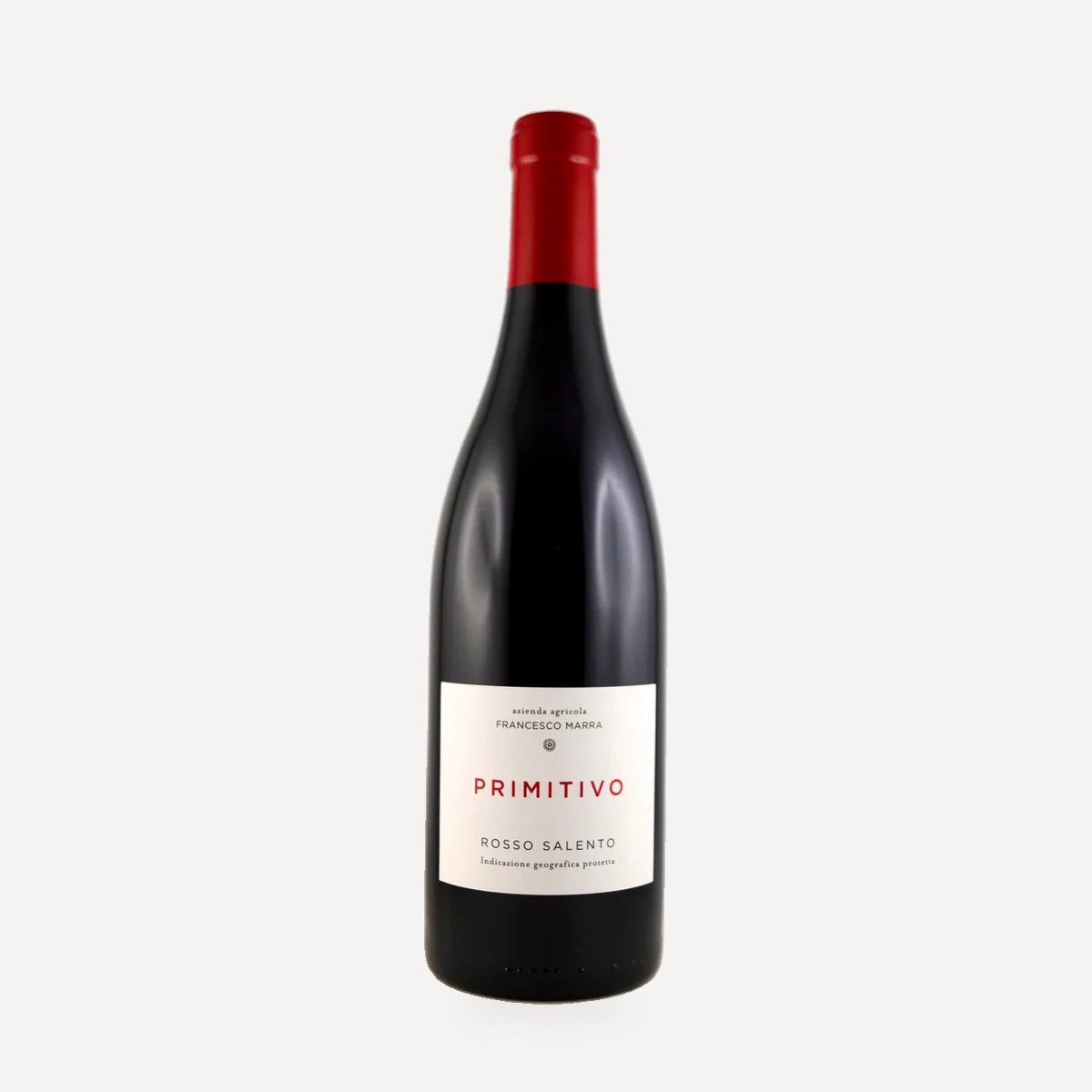
Francesco Marra describes its wines as “naked” and completely natural, with few bottles produced and grape as the sole intended ingredient. Each wine is identified simply with its variety: Negroamaro, Primitivo or Malvasia Nera di Lecce. The underlying principle is that work in the vineyard determines what will enter the bottle, while nature completes the process.
The agricultural approach is framed by a love of nature and a desire to respect and preserve the territory. Organic cultivation, green manure produced from the estate’s own arable crops, spontaneous fermentation, manual cellar work, long maturation on the lees, unfiltered bottling and the avoidance of added sulphites whenever possible form the practical expression of that philosophy. The winery seeks to preserve the character of each vintage and convey Salento through minimal equipment and limited intervention.
Vini