Storia
The roots: 1958–1974
La Collina’s origins lie in the Gruppo Laico Missionario (GLM), founded by Don Lorenzo Braglia in 1958 to involve laypeople in missionary work understood as practical action for justice, hospitality and social commitment. The future cooperative’s founders emerged from this movement, whose spiritual, ethical and organizational principles shaped their plan for a communal life based on shared work and assistance to people in need.
Paola and Gianni Benassi were central to the project’s material foundations. Paola’s uncle bought two farms at Codemondo and created an agricultural operation equipped with a stable, vineyard, well and mill. When he died in 1970, Paola inherited responsibility for running the farm while Gianni worked for a building cooperative. At the same time, Don Lorenzo Braglia, then parish priest at Massenzatico, was bringing together young people who wanted to live communally, work the land and welcome disadvantaged people.
Gianni first helped the GLM obtain temporary use of an empty house at San Maurizio. The group’s first shared-living experiment took place there from 1971 to 1974. The arrangement remained precarious because the house could be reclaimed and the occupants could not invest in it. Paola and Gianni concluded that their Codemondo farms could provide the permanent home and agricultural base the group needed. Rather than sell the property, they donated the farms and land to the GLM.
Foundation in 1975
La Collina was formally constituted before a notary in 1975. Cooperative status allowed the group to receive public contributions and extinguish mortgages already attached to the agricultural business. The founding household consisted of twelve adults—one priest, five unmarried people and three married couples—and later grew through the arrival of nine children. Its members shared common rooms, finances, goods, work, responsibility for raising the children and continual review of collective decisions. Hospitality for disadvantaged people was integral to the arrangement; shortly after foundation, the household received a young person with drug-related difficulties whom the municipality had nowhere else to place.
The agricultural enterprise was conceived as the economic counterpart to this extended family: work, communal life and social inclusion were to operate together. Farming was initially conventional and centred on vines, forage crops, cereals, cattle and pigs. Vegetable cultivation was subsequently added, with produce sold directly at the farm.
Expansion of the social project
Requests for hospitality increased as the founders responded to changing social needs, especially the drug crisis of the period. The wider project consequently developed two additional cooperatives: La Quercia in 1980 and La Vigna in 1985. La Collina continued to link agricultural work with non-judgmental reception, social reintegration and recovery of personal dignity.
Organic and biodynamic transition
The founders came to regard chemical agriculture as incompatible with their social and environmental principles, judging that it impoverished and polluted the soil without accounting for its wider cost to nature and the community. In 1985 La Collina adopted certified organic methods for both crops and livestock, with certification guaranteed by ICEA, the Istituto per la Certificazione Etica e Ambientale.
The cooperative then studied the anthroposophical biodynamic approach. In 1996 biodynamics became the farming method across the entire agricultural operation. The approach was developed through the work and contributions associated with Eugene Kolisko, Pleiffer, Maria Thun and Alex Podolinsky. Soil fertility, biodiversity and the environment came to be treated as common goods to be passed to future generations with added value, while accepting ecological limits on production.
Recent development and the fiftieth anniversary
Since 2016 a NaturaSì store has operated within La Collina, combining the farm’s foods with products from controlled supply chains in the NaturaSì ecosystem. Educational and visitor activities have also developed around biodynamic farming, environmental awareness, vineyards and wine.
A family lunch held in May 2024 became the basis of Alessandro Scillitani’s one-hour documentary Figli di tutti, figli di nessuno. Through conversations between founders and the children raised within the extended household, the film records memories and reflections spanning several generations.
La Collina celebrated its fiftieth anniversary in 2025. The program included a Mass in memory of founder Don Lorenzo Braglia on 20 May, a public screening of the documentary on 3 June, and a full-day gathering at Codemondo on 8 June with discussions, communal meals, music, games, performances and an outdoor screening. A commemorative publication, La Collina: 50 anni di vita condivisa, assembled historical testimony and personal recollections of the cooperative’s communal, agricultural and social life.
Terroir
La Collina’s vineyards are in the Colline matildiche area of the province of Reggio Emilia. The vineyard soils are described as silty-clay.
The five hectares contain vineyards of differing ages and types. Four hectares are planted to red grapes used for Lambrusco—Grasparossa, Salamino, Maestri and Malbo gentile—while one hectare is planted to the white Malvasia di Candia Aromatica. The vines are trained either to GDC, also called Doppia cortina, or to a simple vertical trellis.
The grapes begin ripening with the white variety in the first days of September. Ripening then progresses according to variety until early October.
Vinificazione
La Collina’s entire agricultural production is organic and biodynamic. Organic cultivation and livestock raising were adopted in 1985 under ICEA certification, and biodynamic practice was extended across the farm in 1996. The wine range identifies the vineyard method as organic and Demeter biodynamic, and chemical agricultural products are excluded.
Establishing and maintaining vineyards
New vines are planted during dormancy, between autumn and the end of winter, while frost periods are avoided. The young grafted vines, or barbatelle, have a short stem with two buds. Before transplanting, their roots receive a biodynamic root bath. Vineyard preparation begins before planting with repeated green manures and well-composted mature manure. In established vineyards, green manure is sown in alternating fields to maintain fertility.
Biodynamic framework
The farm is treated as a living organism whose soil, plants, animals and people should operate in balance. Humus is regarded as the foundation of durable fertility. Its biodynamic framework encompasses crop rotations, leguminous plants and green manures, composted manure, drainage and tillage to balance soil air and moisture, biodynamic preparations and attention to natural and cosmic rhythms.
Eight biodynamic preparations are described within this system: two field sprays and six preparations placed in compost heaps to support humus formation. The spray preparations are diluted in large quantities of water and dynamized by alternating circular stirring. Crop rotation and clover-rich or other leguminous leys are used to preserve and improve fertility, while compost contributes organic matter, supports soil structure, improves nutrient availability and increases microbial biodiversity.
The long-term ideal is a biologically self-sufficient farm in which land, vegetation, animals and people sustain one another, with as many inputs as practical produced internally. This mixed-farm structure supplies plant matter, animal manure and other materials needed to stimulate soil biology.
Harvest
Ripening runs from the first days of September, beginning with the white grapes, until early October depending on the variety. Grapes destined for the wines are selected and harvested by hand.
La Collina makes certified organic wine from its own biodynamically cultivated grapes through a local, short production chain.
The grapes are selected and harvested by hand. For the red Lambrusco styles, the disclosed process includes several days of cold maceration on the skins, fermentation with the grapes’ own yeasts and temperature control. Sparkling production follows two routes: low-temperature secondary fermentation in an autoclave, or bottling in the following February for natural refermentation in bottle.
For the rosé Lambrusco and dry Malvasia, the sequence comprises crushing and destemming, gentle pressing and temperature-controlled fermentation with the grapes’ own yeasts. Their secondary fermentation takes place at low temperature in an autoclave.
Filosofia
La Collina joins agricultural production to a broader commitment to communal life, mutuality, social inclusion and environmental responsibility. Its declared aim is harmony and peace among the people who share the work, between the community and the land, and within each person through freely given service.
The cooperative regards soil fertility, biodiversity and the wider environment as common goods that should reach future generations with increased value. This entails respecting ecological limits on production while maintaining an economically viable farm and pursuing sound agronomic and product quality. The land, minerals, plants, animals and people are understood as parts of one living organism for which human beings carry responsibility.
Respect for land and people is treated as inseparable. The cooperative places human needs, dignity and social recovery before profit or maximum efficiency, including the employment and integration of people facing social hardship. Its founding reflections favour tools that are respectful and minimally invasive, human-scale commercial strategies and working rhythms slow enough to avoid forcing the land.
The agricultural expression of this philosophy is organic and biodynamic farming: avoidance of chemical inputs, preservation of humus and biodiversity, respect for natural rhythms and pursuit of a mixed, increasingly self-sufficient farm organism. Sharing, hospitality, environmental care, genuineness, quality and commitment are presented as the operation’s guiding values.
Vini
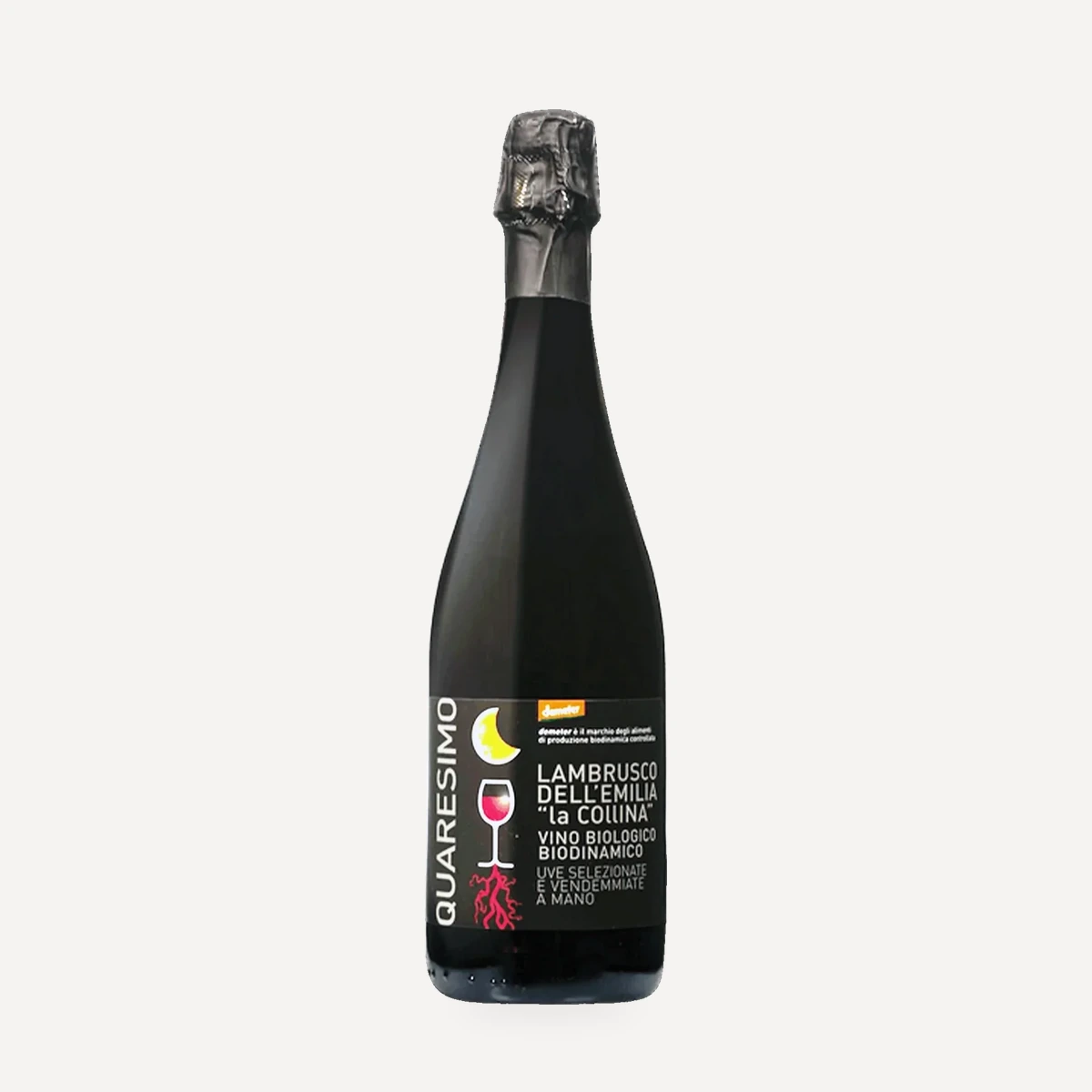
Lambrusco Quaresimo