Storia
A winegrowing place before the modern estate
Wine was already associated with Montefioralle when the village was still known as Monteficalle. On 27 November 1401, Amedeo Gherardini wrote from the castle to the Prato merchant Francesco di Marco Datini, praising a local wine above the others he had tasted and recommending that Datini buy it.
The modern estate also works two small parcels at Il Guerrino that were planted in the late 1930s by an earlier generation of the Taddei/Loretelli family. The family once made its own Chianti Classico called Il Guerrino from these vines.
Renato Sieni and the beginning of Montefioralle
Renato Sieni, born in 1909, reached an agreement with the prior of Montefioralle in 1964, after retiring from his professional career. He took over the management of a vineyard that had been cultivated by the village priests for centuries. Renato planted new vines and began making a wine then called S. Stefano a Montefioralle, producing Chianti Classico for the benefit of the parish of S. Stefano.
Renato remained the founding figure of the family enterprise until his death in 1995. The estate counted 2018 as its 50th harvest and 2019 as its 51st.
Fernando joins the work
At the end of the 1970s, Renato’s son Fernando developed a strong interest in viticulture and oenology. He was then working as an electrical engineer in gas-turbine production, but devoted his free time to helping his father and following the new technical thinking emerging during the revival of Italian wine.
In the early 1980s Fernando planted a few hundred Cabernet Sauvignon and Merlot vines in a new estate plot. Wine from these vines followed a few years later. To distinguish it from Chianti Classico, Fernando named it Monteficalle, recalling the old name of the village: Monteficalle, interpreted as “Mountain of Figs,” in contrast with Montefioralle, “Mountain of Flowers.” The original blend was one-third Cabernet Sauvignon, one-third Merlot and one-third Sangiovese.
When the ecclesiastical administration decided to sell the farm in the 1990s, the Sieni family acquired it immediately, converting the property they had managed into a family-owned estate.
New vineyards and changing blends
A previously fallow parcel acquired by the family was planted in the early 2000s and became known as Terrazze Alte. Its rows run north–south and were planted with the quality-oriented Sangiovese selection Chianti Classico 2000-3.
In 2010, Monteficalle’s blend changed to 40% Cabernet Sauvignon, 40% Merlot and 20% Sangiovese. The Sangiovese component still came from the oldest vines and competed with the Riserva for the estate’s best fruit.
Chianti Classico’s Gran Selezione category was introduced in 2013. Rather than relabel an existing Riserva parcel, Montefioralle began a dedicated experiment with Vigna del Pollaio, a Sangiovese vineyard planted by Renato at the end of the 1970s. Crop levels were reduced to no more than three bunches per vine. Two trial barriques were made, one containing 100% Sangiovese and the other 85% Sangiovese with 15% Merlot. After 30 months, a blind family tasting unanimously favored the pure Sangiovese. The first 2013 Gran Selezione amounted to one 225-litre barrique, or 300 bottles.
The first Gran Selezione was released in February 2017 alongside the Riserva, but its concentration and hard tannins showed that it needed more time in bottle. Subsequent vintages were therefore held for approximately 20 months after bottling before release.
The wet summer of 2014 cost the estate more than 40% of its production. With insufficient top-quality Sangiovese, all suitable fruit was reserved for Riserva and no Gran Selezione was made. Monteficalle consequently changed to equal parts Cabernet Sauvignon and Merlot, a blend retained thereafter as the international varieties became mature enough to stand alone.
For the 2015, 2016 and 2017 Gran Selezione vintages, fruit from Vigna del Pollaio was supplemented by Terrazze Alte. Vigna del Pollaio was small, had missing vines and ran east–west, leaving it vulnerable to uneven sunlight and, in the hot, dry 2017 season, sunburn. From 2018, Gran Selezione relied entirely on Terrazze Alte. Production grew from 300 bottles in 2013 to about 600 bottles in later experimental vintages and approximately 900 bottles from the 2020 vintage.
Organic certification and cellar experimentation
Montefioralle completed the observation period required for organic certification and obtained certification in 2019. Chianti Classico 2019 was its first certified-organic bottling, although the family had already been working organically before the certification appeared on its labels.
In early 2020, the estate bought two 400-litre Clayver stoneware vessels from an artisan producer in Savona. The aim was to moderate oak influence and preserve freshness, floral character and vibrant acidity in increasingly concentrated wines. From spring 2020 to spring 2021, one vessel held Chianti Classico 2019 immediately after malolactic fermentation, while the other held Riserva 2018 after one year in oak. Comparative blind tastings led the family to adopt ceramic vessels for part of the Riserva: after an initial year in used oak, half of the wine now spends its second year in ceramic while the remainder continues in oak.
Il Guerrino: an old vineyard replanted
More than a decade before the 2022 harvest, Montefioralle leased the two Il Guerrino parcels from the Taddei/Loretelli family. Together they covered less than one hectare. Their late-1930s Sangiovese vines stood on a ridge between two valleys, in narrow rows that could not accommodate a tractor. Pruning, treatments and harvesting were consequently performed by hand. The fruit entered the Riserva from the estate’s first year of working the parcels.
Yields declined from 10 quintals to eight and then six quintals in 2021. With the vines reaching the end of their productive life, Montefioralle and the owners decided to uproot and replant, also recovering ground that woodland had gradually reclaimed. The 2022 harvest was kept separate after Valerio, father of consultant Elisabetta, drew attention to the old vineyard’s biodiversity. Fewer than five quintals were fermented in a small tank and matured in a single barrique, producing 300 bottles of Il Guerrino 2022.
The vineyard was replanted, and its new vines were three years old in 2026. Their first small crop that year entered the regular Chianti Classico rather than a separate bottling.
Recent growing seasons
The 2023 season brought persistent rain from early May through the end of June and beyond. Downy mildew caused an estimated 70% crop loss, the smallest harvest Fernando could remember in approximately 50 years. Merlot was among the worst-affected varieties.
The 2025 season combined a mild winter, rainy spring, a July hailstorm and a generally warm but balanced summer. Merlot was picked in mid-September. Sangiovese, Canaiolo and Colorino followed at the end of the month, with Cabernet Sauvignon harvested last. Nearly 30 people worked during the three principal picking days.
The 2026 harvest was early after an exceptionally hot summer tempered by rain at useful moments. The grapes remained healthy, while very ripe, sugar-rich Sangiovese led to unusually long fermentations. It was also the first harvest from the replanted Il Guerrino vines.
Terroir
Montefioralle’s vineyards lie on the southern slopes below the medieval hilltop village, near Greve in Chianti. They occupy separate terraces with predominantly southeastern exposure at about 400 metres above sea level.
The soil contains abundant rock fragments, particularly weathered sandstone identified locally as alberese, and is calcareous. Its strong drainage encourages the roots to penetrate deeply. The combination of this soil and the local microclimate is treated as a distinct Montefioralle cru.
Il Guerrino occupies a ridge descending toward warm southern slopes and looks toward Montefioralle from a natural terrace between two valleys. Its position combines wind, light, slope and periods of shade; the old vines were also exposed to Tramontana winds. Terrazze Alte has north–south rows, giving more even access to sunlight than the east–west Vigna del Pollaio. The latter proved vulnerable to sunburn during the exceptionally hot and dry 2017 season.
Recent vintages illustrate a highly variable climate. The estate experienced severe heat and drought in 2003, 2011, 2012 and especially 2017; persistent spring and early-summer rain and downy mildew in 2023; hail but no water stress in 2025; and an exceptionally hot yet sufficiently watered summer in 2026. Night-time temperature drops helped preserve balance in 2025, while timely August and September rain allowed the very warm 2022 vintage to ripen until late September.
Vinificazione
Montefioralle works approximately 4 ha and has been certified organic since 2019, following a multi-year inspection period. The estate had already adopted organic practices before certification. Chemical herbicides are excluded, and parasite treatments do not use synthetic products.
Organic protection against downy mildew is based on preventive copper treatments. Copper sulphate is dissolved in water and sprayed with a tractor-mounted atomizer. In 2023, almost daily rain repeatedly washed the treatment from the vines, allowing Plasmopara viticola to establish itself and destroy an estimated 70% of the crop. The family acknowledged that treatment timing at the start of the outbreak could have been more precise.
Yield management is adapted to the intended wine. Riserva draws on the oldest estate vines, averaging about 35 years, where bunch numbers are reduced to increase fruit concentration. For the first Gran Selezione, Vigna del Pollaio was restricted to no more than three bunches per vine. Il Guerrino’s old vines yielded naturally tiny crops and required manual pruning, treatments and harvesting because tractors could not enter the narrow rows.
Harvesting and selection are manual where specified. Vin Santo bunches are picked and selected by hand. The red varieties are harvested according to their individual ripening cycles: Merlot generally comes first, followed by the white varieties, then Sangiovese with Canaiolo and Colorino, and finally Cabernet Sauvignon. In 2025, the family delayed Sangiovese to extend phenolic ripening, paused after rain, allowed sun and wind to dry the clusters, and completed parts of the harvest by carrying crates manually when mud prevented tractor access.
The old Il Guerrino vineyard was uprooted after yields fell to uneconomic levels, but woodland that had encroached on its boundaries was reclaimed and the parcel replanted. Its first small crop arrived in 2026.
Montefioralle controls the production cycle from vine cultivation through bottling. Fewer than 15,000 bottles are made annually, and most cellar operations are described as artisanal.
Red-wine fermentation
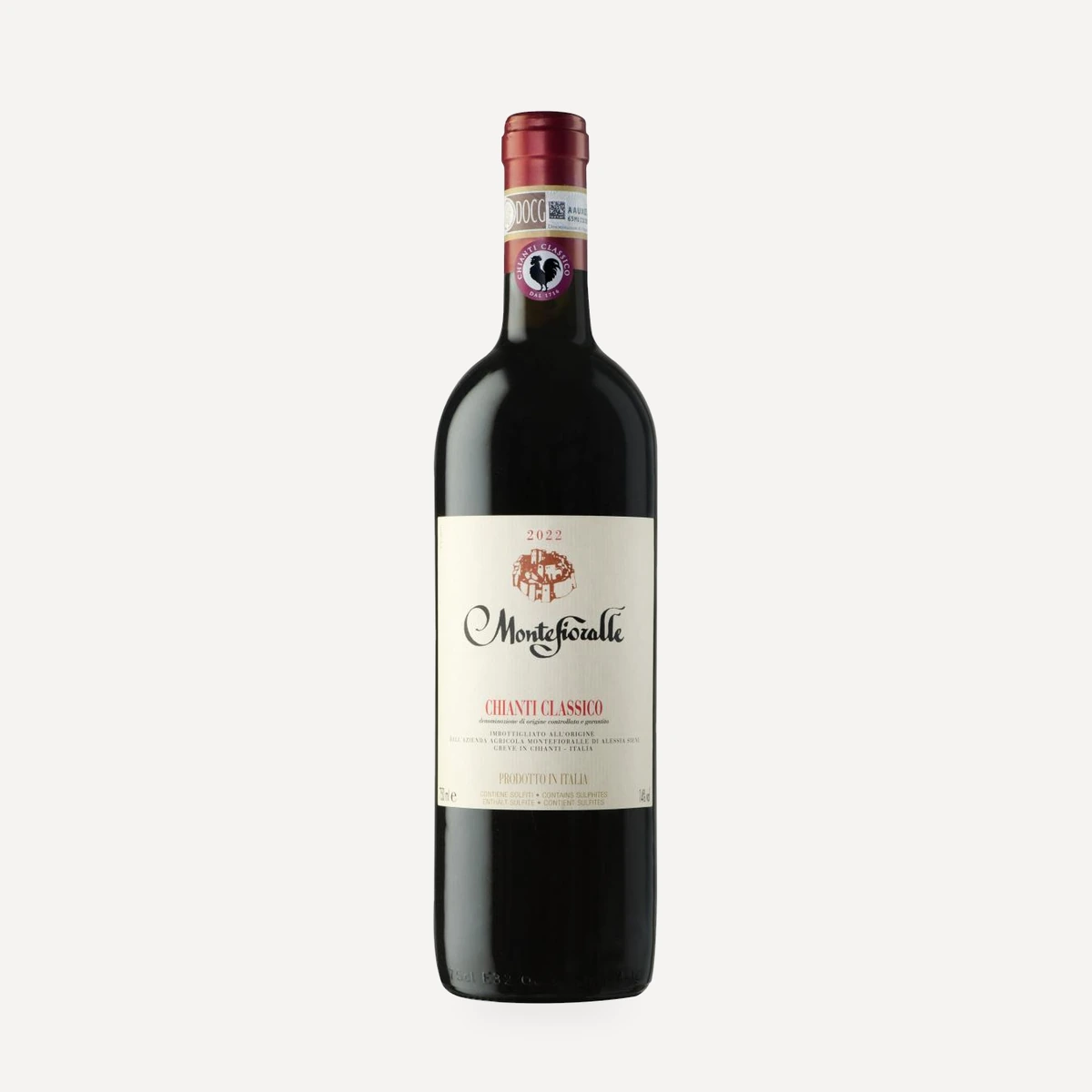
For the principal Chianti Classico, Sangiovese, Canaiolo and Colorino are destemmed and pressed, then co-fermented in cement tanks for approximately two to three weeks. The wine moves to stainless-steel tanks to complete malolactic fermentation. After racking at the end of winter, it matures for 12 months in used oak and receives a light filtration before bottling.
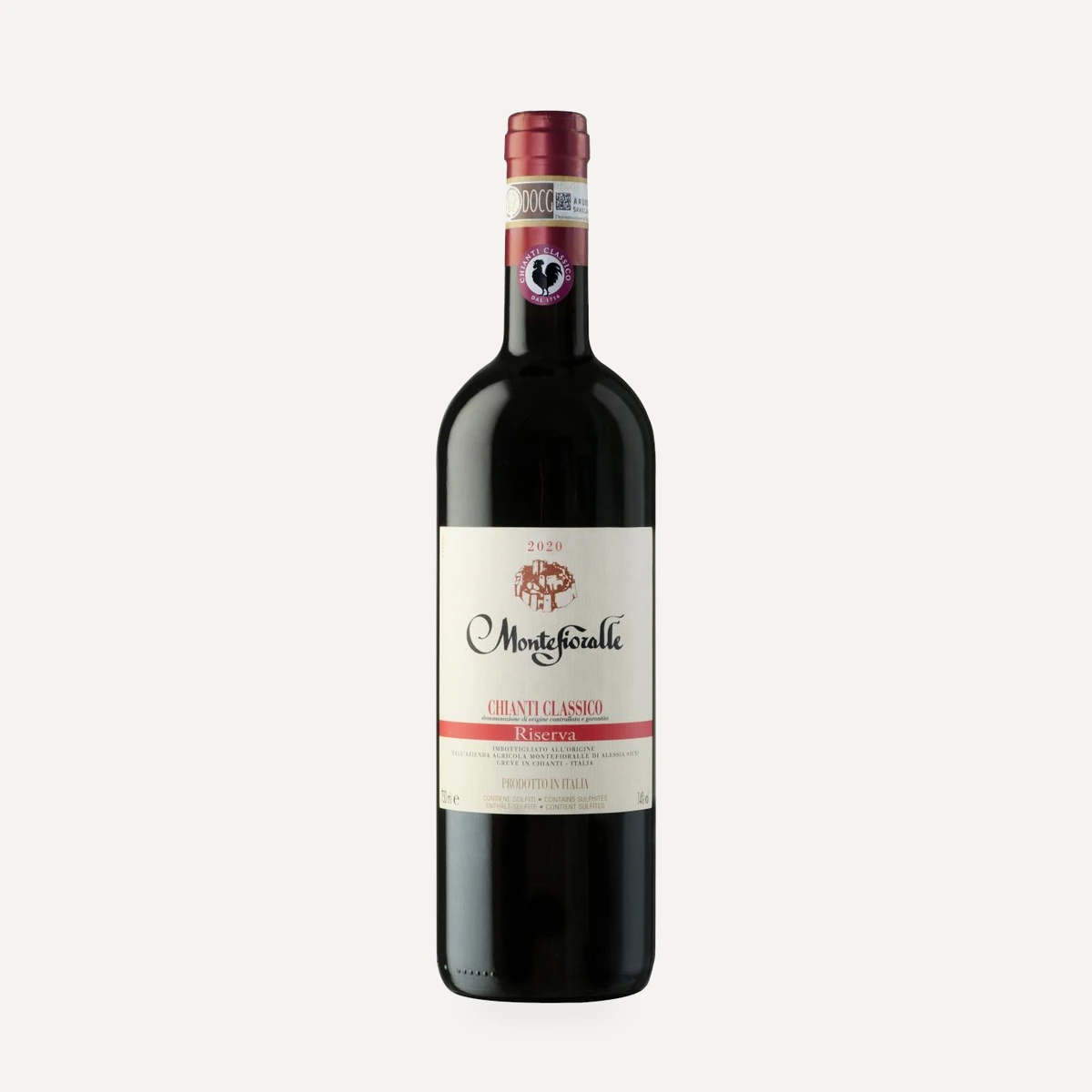
Riserva follows the same general sequence: destemming, co-fermentation for two to three weeks in cement, malolactic fermentation in steel, settling and clarification, then 12 months in used oak. Half is subsequently transferred to ceramic Clayver vessels for another 12 months, while the other half remains in oak. The completed wine is lightly filtered before bottling.
Gran Selezione is fermented in stainless steel and matured for 24–30 months in used oak. It receives a light filtration and rests for at least 18 months in bottle before release. The first experimental 2013 vintage underwent 30 months of maturation and produced one 225-litre barrique, equivalent to 300 bottles.
Cabernet Sauvignon and Merlot for Monteficalle are fermented and handled separately through malolactic fermentation. At the end of the first winter, they are blended in equal proportions directly into small, used fourth-passage oak barrels and mature for 24 months. Production normally ranges from 600 to 1,200 bottles.
Il Guerrino 2022 was vinified separately from fewer than five quintals of Sangiovese in a small fermenter and matured in a single barrique, producing approximately 300 bottles.
Ceramic maturation trials
Two 400-litre Clayver stoneware vessels were purchased in early 2020. One held Chianti Classico 2019 immediately after malolactic fermentation for 12 months, while the other held Riserva 2018 after a year in oak. More than 20 sommeliers, technicians, producers and other tasters compared ceramic- and oak-matured samples blind. Oak was narrowly preferred for the Chianti Classico, but more than 80% preferred Riserva matured for one year in oak and one in ceramic over the version matured for two years entirely in oak. The ceramic sample retained more freshness, floral character, acidity and balance. This trial shaped the present split maturation of Riserva.
Small barrels remain central to the cellar. New, heavily toasted oak is rarely used; older barrels are preferred to control aromatic transfer. More than 70 individual barrel samples may be assessed in a single tasting session to follow evolution and detect bacterial contamination, oxidation or barrel faults.
Vin Santo
Malvasia and Trebbiano bunches are hung on wooden canes in ventilated drying rooms for about two to three months. The dried grapes are pressed and the must transferred to small wooden caratelli, filled to no more than three-quarters of their capacity. The barrels are sealed hermetically; pressure and daily temperature variation contribute to a slow fermentation and maturation lasting three years. The wine is filtered before bottling.
Bottling and closures
The estate uses natural one-piece cork. After a TCA-contaminated batch spoiled almost 5% of Chianti Classico Riserva 2010, it changed supplier. The reported incidence subsequently fell below 1%. Gran Selezione from 2015 and Riserva magnums from 2018 use individually selected corks certified free of TCA through gas-chromatography testing.
Filosofia
Montefioralle’s approach is built around small scale, direct family involvement and control of every stage from the vineyard to the bottle. Production below 15,000 bottles allows individual attention to vines, barrels and bottlings rather than reliance on standardized large-volume processes.
The family regards Sangiovese as particularly sensitive to soil, climate and environment. Gran Selezione was therefore developed through dedicated vineyard selection rather than by relabeling an existing Riserva lot. Its evolution has remained explicitly experimental: parcels, yields, blend trials, maturation and release timing have been adjusted through repeated tasting.
Cellar intervention is intended to support rather than obscure fruit and site. Used barrels are preferred to strongly toasted new oak. Ceramic vessels were introduced to preserve freshness, floral expression and acidity as warmer seasons produced richer, more alcoholic grapes. Barrel samples are tasted systematically to monitor development and identify faults before they compromise a batch.
Vintage differences are accepted rather than forced into a fixed profile. The family delays judgment immediately after harvest, adapts picking dates to technical and phenolic maturity, and recommends different drinking windows for individual vintages. Organic certification, the exclusion of synthetic vineyard products, natural cork and shipment trials form part of a broader commitment to environmental responsibility and product integrity.
Family continuity remains central: Fernando still supervises vineyard production, Alessia owns the estate, Lorenzo contributes to winemaking and marketing, and Manila oversees hospitality and administration with Alessia.
Vini
Chianti Classico DOCG