Storia
First vintage and the beginning of the estate’s inquiry
Silvio Messana made his first vintage in 2000. The initial vinifications began an ongoing process of learning how the land, vines and human hand interact. His work developed around a central question: what kind of wine will a particular place produce when the vine is properly nourished and given a balanced habitat?
During his first year working the vineyards, Messana used chemical products. Their physical effect on him made the approach untenable, while he considered ordinary organic farming an insufficient answer.
2003: conversion to biodynamics
In 2003, Messana attended a Nicolas Joly seminar in Bologna. Already familiar with Joly’s wines, he found them distinctive and was ready for a fundamental change. On returning home the following day, he discarded the estate’s chemical products and began farming biodynamically.
The decision also had a personal foundation. Rudolf Steiner’s thought had long been present in the Messana family, and all of Messana’s children had attended a Steiner school. Biodynamic farming therefore connected a pre-existing family outlook with practical vineyard work. Messana has treated it as a continuing process of observation and annual improvement, reporting changes in both the vineyards and the resulting wines.
Development of two growing areas
The original family vineyards occupy the lower part of the estate’s landscape around Cerbaia. Montesecondo later acquired higher-altitude land at Vignano, at the upper end of the San Casciano UGA. The acquisition gave the estate two contrasting sources for similar grape material: a low, warmer sector and a high, limestone-influenced sector at approximately 450 m.
The distinction became central to Montesecondo’s work. Cerbaia supplies roundness, warmth and flesh, while Vignano provides greater freshness, acidity and structural definition. Fruit from the two places may be combined, as in Chianti Classico, or interpreted separately in other cuvées.
Amphora wines and long macerations
Messana subsequently extended the estate’s low-intervention approach through clay-amphora fermentations and unusually long skin contact. The TÏN wines became the principal expression of this work. Sangiovese has been fermented, macerated for approximately ten months and matured in clay amphorae, while Trebbiano has undergone amphora fermentation with approximately six months of maceration. The listed vintage histories begin with TÏN Sangiovese 2011 and TÏN Trebbiano 2014.
San Martino and recent development
San Martino debuted with the 2018 vintage. The next release was the 2024, sourced from Montesecondo’s highest vineyards in the Vignano district. That vintage remained on the skins for six weeks and matured in cask.
The 2024 harvest began in mid-September. As rainfall intensified toward the end of picking, the team accelerated the final stage of harvest. By this period, Messana’s approach remained centred on low-intervention farming, indigenous fermentations and minimalist cellar work.
Terroir
Montesecondo works with two territories within San Casciano Val di Pesa that carry similar grape material but differ in elevation, climate, exposure and soil.
Cerbaia
The original family vineyards lie in the lower Cerbaia sector, on an alluvial plateau at modest elevation. The soils are principally clay, with intermittent sand and galestro. This warmer setting produces riper, rounder and fleshier expressions. A central two-hectare section of Cerbaia is identified as Vigna di Mezzo.
Vignano
The second territory lies among the high hills of Vignano, at the upper end of the San Casciano UGA. The principal altitude given for this sector is approximately 450 m. Its soils contain more limestone and are more freely draining; the hills are also described as galestro-rich. The combination produces crisper fruit, greater freshness, more pronounced acidity and a stronger structural framework.
The contrast between Cerbaia and Vignano is integral to the estate’s territorial expression: the lower sector contributes warmth and roundness, while the elevated sector contributes tension, freshness and structure.
Vinificazione
Montesecondo has farmed biodynamically since 2003. Silvio Messana regards biodynamics as an evolving practice refined through observation each year, rather than a completed formula. The transition followed one initial year of chemical treatments; all chemical products were discarded after the 2003 Bologna seminar that prompted the change.
The estate is conceived as a living organism containing vital forces, not merely as a production system. Vineyard work is directed toward nourishing the vine and creating the most balanced possible habitat so that the plant can express its site. Current hospitality material also characterizes the agricultural approach as organic, while more recent profiles describe it as low-intervention.
Vineyard selection reflects vine age and planting density. Younger Sangiovese parcels are planted at 6,250 vines/ha; the older mixed vineyards supplying most Chianti Classico fruit are planted at 3,300 vines/ha; TÏN Sangiovese comes from vines averaging about 20 years at 6,500 vines/ha; and Il Rospo comes from vineyards about 15 years old at 6,250 vines/ha. Sangiovese, Canaiolo and Colorino for Chianti Classico are assembled at harvest.
Montesecondo follows a low-intervention, minimalist cellar approach intended to preserve varietal and territorial expression. The range consists principally of single-variety wines, and fermentations use indigenous yeasts.
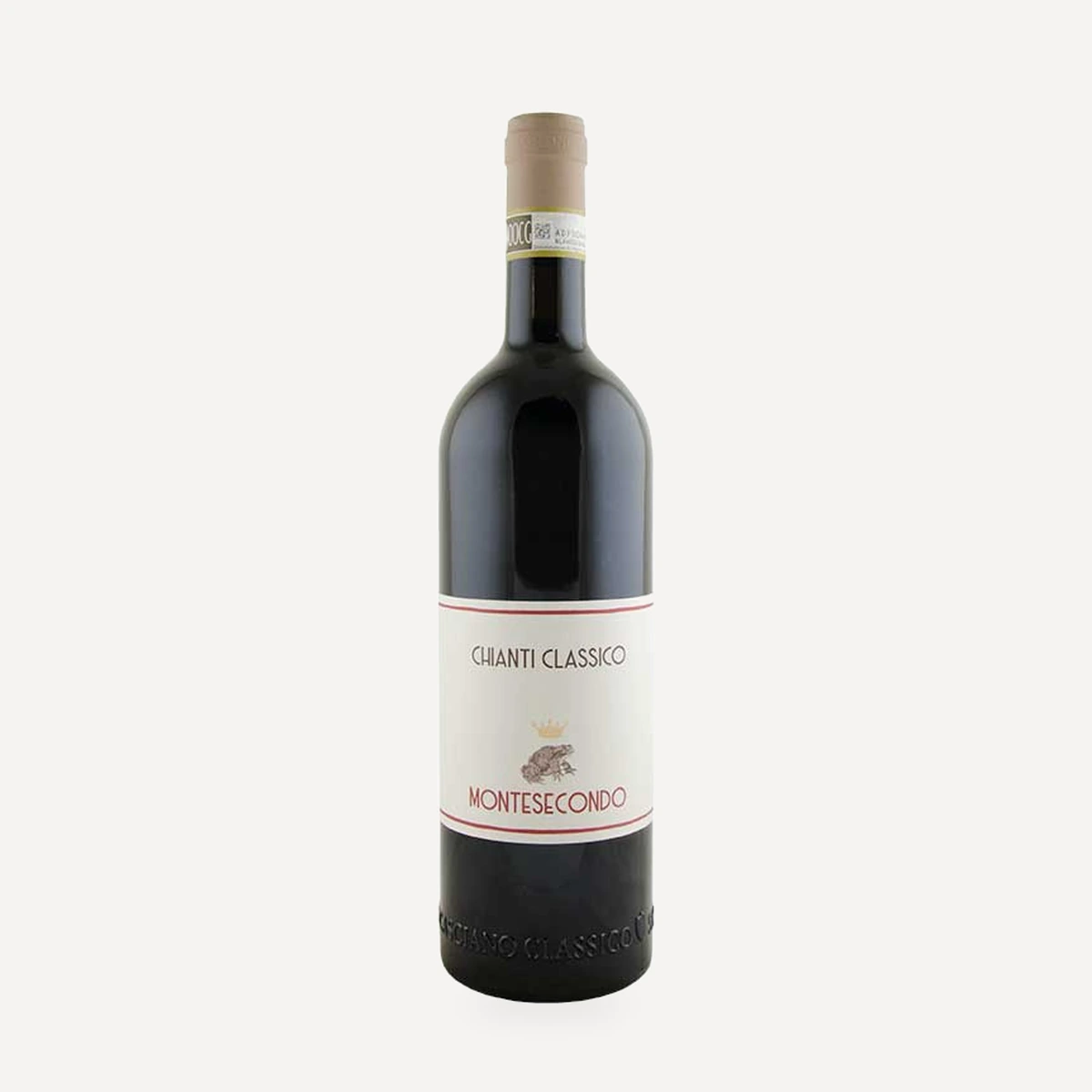
Cement is a central maturation vessel. Montesecondo Rosso is matured in cement to soften Sangiovese tannin without obscuring the fruit. Il Rospo also matures in cement to retain freshness and fruit suppleness. Chianti Classico is matured half in medium-sized casks and half in cement, balancing the effects of the two vessels. Montesecondo Bianco, made entirely from Trebbiano, receives two days of skin contact before maturation in cement.
Clay amphorae support the estate’s longest macerations. TÏN Sangiovese is fermented and matured in clay amphorae, with approximately ten months of maceration in the 2020 description; the 2024 remained in amphora for six months. TÏN Trebbiano is also fermented in clay amphorae and undergoes approximately six months of skin contact.
Garnaccia Bianca is made from Vernaccia di San Gimignano, fermented with the stems and macerated for ten days. San Martino 2024 remained on its skins for six weeks and was matured in cask.
Sulphur levels reported for the current wines are low, but they vary by cuvée and vintage. No single estate-wide dosage protocol is defined.
Filosofia
Montesecondo begins with the question of what wine a particular piece of land can give. Vinification is treated as the start of a continuing process of discovery: the grower learns how to nourish the vine and create a balanced habitat, after which the vine is allowed to express itself.
The guiding principle is to work for the land rather than merely work the land. The farm is understood as a living organism containing vital forces, not simply a production mechanism. This outlook connects the estate’s biodynamic practice with a wider Steiner-influenced family background.
Human agency remains essential. A territory is expressed through a person’s hands, and a change of hands necessarily produces another interpretation of the same place. Wine’s complexity, variability and capacity to surprise are therefore treated as intrinsic qualities rather than defects to be engineered away.
In the cellar, this translates into indigenous fermentations, low intervention and minimalist handling. Cement and clay are used to support fruit, variety and place rather than impose a dominant élevage signature. Vintage differences are retained: the aim is transparency and individuality, not uniformity.
Vini