Storia
Agricultural roots
Pian di Stantino developed as an organic agricultural enterprise and agriturismo in the Alto Appennino forlivese, near the boundary of the Parco Nazionale delle Foreste Casentinesi, Monte Falterona e Campigna. The farm occupies a restored and extended old rural building in the Valle del Tramazzo, a few kilometres from Tredozio and approximately 500 metres above sea level. The renovation retained the building’s original rural characteristics.
Brothers Andrea and Martino established complementary roles within the project. Andrea works as an enologist and winegrower. Martino is a farmer, cook and restorer as well as the holder of Agriturismo Pian di Stantino. The farm also cultivates old varieties of maize, legumes, fruit and vegetables as part of a broader effort to preserve local biodiversity.
2016: recovery of abandoned vineyards
In 2016 the brothers began recovering and cultivating small abandoned Sangiovese vineyards in the upper Apennines. Their purpose was to revive a mountain winegrowing territory that had formerly possessed a distinct viticultural identity. The recovered sites yielded a small initial production. Ridaccio became the first wine made that year, drawing on different Sangiovese biotypes from several small, old vineyards scattered through the upper Valle del Montone.
The number of vineyards contributing to the project subsequently increased. This created an itinerant model in which Ridaccio could represent several mountain sites rather than a single parcel, with the composition changing between vintages while retaining a recognisable territorial identity.
Crowdfunding and the first bottling project
After returning the old vineyards to production, harvesting the grapes and making the wine, the brothers launched the “Bevi Pian!” crowdfunding campaign to finance completion of a Pian bottling. The campaign combined open donations with reward packages that included wine. Its published bottling budget covered glass, cork, capsule, label printing, cartons and bottling for 6,000 bottles, with total estimated costs of €9,955 including VAT.
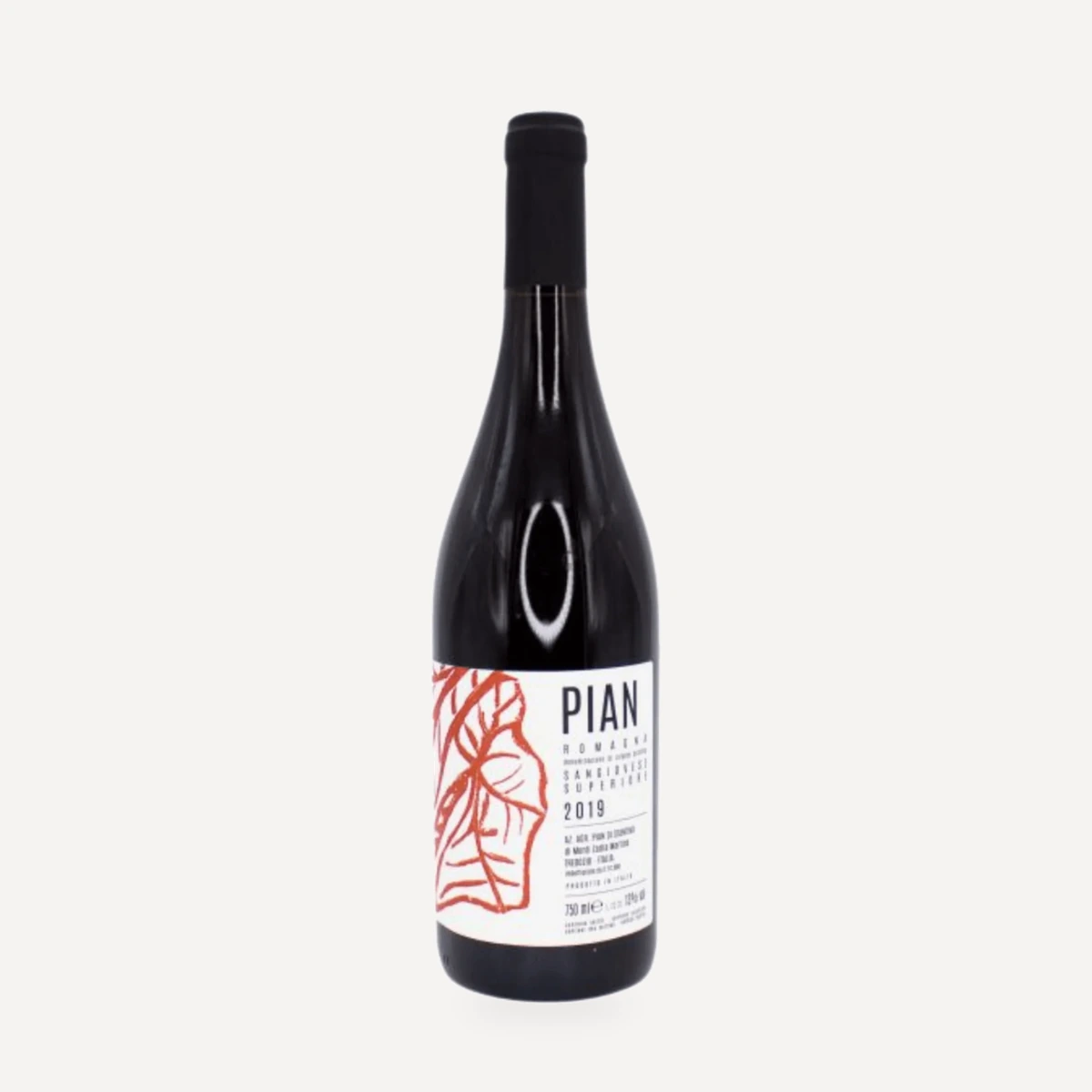
Milanese artist Anna Resmini conceived and produced the Pian label without charge.
2018: the Pian single-vineyard wine
Pian was introduced in 2018 as a pure Sangiovese from one vineyard in the municipality of Modigliana. The site lies at 500 metres in the upper Valle del Tramazzo on marl and sandstone. It was conceived as a cru expressing the terroir of that particular vineyard.
Expansion across the mountain valleys
The vineyard network came to encompass sites in both the upper Montone and Tramazzo valleys, at elevations ranging from 350 to 700 metres. Buscamara extended the range to a Sangiovese vineyard at 700 metres on Monte Busca, between the two valleys. A white-wine project, PianGO!, brought together Chardonnay, Trebbiano and other varieties cultivated on the same marl-and-sandstone formations. Collemosso later appeared among the wines offered by the estate.
Terroir
Pian di Stantino works with mountain vineyards in the upper Valle del Montone and Valle del Tramazzo, within the Alto Appennino forlivese. The sites range from 350 to 700 metres above sea level and are rooted in marl-and-sandstone soils.
The Pian single vineyard lies at 500 metres in the upper Valle del Tramazzo, within the municipality of Modigliana. Its geology consists of marl and sandstone. The Monte Busca vineyard reaches 700 metres and occupies a position between the Montone and Tramazzo valleys; it is identified as the highest vineyard in the area.
The estate itself is set at approximately 500 metres in the Valle del Tramazzo, a few kilometres from Tredozio and close to the Parco Nazionale delle Foreste Casentinesi, Monte Falterona e Campigna. The surrounding mountain landscape includes woods, pastures, old mule tracks, rural settlements and small villages.
Vinificazione
Pian di Stantino forms part of an organic agricultural enterprise whose wider work is centred on maintaining biodiversity. The farm preserves and cultivates old varieties of maize, legumes, fruit and vegetables alongside its vines.
The vineyard project began with the recovery of small, abandoned Sangiovese sites in the upper Apennines. Pruning, mowing and treatments with copper and sulfur continue to be performed largely by hand. This labour-intensive approach is applied across mountain sites ranging from 350 to 700 metres above sea level.
The gradual addition of more old vineyards has expanded the cultivated network without erasing the distinctions among its individual mountain sites.
Cellar work is based on spontaneous fermentation followed by maturation in stainless steel and concrete. Indigenous yeasts are used for the pure-Sangiovese projects. The red-wine approach includes extended contact with the skins, while wood, concrete and stainless steel appear among the fermentation or maturation vessels used across the range.
The original Pian bottling project called for nine months of maturation in stainless steel and concrete before bottling. The broader production philosophy favours direct, unembellished wines intended to retain the fresh, floral aromatic character of mountain-grown Sangiovese and the identity of the individual vineyards or valley network.
Filosofia
The project’s stated purpose is to restore a voice to a mountain territory that once possessed an important viticultural identity. Recovering abandoned vineyards is therefore both an agricultural undertaking and an act of territorial preservation.
Biodiversity is treated as a farm-wide principle rather than a concern limited to vines. Old varieties of maize, legumes, fruit and vegetables are cultivated alongside the vineyards, while the agriturismo links agriculture, food and hospitality.
In wine, the brothers seek a lean, direct expression without superfluous embellishment. Sangiovese is intended to retain its fresh and floral aromatic character while reflecting the particularity of high-altitude sites and an old, demanding form of mountain viticulture. Vintage variation is accepted within the multi-vineyard Ridaccio project: its component sites can change while the wine remains recognisable as an expression of the wider mountain territory.
The wider hospitality philosophy centres on a slower relationship with the environment, stone buildings, gardens, nature and agricultural work. Pian di Stantino presents itself as an agricultural refuge and an alternative form of tourism rooted in the life of the farm.
Vini