Storia
Lorenzo Ferretti and the family's first land
The family's documented story begins with Lorenzo Ferretti, born on 28 January 1846 to Pietro and Caterina at Villa a Tolli, a hamlet in the hills above Sant’Antimo. He came from a farming family and worked as a gamekeeper, while aspiring to own land rather than work fields controlled by local landholding families. Lorenzo could write—an unusual skill among rural labourers of his time—and his signature survives in the family's documentary record.
Lorenzo married Carlotta, who was ten years younger. They had six children: four daughters and two sons, Guido and Settiminio. At the end of the nineteenth century Lorenzo acquired a small plot called Logarelli. Bramante, Lorenzo's nephew and Luciano Ciolfi's grandfather, remembered that the property initially contained little more than a shelter for grazing pigs. Lorenzo built a house there within a few years, and the family moved to the holding around the turn of the twentieth century. The farm combined about one hectare of vines mixed with olive trees with firewood production, pigs, cattle, sheep, chickens and rabbits; its wine was intended for household consumption.
Lorenzo died in 1916 at the age of seventy and is believed to have been buried at Pieve Santa Restituta, formerly known as Intistieti. Carlotta also lived to seventy. The family continued to grow at the holding, subsequently referred to as Rogarelli.
The creation of Sanlorenzo
By 1950 the original property could no longer accommodate the expanding family. Guido, Lorenzo's son, and Giovanni, Guido's son, separated a portion of Rogarelli and purchased adjoining land from the Argiano estate. They established a new farm and named it Sanlorenzo in honour of Lorenzo Ferretti and his ambition to own and cultivate land.
Livestock and the first modern vineyards
In 1972 Fiorella married Paolo Ciolfi, who came from Val d’Orcia. They directed the farm toward livestock and constructed a modern barn, while simultaneously planting a modern vineyard. A second vineyard followed in 1992. At this stage the grapes were sold to other wineries rather than vinified at Sanlorenzo.
Paolo and Fiorella had three children: Luciano, Luciana and Luca. After completing their studies, Luciano worked at a winery in Montalcino. Luciana married and moved to Cinigiano.
Conversion into a wine estate
Luciano returned to Sanlorenzo in 1997 during the expansion of Montalcino and Brunello production. He chose to turn the family farm toward estate winemaking, and five hectares of new vineyards were planted. Livestock farming ended in 2000, when Sanlorenzo began operating as a winery.
The first estate vintage was 2003. A rosato project began with trials before its first commercial vintage in 2014. Initially produced by drawing juice from a Rosso di Montalcino vat, it developed into a separate small-production expression.
Continuity and renewal
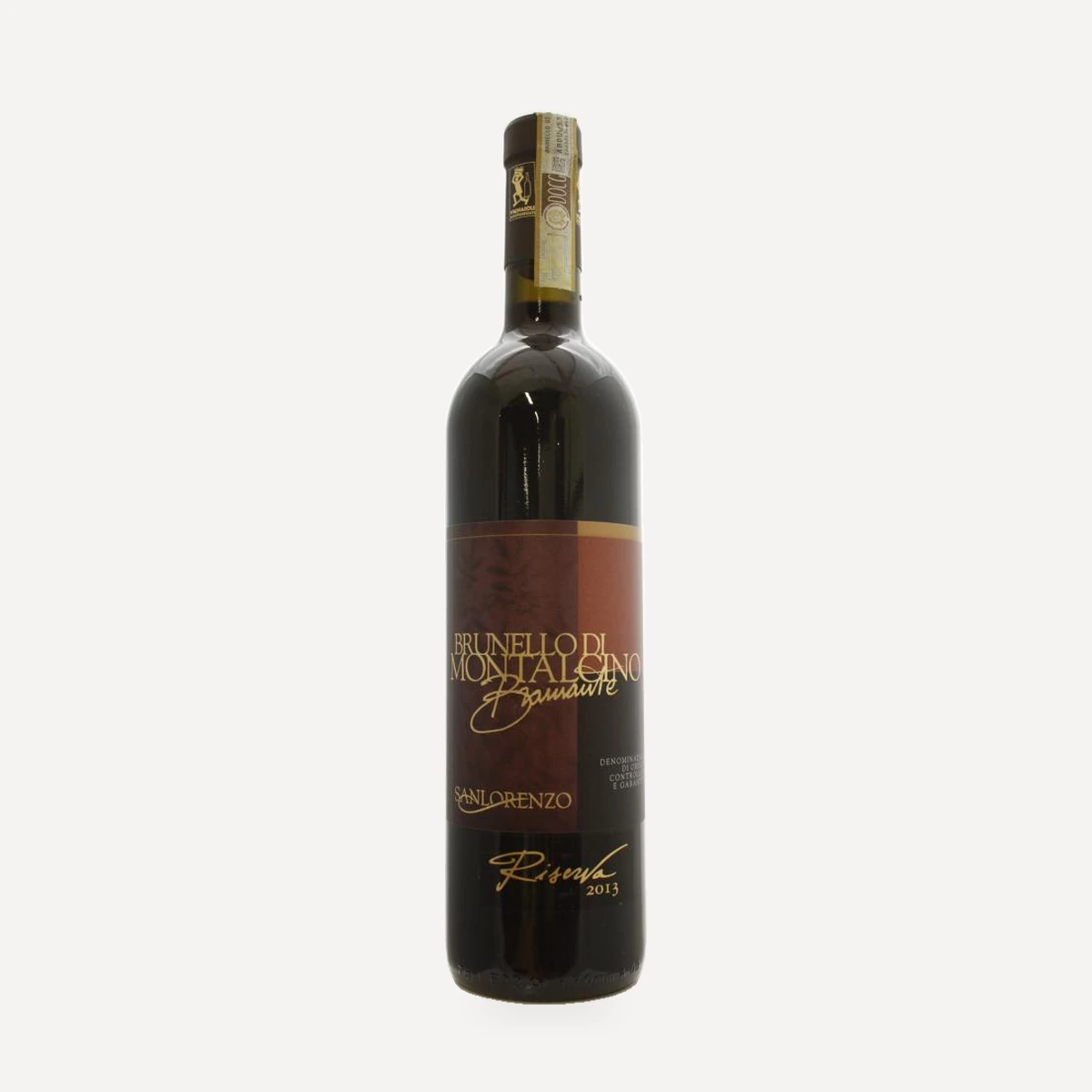
Bramante Ferretti, born on 3 May 1915, died on 29 October 2016 at the age of 101 years and nearly six months. The Bramante Riserva commemorates him. Luciana returned to Sanlorenzo in the same year, rejoining the family enterprise. The vineyard planting chronology continued through 2018, the most recent planting identified in the estate overview.
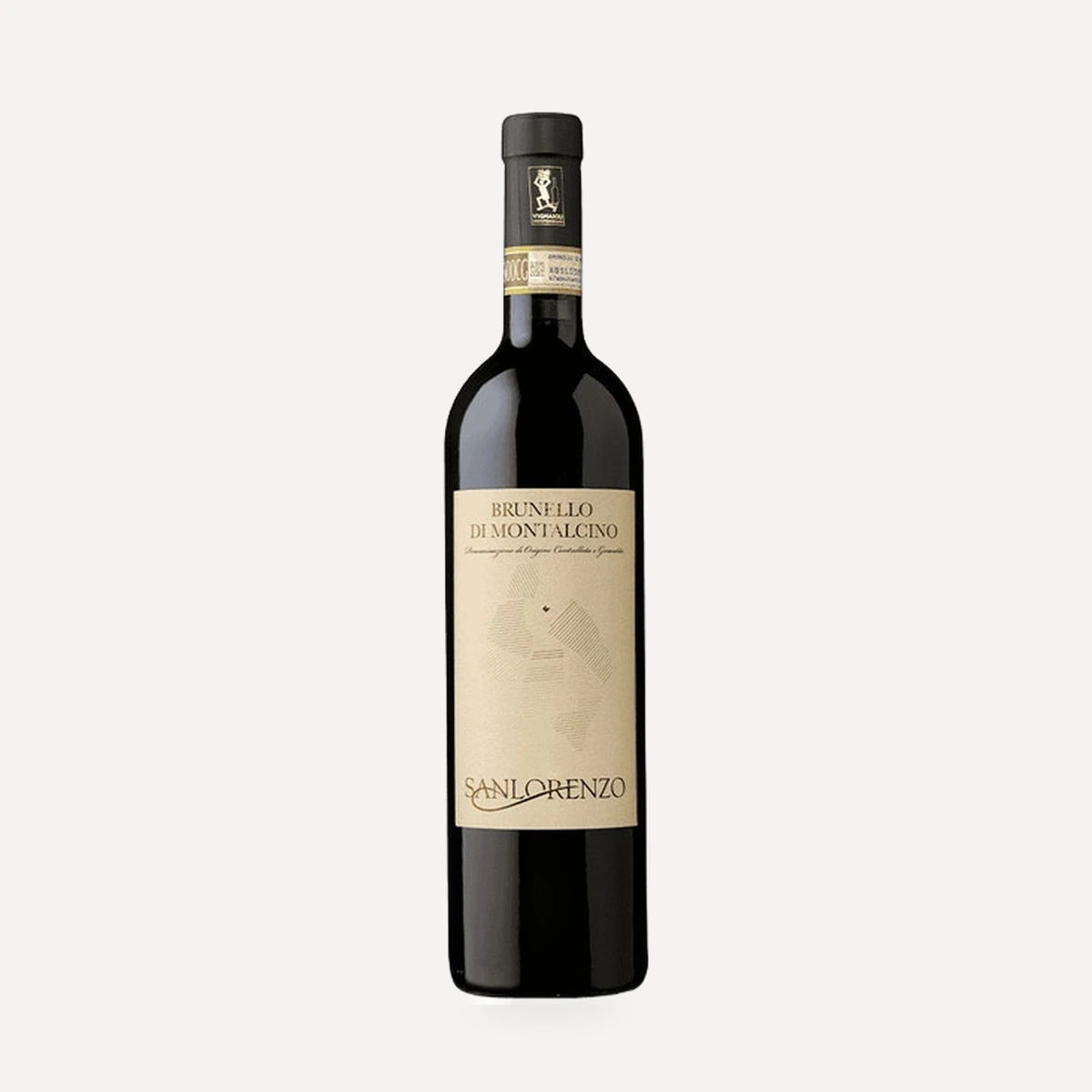
In 2021 Sanlorenzo introduced a redesigned visual identity. The new labels made the vineyards central to the design, using the slopes of the rows and colour distinctions connected to planting age to narrate the estate's development through successive vineyard plantings.
Terroir
Position and exposure
Sanlorenzo lies on the south-western side of the municipality of Montalcino, on a ridge at approximately 500 m above sea level. The ridge descends from Poggio della Civitella toward the Ombrone river. The property extends across both sides of the hills: woodland and Val d’Arbia lie to the north, while the vineyards face south or west according to the natural terrain and open toward the south-west, Maremma and the sea. The youngest vineyards form an amphitheatre facing Valle dell’Orcia and the sea.
The high-hill microclimate is shaped by altitude, exposure, rainfall and temperature patterns. Marked day-to-night temperature variation was particularly evident during seasons such as 2022, when it supported late ripening.
Geological foundation
The dominant geological outcrop is the Formation of Santa Fiora, dating from the Upper Cretaceous to the Lower Eocene and described as approximately 40 million years old. It consists of alternating hazel-grey, green or red clay-marl layers and decimetre-thick grey strata of calcarenite and fine limestone. The geological map also identifies Pietraforte within the property.
Pedogenesis over this formation has produced structured, medium-textured soils with a substantial clay fraction. Typical profiles are approximately 50–70 cm deep, with abundant stones set in a sandy-clay matrix, high calcium content and moderate drainage. The soils are generally not very deep or fertile, tend to dry at the surface and are vulnerable to erosion on slopes, although their clay component retains water.
As the upper soil dries, roots penetrate fractures in the underlying rock. Interbedded clay-rich layers provide water-holding capacity and reserves that help the vines withstand moderate drought stress. The combination limits excessive vegetative growth during ripening and favours the accumulation of sugars and other berry components when water stress does not become excessive.
Pedological variation
The estate soil map distinguishes four units. CBO1 comprises shallow, gravelly to very gravelly and pebbly clay-loam or loam soils, weakly to strongly calcareous, neutral to slightly alkaline and well to moderately well drained. MTQ1 comprises moderately deep to deep, sparsely gravelly, sandy-loam and sandy clay-loam soils; these are non-calcareous, slightly to moderately acidic, have low base saturation and range from well to occasionally excessively drained. SBR1 comprises moderately deep to deep, sparsely gravelly to gravelly silty-clay and silty clay-loam soils, moderately to strongly calcareous, slightly to moderately alkaline and imperfectly to poorly drained. VIV1 comprises moderately deep to deep, sparsely gravelly clay-loam soils that are slightly calcareous, neutral to slightly alkaline and well drained.
The cartography records ground elevations ranging from roughly 399 to 513 m and maps slope classes from below 5% to above 55%.
Vinificazione
The vineyards are certified organic and are worked manually, with manual grape selection and an emphasis on low yields. Sangiovese is the sole planted variety. Training is divided between cordon and Guyot, while planting density rises from approximately 3,000 vines/ha in the oldest vineyard to approximately 4,500 vines/ha in newer plantings.
Harvest timing follows the progress of each season. Grapes are picked by hand and selection can occur both in the vineyard and after arrival at the winery. This was especially important in 2024, when late rain caused mould and only the soundest material was retained. Climatic pressure can substantially affect production: a spring cold wave froze almost half of the emerged buds in 2020; hail on 23 August damaged leaves and grapes in 2021; and downy mildew destroyed approximately 70% of the potential 2023 crop after prolonged May and June rain.
The harvest reports document the estate's focus on balancing phenolic maturity, sugar accumulation, acidity and grape health rather than relying on a fixed date. Harvest took place on 28–29 September in 2020, 7–8 October in 2021, 26–27 September in 2022, 25 September in 2023, approximately 14–15 October in 2024 and 1–2 October in 2025.
Grapes are taken to the winery immediately after picking, carefully destemmed and crushed. Fermentation takes place in temperature-controlled stainless-steel tanks. Fermentation and subsequent skin maceration generally extend for about 25 days, with temperatures moving from approximately 28 °C during the opening days to around 20 °C toward the end. The fermenting wine is periodically circulated and racked.
After vinification, the wines return to stainless steel before their respective maturation paths. Rosso di Montalcino matures for approximately 12 months in old barriques and tonneaux of different sizes, followed by bottle refinement; it is released in the spring of the second year after harvest. Brunello di Montalcino matures in large wooden casks. The estate overview identifies 30 hl casks and a period exceeding two years, while the current Brunello specification gives approximately three years in 30–35 hl large oak casks. It subsequently returns to steel, is bottled and rests for at least four months before release from January of the fifth year after harvest.
Bramante Riserva is made only in selected exceptional years from a selection of the best grapes. It matures in medium or large wooden casks, is bottled in its fourth year and remains in bottle until release in January of the sixth year following harvest.
Rosato began with a different small-scale process. From 2014 through 2018, juice was drawn from a Rosso di Montalcino vat and supplemented with must from other vats. It fermented and remained in barriques until the end of winter without racking or bâtonnage. From 2019, vinification and maturation were divided between barriques and a Clavier ceramic vessel. Production has remained very small, historically no more than about 600 bottles per year and currently presented within a range of approximately 500–1,200 bottles.
Filosofia
Sanlorenzo defines its approach through respect for the terroir, sincerity in the wines and production in small batches. Its outlook joins Montalcino tradition and local knowledge with technology, research and experimentation.
The family's self-description places authenticity, hard work and personal simplicity at the centre of the estate. Vineyard work, seasonal waiting and direct family participation are treated as inseparable from the finished wine. The progression of vineyard plantings is also part of the estate's identity: the redesigned labels make the rows, slopes and planting ages the visible record of that development.
Luciano Ciolfi's accounts of individual growing seasons emphasise patience and adaptation to nature's rhythm. Lower production is accepted when selection or adverse weather demands it, while vintage differences are preserved rather than presented as something to erase. The stated ambition is to maintain tradition while remaining open to the future.
Vini
Brunello di Montalcino Bramante Riserva DOCG