Storia
Origins in 2013
SETE began in 2013 with a meticulous survey of old vineyards across the Valle dell’Amaseno. The mapping work led to a relationship built on listening and trust with elderly local winegrowers. The project initially collaborated with them, learned from their experience and, over time, took over and preserved vineyards that were at risk of disappearing.
The recovery programme combined restorative pruning, conversion to certified organic farming and a census intended to secure formal recognition of the vineyards as agricultural and cultural heritage with the Regione Lazio. Its purpose was to restore a viable future to old, fragmented vineyards and to the agricultural knowledge associated with them.
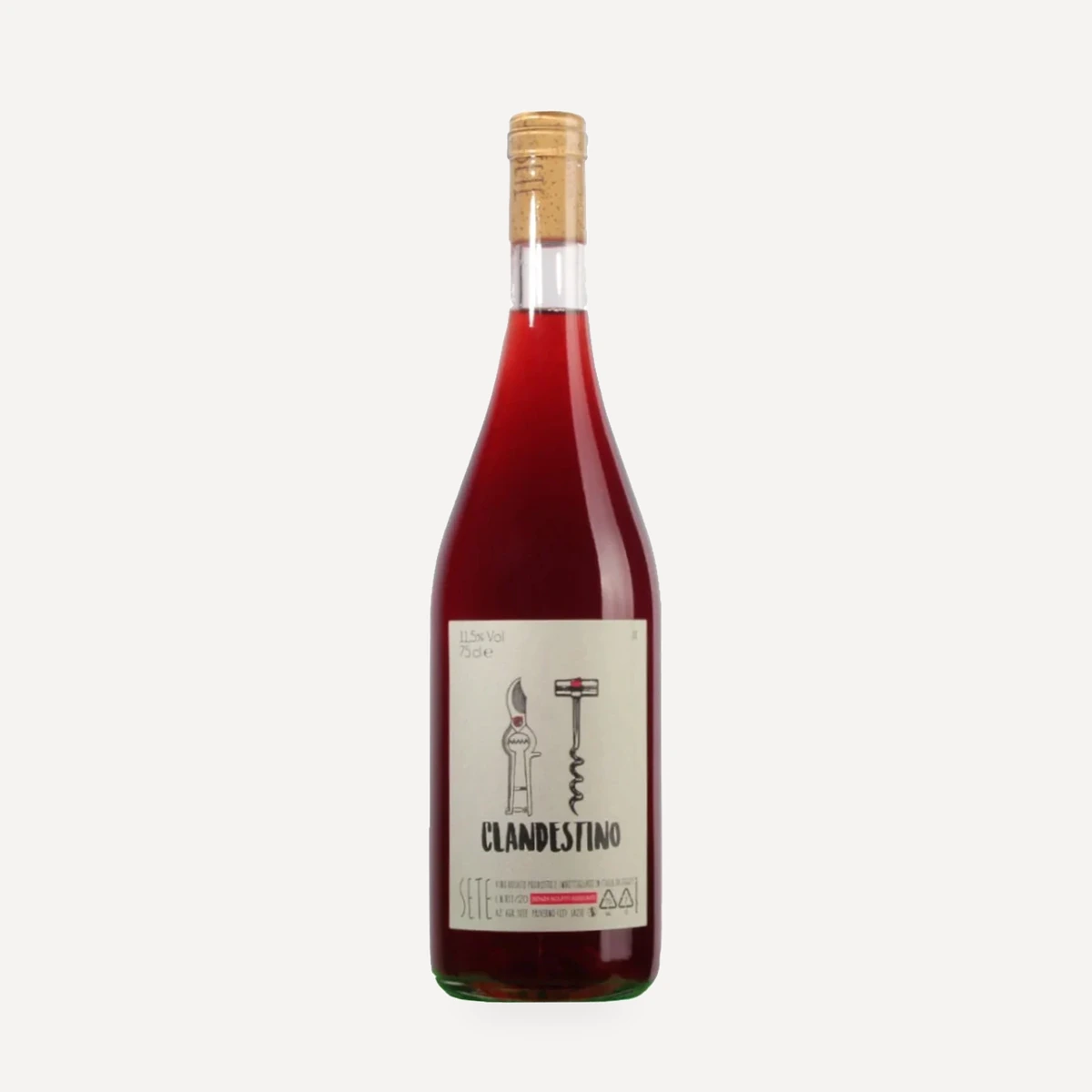
The first experimental wines were made in an improvised “clandestine” cellar. This period later inspired the name Clandestino, whose label combines pruning shears and a corkscrew as symbols of work and conviviality.
The 2014 season
In 2014, SETE began managing two historic mixed-variety plots planted in 1978. Their red and white varieties are traditionally harvested and vinified together as a field blend.
The same year also produced Freaky. Persistent rain and severe downy mildew pressure left only a very small quantity of sound fruit in two small vineyards belonging to an elderly grower then under SETE’s management. Rather than separate the remaining white and red grapes, the team fermented them together. The successful result became an annual practice whose precise composition changes with the fruit available from each harvest.
Regenerating an old-vine landscape
The project now cultivates 4.5 hectares divided among 12 plots. The old vineyards range from approximately 50 years to more than a century in age. They originated in an agricultural landscape where vineyards were part of daily subsistence farming rather than isolated monocultures. SETE continues to exchange knowledge with elderly local winegrowers and, when possible, also works with their grapes to keep these small agricultural holdings productive.
The recovered vineyards have been integrated into an organic, polycultural system where vines coexist with centuries-old oaks, fruit trees and olive trees. The estate focuses its present cultivation on Ottonese, Moscato Bianco and Malvasia Puntinata.
The 2023 climatic crisis
Incessant rain during spring and summer 2023 caused the most severe harvest loss SETE had experienced since its foundation. After months of vineyard work, the cellar was left with only a very small proportion of the season’s fruit. The surviving grapes came from vineyards with different soils and were consolidated into just two cuvées, one white and one red, rather than the normal range. Both were named Quello che rimane—“What Remains”—as a reflection on the instability of natural systems and viticulture’s exposure to the contemporary climate crisis.
Adaptation in 2024
Climatic difficulties again affected part of the red crop in 2024, slowing ripening and leaving the grapes with less sugar. SETE responded by accepting the fruit’s character rather than attempting to impose a predetermined style, using the lower sugar level as the basis for a lighter, fresher expression.
Terroir
SETE is based at Priverno in Lazio’s province of Latina, approximately 100 km south of Rome and midway between Rome and Naples. The vineyards lie against the Monti Lepini, between the Agro Pontino and Ciociaria, a short distance from the sea and the Parco Nazionale del Circeo. Monte Semprevisa, reaching 1,536 metres above sea level, shelters the area.
The vineyards occupy a transitional position between mountains and coast, where cold air currents descending from the mountains meet maritime breezes. Geologically, this is the point where limestone rock gives way to marine influence.
The soils are principally red clay and silt, with smaller components of sand and limestone. They developed through millennia of alluvial sedimentation: water descending from the mountains weathered the rock, carried minerals and iron oxide into the valley and deposited them before draining away without prolonged stagnation.
Vinificazione
SETE’s viticulture is based on the recovery rather than replacement of old vineyards. Work following the 2013 survey included restorative pruning, conversion to certified organic agriculture and a census seeking recognition of the vineyards’ agricultural and cultural significance by the Regione Lazio.
The agricultural system continues the area’s historic polyculture. Centuries-old oaks, fruit trees and olive trees coexist with the vines, supporting a diversified landscape rather than a vineyard monoculture. SETE presents these trees as elements that protect and nourish the vines and regards respect for natural cycles as an inherited form of practical biodiversity.
Daily vineyard work is artisanal and informed by continuing exchanges with elderly winegrowers. SETE gathers their experience, collaborates with them and, when possible, accepts their grapes so that small, old holdings remain part of the working agricultural landscape. The cultivated varieties identified as the present native focus are Ottonese, Moscato Bianco and Malvasia Puntinata.
The project adapts vineyard and cellar decisions to the conditions of each season. In 2014, a combination of persistent rain and downy mildew sharply reduced the healthy crop in two managed vineyards. In 2023, relentless spring and summer rain caused an exceptionally severe harvest loss. Climatic pressure in 2024 slowed the ripening of some red grapes, and the resulting lower sugar levels were accepted as part of the vintage’s character.
SETE treats wine as living, evolving fermented grape juice and seeks to transform the fruit without manipulation. Fermentations begin spontaneously with indigenous yeasts. Additives and processing aids are excluded, and no sulphites are added at any stage.
Maceration is used as an interpretive tool rather than according to one fixed recipe. Its purpose is to explore the expressive potential of the variety, site and vintage, producing wines that may range from agile and immediately drinkable to more structured. The objective is not stylistic uniformity: each vintage is allowed to retain its own character and remain capable of evolution.
The production approach can include the joint fermentation of mixed varieties. Historic field-blend plots are vinified together, while the recurring Freaky blend combines white and red grapes in proportions determined by the crop available in a given season. During the severely reduced 2023 harvest, grapes from vineyards with different soils and characters were consolidated into only two cuvées and fermented without additions.
Filosofia
SETE describes agriculture and wine as tools for independence, human connection and conviviality. The project is rooted in the places where its team was born, grew up, later returned and ultimately chose to remain. Wine is intended to communicate the continuing transformation of those places rather than present a static regional image.
The recovery of abandoned or vulnerable old vineyards is framed as an act of agricultural resistance and reuse. Listening to elderly winegrowers, preserving their practical knowledge and keeping their small parcels in production are therefore part of the project’s cultural purpose as well as its farming activity.
In the vineyard, biodiversity is understood through the inherited polyculture of previous generations and respect for natural cycles. In the cellar, the corresponding principle is non-manipulation: spontaneous fermentation, indigenous yeasts, no additives and no added sulphites. SETE rejects a fixed stylistic standard in favour of wines shaped by variety, place and vintage—living products expected to continue changing after fermentation.
Conviviality is central to this outlook. Wine is treated as a shared food and as a means of bringing people, agricultural knowledge and local cultural activity into relationship. Climatic adversity is not concealed through forced uniformity; the difficult harvests of 2014, 2023 and 2024 became occasions to alter blends, reduce the range or accept a lighter expression according to the fruit available.
Vini