Storia
Expansion into Maremma
The Zingarelli family entered Maremma in 1998 with the acquisition of its first estate in the area. Tenuta Casa Maria followed in 2003, strengthening the family’s presence in Maremma and bringing the two properties’ combined vineyard area to approximately 50 ha.
Acquisition and vineyard development in 2003
Tenuta Casa Maria comprised 64 ha at the time of its acquisition. Approximately 25 ha are now under vine, with the measured vineyard surface reported as 24.64 ha. Vineyard plantings date from 2003 and 2008.
The estate marked the Zingarelli family’s first planting of Vermentino. This variety became a distinct focus at Casa Maria alongside Sangiovese and Cabernet Sauvignon, reflecting a project to explore Vermentino’s potential in the coastal environment of Maremma.
The L’Aja Bruciata project
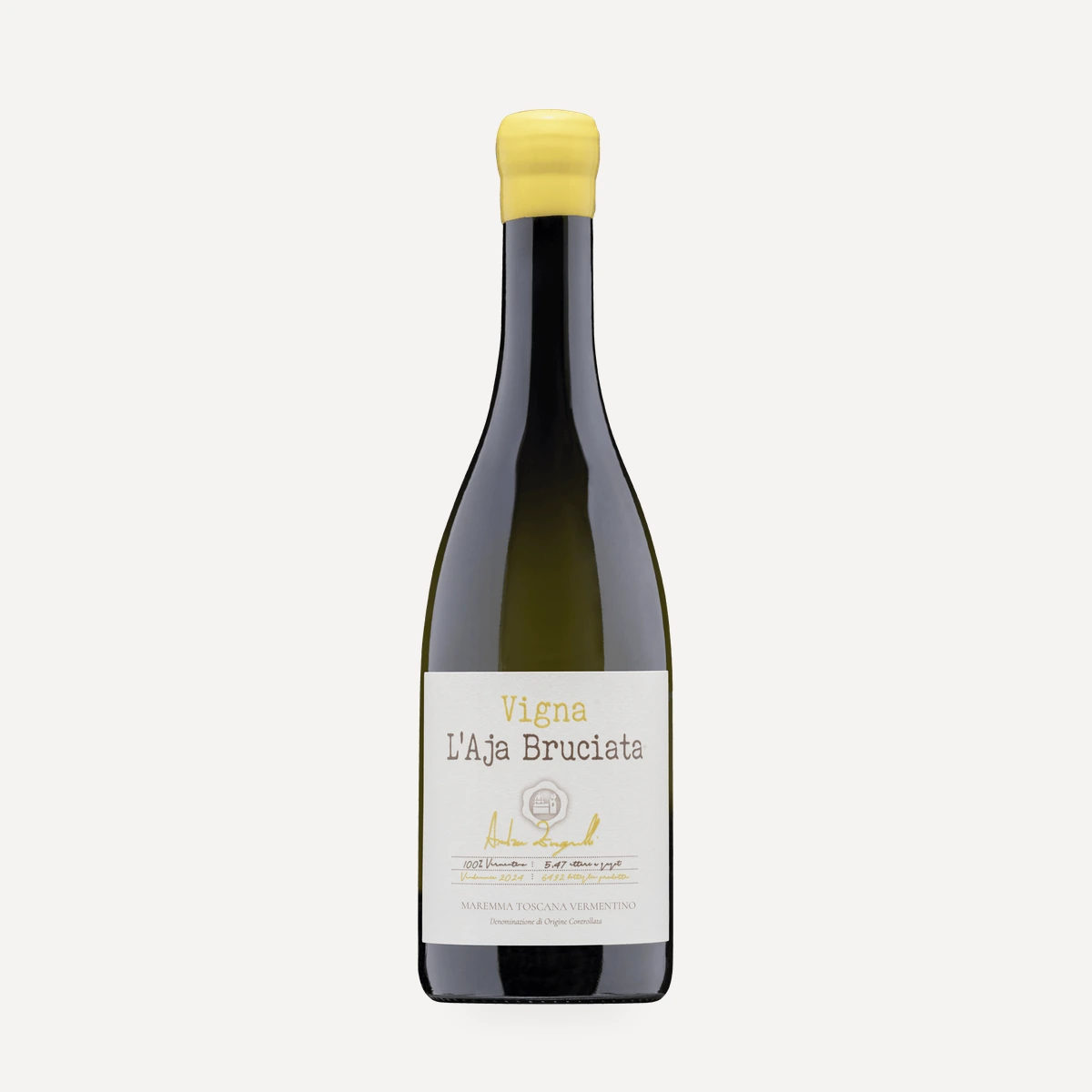
Vigneto L’Aja Bruciata was planted in 2008 as a 5.47-ha Vermentino vineyard. Andrea Zingarelli developed the associated project to test the variety at the limits of its potential, including its capacity for evolution with age.
First release in 2021
The first release of Vigna L’Aja Bruciata took place in 2021. Made entirely from Vermentino grown at Casa Maria, it established a named estate wine dedicated to the variety and its expression in Maremma.
Terroir
Tenuta Casa Maria lies in Maremma, in the Province of Grosseto, Tuscany. The 64-ha property contains 24.64 ha of vineyards between 110 and 150 m above sea level.
The vineyards principally face north to northwest. Their soils are quartz-rich sandstone with a sandy-loam texture and a tendency toward sub-acid conditions.
Casa Maria’s Vermentino project is closely associated with its coastal Maremma setting. The variety is presented as particularly responsive to the sea and capable of reaching its strongest expression in coastal areas. Vigneto L’Aja Bruciata occupies the upper portion of the estate’s stated altitude range, at 135–150 m, and shares the estate’s north-to-northwest orientation and quartz-sandstone, sandy-loam, sub-acid soil profile.
Vinificazione
Casa Maria’s vineyards use spur-pruned cordon and Guyot training, with Guyot specified for Vermentino. The recorded planting years are 2003 and 2008; Vigneto L’Aja Bruciata was planted in 2008 at 6,060 vines per hectare.
The estate belongs to the Zingarelli family’s broader sustainability programme. In 2000 the business began abandoning a number of environmentally invasive techniques and introduced an internal sustainability protocol designed to reduce and rationalise the consumption of natural resources, avoid waste and limit pressure on ecosystem balance.
Across the family’s vineyards, monitoring combines contemporary technology with established practices. Measures include weather stations linked to plant-health monitoring and warning systems, infrared mapping of vineyard health, monitoring of harmful insects, introduction of antagonist insects, pheromone-based mating disruption, beekeeping along vineyard margins, organic fertilisers, green manure, and the recovery of rainwater and wastewater.
In 2021 this programme entered the VIVA sustainability certification framework. VIVA evaluates four indicators: Air, covering climate footprint; Water, covering water footprint; Vineyard, covering the impact of agronomic management; and Territory, covering socio-economic and cultural effects.
Filosofia
Casa Maria forms part of the Zingarelli family’s Global Quality programme, developed from the 1990s around the pursuit of high-quality grapes as the basis for high-quality wine. Since 2010, Lorenzo Landi has supported Andrea Zingarelli and the technical team in translating that objective into agronomic and oenological decisions.
The family’s approach has shifted from treating the vineyard simply as a source of grapes to examining individual, internally uniform plots as the basis for wines with distinct territorial identities. Within Casa Maria, the focused development of Vigneto L’Aja Bruciata and its Vermentino project reflects this parcel-based approach.
The family describes drinkability as a prerequisite rather than the final objective. Its broader ambition is for wine to communicate the landscape beyond the glass—a form of “wine landscape” capable of expressing place as well as technical quality.
Environmental responsibility is presented as inseparable from territorial identity. The internal sustainability protocol seeks to conserve water, air and soil, reduce waste and minimise the effect of human activity on ecosystem balance while combining technological monitoring with vineyard practices rooted in tradition.
Vini