History
1920 and the survival of Mamojada’s vineyards
The defining historical background is the isolation of Mamojada. In the estate narrative, phylloxera destroyed 99% of Europe’s vineyards in 1920 but did not reach this remote part of Sardinia. Historic vineyards consequently survived, including century-old Cannonau vines that remain central to the project.
The Bacci Wines acquisition
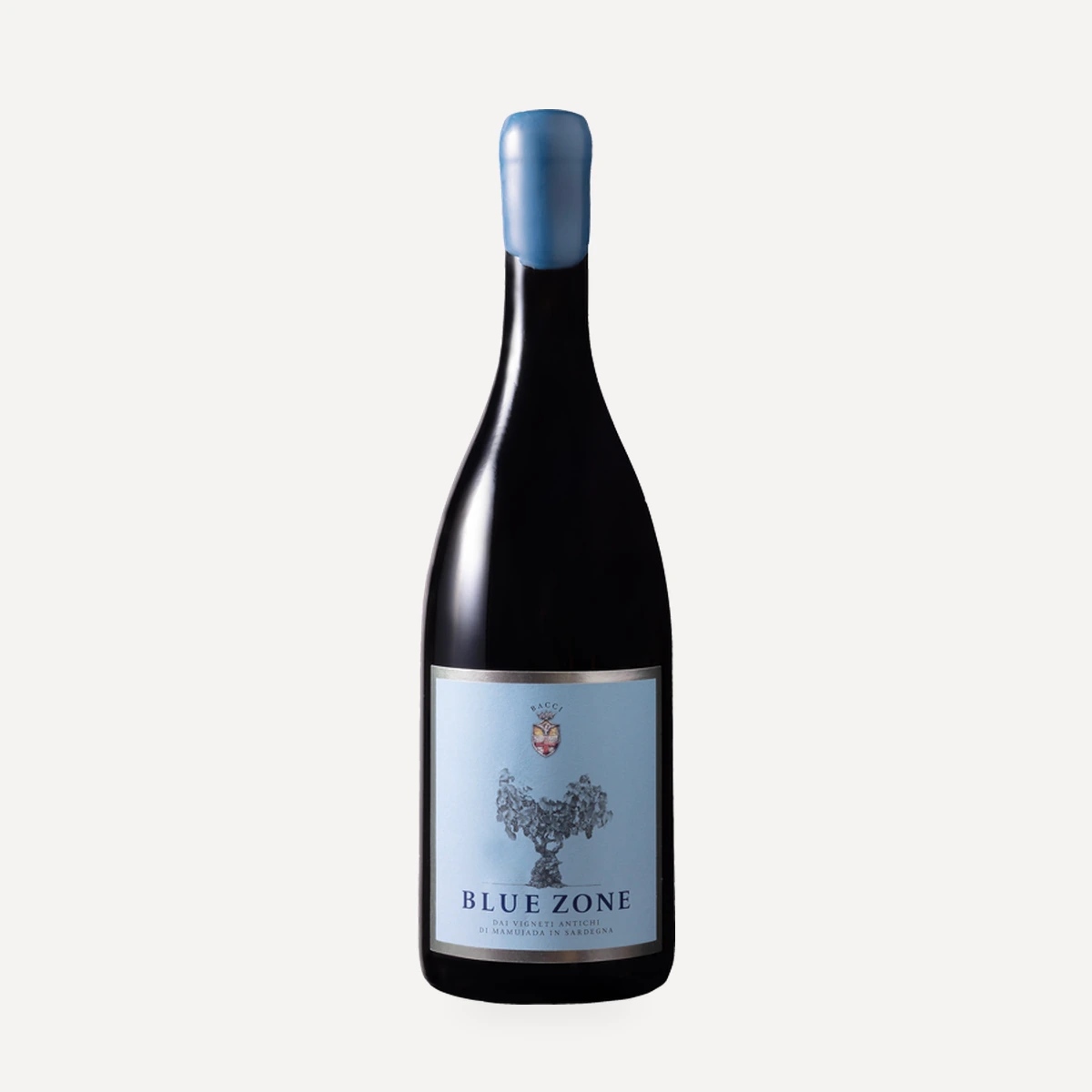
At an unspecified date, Bacci Wines acquired Blue Zone as its latest estate and established Marco Bacci’s new Sardinian project in Barbagia, at Mamojada. The project was conceived around the meeting of local tradition, innovation and the character of the Sardinian territory.
The estate adopted an artisanal, deliberately small-scale model. Production was restricted to 3,000 bottles annually, while work in the difficult mountain vineyards continued by hand or with traditional Sardinian oxen adapted to the rocky terrain.
Terroir
Blue Zone is based at Mamojada in Barbagia, in the remote central-eastern part of Sardinia. Its vineyards occupy mountainous, difficult terrain between 400 and 900 m above sea level.
Granite and rock dominate the vineyard soils. This geology interacts with a locally distinctive climate and Mamojada’s established winegrowing traditions. The area’s isolation is especially important: it kept phylloxera from reaching the historic vineyards, allowing century-old Cannonau vines to survive.
The combination of elevation, rocky granite terrain, climate and old vines forms the environmental basis of the estate’s identity.
Winemaking
All vineyard operations on the difficult mountain terrain are performed manually or with the assistance of Sardinian oxen. This traditional breed is well adapted to the rocky conditions.
The oxen are used to work the soil gently, reducing disturbance and helping to preserve its integrity. This respectful treatment of the ground is the estate’s stated basis for sustainable viticulture.
Blue Zone follows an artisanal, deliberately limited production model guided by rigorous attention to quality. Annual output is restricted to 3,000 bottles, with the objective of expressing Mamojada’s terrain, historic vines and local traditions.
Philosophy
Blue Zone is conceived as a meeting of Sardinian tradition, innovation and the authentic character of Mamojada. Its approach links wine quality to the preservation of historic vineyards, careful treatment of difficult soils and respect for local agricultural traditions.
Manual labour and the use of traditional Sardinian oxen embody this relationship with the terrain. Production remains intentionally limited, with an artisanal focus intended to convey the environmental and cultural identity of Mamojada.
Wines