History
The Bertoroni farmhouse, 1760–1873
The earliest nucleus of Cascina Bertoroni was built in 1760. The farmhouse stood amid woodland and vineyards in a landscape described as broadly resembling the present setting.
Luigi Arnulfo was born in Cherasco on 14 May 1852. His father, Carlo Arnulfo, ran the family pharmacy, and Luigi was initially expected to continue that profession. His pharmaceutical education nevertheless became useful later, informing ideas that were considered advanced in the contemporary wine sector.
On 3 April 1873, Luigi received a letter from his cousin Felice Zabaldano of Monforte d’Alba proposing the purchase of Cascina Bertoroni and its property in the Costa della Bussia area, already known for the quality of its grapes.
Foundation of Tenuta Arnulfo, 1874
Luigi and his father completed the acquisition on 24 February 1874, founding what became Tenuta Arnulfo. Luigi was 22. He abandoned the more secure prospect of running the pharmacy, moved to Bertoroni and personally directed the agricultural and winemaking work—an unusual decision for a landowner of that period.
The deed described the farmhouse and several named holdings, including the field called terra dei buoi, partly under vine; the meadow called Gatto; the field dell’Uvaro; and the Bricco land planted with mulberry trees. The stated consideration was 20,000 lire for Luigi’s portion and 7,000 lire for Carlo’s.
A surviving bottle from the 1874 vintage connects the estate’s foundation year directly with Luigi’s winemaking activity.
Luigi Arnulfo and overseas trade, 1883–1928
Luigi became an early advocate for identifying the origin of his wine. The label on a surviving one-gallon square bottle of the 1883 vintage carried both “Regione Bussia – Fini di Monforte d’Alba” and “Luigi Arnulfo proprietario.”
From 1890, he pursued new commercial opportunities and sent Barolo to North America, specifically California. Correspondence from San Francisco records importer Carlo Rossi thanking him for a shipment. Unlike the barrels commonly used in the period, the wine crossed the ocean in square containers of approximately one gallon, a format conceived to use transport space efficiently. Letters from London and Munich further document the international reach of his contacts.
Luigi died in 1928. His death began a period of decline for the winery. His daughter Carolina did not continue direct production with the same commitment and, after several years, granted the inherited land in usufruct to a family from Monforte d’Alba.
Dormancy and continuity in the vineyards, 1928–1988
Although direct wine production ceased, viticulture continued on the property. Campo del Gatto was planted in 1969 and is now the estate’s oldest vineyard. Carolina died without heirs in 1975. The property remained with Mr Barale, who continued cultivating the vines while the farmhouse stood unoccupied.
Revival as Costa di Bussia, 1988–1990
Paolo and Guido Sartirano invested in the property in 1988 with the aim of restoring it. The reborn winery took the name Costa di Bussia, an old place-name already used for the property in the nineteenth century.
Restoration took approximately two years. The project reinstated the historic rooms used for vinification and maturation, rehabilitated existing vineyards and included replanting. Nebbiolo vineyards were planted in 1988, and Bricco was replanted in 1990. The first productive harvest of the revived estate took place in 1990, when Costa di Bussia released wine again.
During the 1988 work Paolo Sartirano found two historic bottles in the farmhouse: the 1874 bottle and the square, one-gallon bottle of 1883 Barolo associated with Luigi’s California shipment.
Vineyard development, 1992–2011
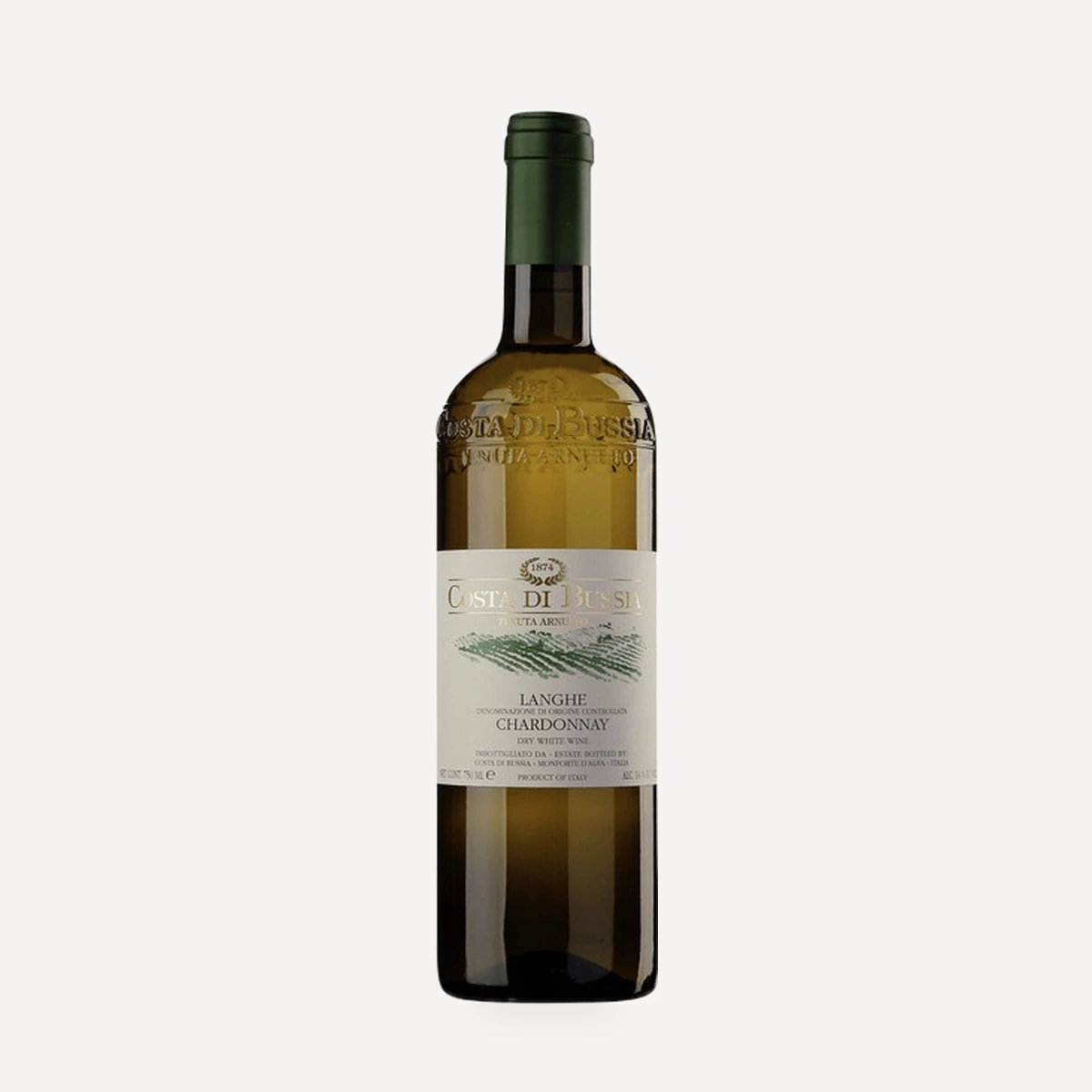
In 1992 Paolo Sartirano planted 0.75 hectares of Chardonnay in Bussia, deliberately testing the variety in land principally associated with structured red wines. Further Nebbiolo plantings followed in 1996 and 1997. The principal modern Barbera vineyard was planted across 2006 and 2007.
The name Campo del Gatto had appeared in the estate’s original acquisition documents and remained in use. From the 2011 harvest, “Vigna Campo del Gatto” became an officially permitted vineyard mention under the Barbera d’Alba D.O.C. production rules.
Restoration, museum and hospitality, 2012–2024
Between 2012 and 2014, the first floor of Cascina Bertoroni—the former living quarters of Luigi and later Carolina—was restored and converted into an agriturismo. The oldest ground-floor section became the Museo Storico Luigi Arnulfo with an adjoining tasting room.
A change also occurred in the Arcaplà tradition. Until the 2010 vintage, Langhe D.O.C. Rosso “Arcaplà” had combined 70% Nebbiolo and 30% Barbera using the old arcaplé approach. Beginning with the 2014 vintage, the name passed to a Langhe D.O.C. Nebbiolo made entirely from estate-grown Nebbiolo.
The estate marked its 150th anniversary in 2024. Its activities now encompass 11 hectares of vineyards, on-site vinification, bottling and maturation, the historical museum, guided visits and tastings, and accommodation within Cascina Bertoroni.
Terroir
Costa di Bussia occupies the Bussia hill between Barolo and Monforte d’Alba, with 11 hectares of vines surrounding the winery. The vineyards form part of the Langhe landscape and extend over pronounced slopes where mechanisation is difficult.
Bussia lies across two geological complexes: clay–marl and sandstone–marl. These origins overlap, alternate and intermingle across the hill, creating pedological variation among different exposures and elevations. At estate level, clay-rich soils carry abundant mineral components. Individual sites vary in their proportions of marl, clay, sandstone, sand and carbonate.
Lower Nebbiolo parcels run from southern to western exposures. Their medium-textured soils are rich in carbonates and have a balanced nutrient supply. Sand gives way to clay enriched in calcium and potassium. Fertility is moderately restrained, while alternating leaner and more fertile sections produce variations in ripening.
Campo dei Buoi rises from 250 to 350 metres and is entirely south-facing. Marl dominates, with smaller proportions of clay and sandstone. Its high carbonate content regulates water availability, including in difficult seasons; potassium, phosphorus, calcium and other mineral elements are balanced.
Bricco occupies the hilltop behind the farmhouse, on southern and western exposures, at nearly 400 metres. Erosion has exposed marl-rich parent rock. These lean, carbonate- and mineral-rich soils compel the roots to explore deeply.
Campo del Gatto faces due south on a limestone-rich ridge where clay marl reaches the surface. Its severe soil restrains Barbera’s vigour. Sand is scarce and the clay fraction correspondingly high.
The principal Barbera site faces west on medium-fertility soil. Sandstone lightens the clay and reduces fertility, while mineral components support balanced grape development. The Chardonnay parcel has a less severe, comparatively loose and constituent-rich soil with abundant mineral elements. Even within the contiguous estate, these geo-climatic differences require parcel-specific responses in seasonal work and vinification.
Winemaking
All wine production is derived exclusively from the estate’s 11 hectares surrounding the winery. Vineyard work is adapted to the geo-climatic character of each parcel rather than treating the holdings uniformly.
The steep terrain restricts the use of machinery, leaving much of the care of the rows dependent on manual work. Harvesting is strictly by hand. Picking dates vary by variety and season: Chardonnay generally begins in September to retain acidity and freshness, followed by Dolcetto, Barbera and Nebbiolo during autumn.
The 2023 season illustrates the estate’s responsive approach. A dry opening to spring was followed by abundant rain in May and June, promoting vegetative growth but requiring considerable work to prevent early vine diseases. The season’s most violent weather event occurred on 6 July, although the vineyards escaped damage. Chardonnay matured in the first week of September, Dolcetto and Barbera in the second half of that month, and Nebbiolo picking began in the second week of October.
All estate wines are vinified, bottled and matured at Cascina Bertoroni. The restored production spaces include the rooms in which Luigi Arnulfo originally worked.
Harvest and white-wine processing
Harvesting is manual. Chardonnay is usually the first variety picked, beginning in September to preserve acidity. After a short period of skin contact, the crushed white grapes are pressed immediately. The must settles for approximately 12 hours at low temperature for clarification, after which the clear juice begins alcoholic fermentation at no more than 15°C.
Chardonnay remains on fine lees for approximately six months. It then receives a gentle filtration before bottling.
Red-wine fermentation and maceration
Red grapes are destemmed. Alcoholic fermentation proceeds with the skins in stainless-steel tanks at a controlled 27–30°C. Maceration lasts approximately one week for younger styles such as Dolcetto d’Alba and Barbera d’Alba, and may extend to three weeks for Barbera d’Alba Vigna Campo del Gatto and the Barolo selections.
Repeated pump-overs irrigate the cap with fermenting must to regulate extraction of colour, tannins and aromas.
Maturation
Younger Dolcetto and Barbera mature in stainless steel for 6–8 months. Repeated rackings clarify and soften the wines while their aromatic profile develops.
Barbera d’Alba Vigna Campo del Gatto matures for at least 12 months in 500-litre French-oak tonneaux. Nebbiolo and Barolo use wooden vessels of different types and sizes; Barolo rests in 5,000-litre Slavonian-oak casks for periods ranging from 18 months to 36 months for Riserva, with the duration adjusted to the vintage.
The wines are bottled under inert atmosphere. Bottle maturation continues for a wine-dependent period in stable conditions of 14°C and 75% relative humidity.
Philosophy
Costa di Bussia presents wine as a balance between natural factors—geology, climate, exposure and the character of each site—and sustained human work in both vineyard and cellar. Quality is understood to begin in the vineyard, with seasonal decisions and subsequent vinification tailored to the differences among parcels.
The estate’s stated aim is to keep its inherited historical and enological culture alive through wines grown, vinified, bottled and matured on the property. Tradition is paired with technical control: manual work and large Slavonian-oak casks coexist with temperature-controlled stainless steel, inert-atmosphere bottling and stable bottle-storage conditions.
Respect for terroir also governs sourcing. The wines are made exclusively from estate-grown grapes, and the identity of Bussia and individual historic sites—particularly Campo del Gatto, Campo dei Buoi and Bricco—is retained through vineyard-specific production.
Wines