History
Ancient agricultural roots
Three archaeological fragments incorporated into a wall at La Parrina came from the excavation of an ancient Roman agricultural villa. They evoke an older model of mixed farming in which land with different aptitudes was managed as a single productive system—a conception that continued through the Middle Ages and remains central to the estate’s identity.
1830 and the formation of the estate
Antica Fattoria La Parrina traces its modern history to 1830. In the first half of the nineteenth century, the aristocratic banker Michele Giuntini acquired the first nucleus of the old Tuscan agricultural property. Abundant harvests and productive land encouraged its subsequent development; over the following decades, the estate began to assume the scale and agricultural diversity associated with La Parrina today.
The property was organized through mezzadria, a long-term sharecropping system under which tenant farmers participated in both costs and profits. Entire families of estate managers, farmers and laborers worked at La Parrina across successive generations.
Mechanization, reclamation and expansion
From the late nineteenth century, the spread of agricultural mechanization was accompanied by substantial investment, crop diversification and land reclamation. These measures produced major growth, and La Parrina eventually accommodated as many as 460 workers.
The estate retained the integrated structure of the historical agricultural villa: productive fields were assigned to crops suited to their particular conditions, while other ground was used as pasture, allowed to rest, maintained as woodland or planted with trees for firewood.
The Second World War and recovery
The Second World War caused a serious interruption to the estate’s development. La Parrina subsequently recovered its agricultural identity while adapting its activities to modern requirements. The continuity of farming—and the preservation of a diversified estate rather than a vineyard monoculture—remained the basis of its development.
1971: the cellar and Parrina DOC
The estate cellar has been active since 1971. In the same year, La Parrina received recognition as a Denominazione di Origine Controllata. The denomination is presented as one of the very few Tuscan designations associated exclusively with a single agricultural estate, although its defined geographical area extends beyond the property into the surrounding territory and includes both white- and red-grape vineyards.
1983: development of the nursery
The estate nursery began operating in 1983. It later expanded to 7 ha and developed expertise in Mediterranean and drought-tolerant gardens as well as ornamental, fruit, climbing and exotic plants.
The transformation led by Franca Spinola
For many years Dr. Franca Spinola directed La Parrina. She rejected the former view of the Maremma as unsuitable for high-quality wine and committed the estate to a long program of improvement. Beginning in the 1990s, and working with skilled oenologists, she transformed both the choice of varieties and the cellar. Vermentino, Ansonica, Trebbiano, Merlot and Sangiovese were among the varieties involved in this renewal, while modern stainless-steel vats were introduced alongside traditional oak vessels and barriques.
The transformation required approximately 20 years of work and was coupled with a determined commitment to organic farming. Natural-origin fertilizers and organic methods were treated not as constraints on quality but as means of enhancing it.
1995: recognition for Ansonica
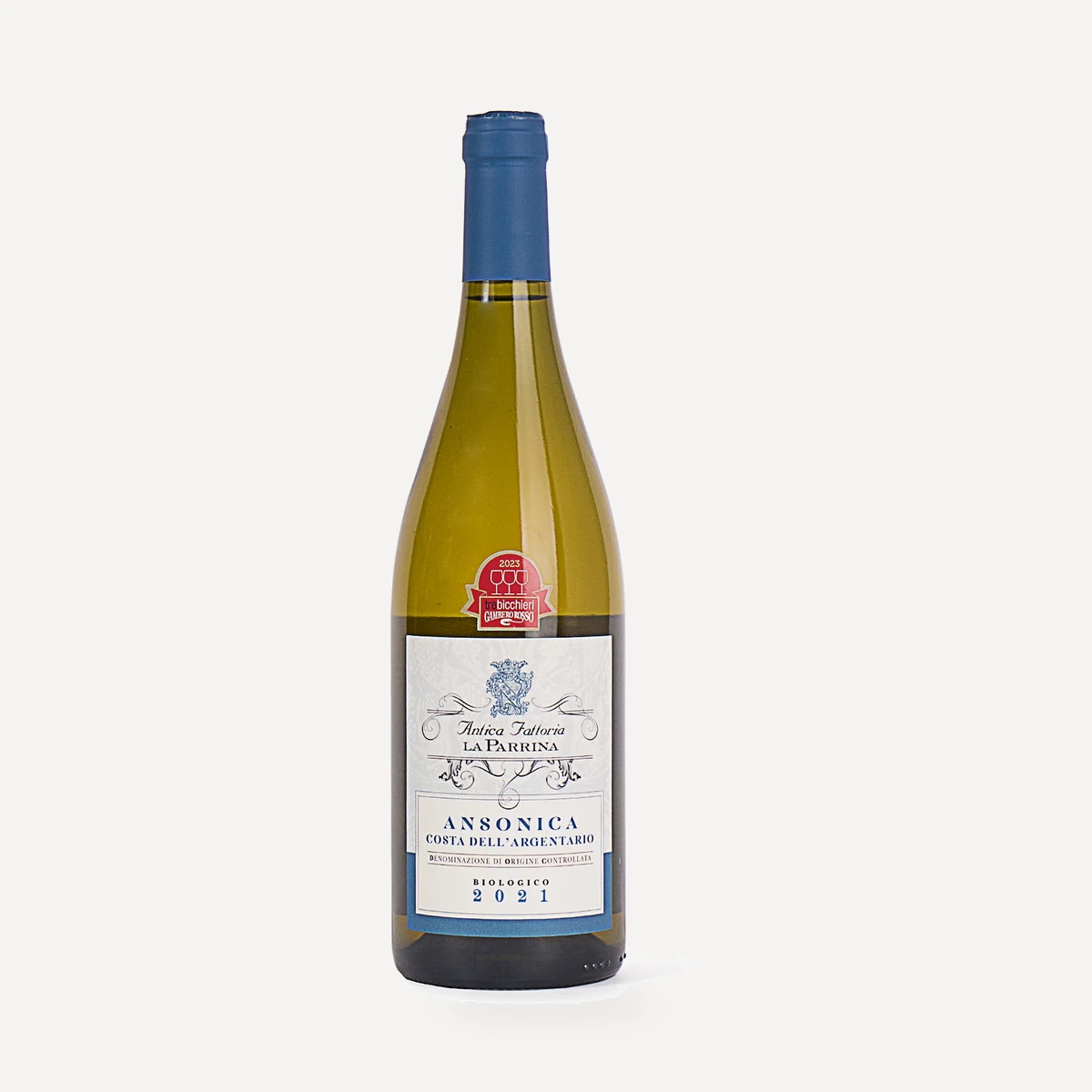
Wines produced from Ansonica obtained DOC recognition in 1995 under Ansonica Costa dell’Argentario DOC. The variety has a distinct place among the estate’s white grapes and is associated with named vineyards including Tinaro and Pini.
A diversified organic farm today
The contemporary estate continues the mixed-farming model. Approximately 200 ha are cultivated: 60 ha of vineyards, 40 ha of fruit orchards, 20 ha of horticultural crops and 22 ha of olive groves, with the remaining cultivated land used for arable crops and nursery production. Agricultural land adjoins a substantial wooded wildlife area within a predominantly hilly landscape extending across approximately 585 ha.
Wine production remains entirely within the estate, from organically grown grapes through vinification and bottling. The wider property also encompasses olive oil, fruit, vegetables, preserves, honey, cheese, horticulture, hospitality and food service.
2020: Orto Giusto
In July 2020, friends and entrepreneurs from Orbetello founded the Orto Giusto social cooperative. Its activities take place in La Parrina’s organic fields and involve young people with disabilities or cognitive and motor delays in programs supporting personal development, socialization and vocational skills.
Terroir
Position between the Mediterranean and inland hills
La Parrina is near Albinia in the municipality of Orbetello, a few kilometres from Monte Argentario. The Maremma setting is described as a meeting point of contrasting influences: the Mediterranean lies in front of the estate, while a long-extinct volcano stands behind it. The landscape includes a reclaimed plain, perforated tufa hills and predominantly hilly woodland.
The vineyards occupy approximately 60 ha in a strip immediately adjoining the hills of the Orbetello hinterland. They rise from the plain toward the first Tuscan hills; the Muraccio area is a foothill zone facing the Maremma coast.
Maritime air and winds
The sea affects the estate through its air and winds. The south-westerly libeccio, the scirocco carrying the scent of the sea and the breeze reaching the manor-house terrace all form part of the property’s immediate environment.
Soils and parcel variation
Vineyard soils vary by site and include sandy and clayey-sandy ground. The Tinaro and Pini vineyards associated with Ansonica are described as having clay and calcareous soils. Parcel-by-parcel vinification is used to retain the distinctions created by each combination of soil and microclimate.
Mediterranean vegetation and fauna
The surrounding vegetation includes holm oak, mastic, myrtle, strawberry tree, olive and maritime pine. Agricultural areas adjoin extensive woodland that shelters resident and migratory wildlife. Recorded mammals include hares, pine martens, stone martens, weasels, hedgehogs, porcupines, badgers, squirrels, foxes, fallow deer, roe deer and wild boar. Birdlife includes pheasants, quail, hoopoes, jays, woodpeckers, bee-eaters, hawks, kites, buzzards, kestrels, owls, scops owls, barn owls and tawny owls, together with water-associated mallards, teal, moorhens and herons.
Winemaking
Organic cultivation
The estate’s grapes are grown organically, using fertilizers of natural origin and methods designed to respect the botanical characteristics and natural cycles of each variety. Organic agriculture is part of a broader farm system rather than a practice confined to the vineyards.
Each plot is assigned to the crop considered most appropriate to its character. Free buffer areas are maintained around cultivated plots to reduce the risk of contamination. Working practices are timed around natural rhythms, and the agricultural approach combines inherited farming knowledge with modern agronomic research, technology, university collaboration and specialist expertise.
Training, pruning and crop management
The vineyards use spur-pruned cordon. Leaving relatively few buds on each vine was selected as the most suitable approach for the estate’s sandy and clayey-sandy soils, with the aim of increasing grape sugar levels and aromatic components.
Ansonica is characterized as late-ripening. In the documented Tinaro and Pini protocol, bunch numbers and bunch size are reduced several days before harvest to concentrate sugars and flavors before picking in early October.
Harvest and selection
The overall cellar protocol describes grapes as hand-harvested, transported to the estate cellar and carefully selected. Harvest lots are kept distinct so that parcels shaped by different soil and microclimate combinations can be vinified separately.
Biodiversity and mixed farming
Viticulture forms part of approximately 200 ha of cultivated land that also includes 40 ha of orchards, 20 ha of horticultural crops, 22 ha of olive groves, arable fields and nursery production. Woodland, pasture and uncultivated buffer areas provide additional habitats. Hawks are regularly observed perching on vineyard posts, while horses, sheep, donkeys, geese, ducks and other farm animals are integrated into the wider estate environment. Animal management emphasizes welfare, open space and freedom of movement.
All stages from vineyard to bottle take place within Antica Fattoria La Parrina. Grapes grown organically on the estate are brought to a cellar active since 1971, where they are carefully selected before vinification.
Stainless-steel tanks provide control over temperature and fermentation. Parcels are vinified separately to preserve the characteristics arising from their particular soil and microclimate. Modern steel vessels coexist with traditional oak containers and barriques, reflecting the cellar transformation begun under Franca Spinola in the 1990s.
Wine lots undergo organoleptic and laboratory monitoring throughout maturation and through bottling. The cellar produces Parrina DOC whites and reds, including wines intended for maturation, as well as Ansonica Costa dell’Argentario DOC and Toscana IGT Passito. Selected red wines are matured in wood; the Sangiovese Riserva, Muraccio and Radaia are identified as barrique- or wood-matured wines. Production is limited in scale.
A documented Ansonica protocol adds further detail for the Tinaro and Pini vineyards: late-ripening grapes are picked in early October after crop reduction, cooled after arrival to preserve fruit quality, softly pressed at approximately 60% yield and fermented under temperature control. The wine remains on noble lees for several months with daily bâtonnage, undergoes further refinement in oak, and is filtered before bottling.
Philosophy
La Parrina’s philosophy begins with the premise articulated by Franca Spinola that nature understands its own aptitudes. Each plot is regarded as already possessing a particular agricultural vocation; the human role is to recognize it, support it with science and technology and transform its produce without losing the values of its origin.
This principle explains the preservation of the historical mixed-farm model. Vineyards, orchards, olive groves, vegetable fields, arable land, pasture, woodland, nursery production and animal husbandry are treated as parts of a single agricultural system. Productive land, resting ground, forest and habitat are retained for different but complementary purposes.
Organic cultivation is presented as a means of reinforcing quality rather than compromising it. Natural-origin inputs, buffer zones, respect for seasonal rhythms, animal welfare and artisanal processing are combined with agronomic research, modern technology and specialist collaboration.
Continuity does not mean resisting change. The estate’s nineteenth-century organization has been adapted through mechanization, land reclamation, cellar modernization, revised varietal choices and contemporary research while maintaining the link between land, agricultural work and finished products. Hospitality extends the same philosophy by allowing visitors to encounter the farm’s products, daily work, seasonal rhythms and natural environment directly.
Wines