Storia
The Tenute Lunelli project
Tenute Lunelli began in 1987 with the production of the Lunelli family's first still wines in Trentino. Around 2000, the family broadened the project toward established red-wine territories. The stated stylistic aim across the estates was to create elegant, ageworthy wines closely connected to their places of origin.
2001: arrival in Umbria
In 2001, the family expanded Tenute Lunelli through the acquisition of vineyards within the Montefalco Sagrantino DOCG in Umbria. This established the project that became Tenuta Castelbuono, dedicated principally to Sagrantino and based at Cantalupo, in the commune of Bevagna.
Third-generation stewardship
In 2005, cousins Marcello, Matteo, Camilla and Alessandro Lunelli—the family's third generation—assumed leadership of the wider family business. Tenuta Castelbuono consequently developed under their stewardship as the Umbrian component of Tenute Lunelli.
2012: inauguration of the Carapace
The Carapace was inaugurated in 2012. The Lunelli family commissioned sculptor Arnaldo Pomodoro to create the working winery, conceived as a synthesis of sculpture, architecture, nature and wine. Its form evokes a tortoise shell, representing stability and longevity. The building has been described as the first sculpture in the world in which people can live and work.
2014: certified-organic production
Tenuta Castelbuono obtained organic certification beginning with the 2014 harvest. The certification encompasses its estate vineyards and Umbrian wines; the estate later also held Biodiversity Friend certification for both wine grapes and bottled wines.
2023: water resilience and biodiversity
The 2023 season was difficult, with abundant rain and low temperatures through June. Fungal diseases developed and, despite treatment, substantially reduced the crop. During the year, approximately 2 ha were planted on Winegraft rootstocks to reduce water consumption. These rootstocks were selected for water-stress resistance and used 25–30% less water over the vegetative cycle than conventional rootstocks under equivalent site and varietal conditions, without reducing yield or quality.
A Biodiversity Friend assessment found more insects and greater soil biodiversity than in preceding years. The result was associated with lower copper inputs, insect shelters and spontaneous ground cover that requires no forced irrigation.
2024: vineyard expansion and international recognition
Six additional hectares of vineyard were acquired in 2024. At year-end, the Umbrian operation recorded 39.5 ha of estate-owned vines and 8 ha of supplying vineyards. Total grape volume was 2,581 metric quintals, equivalent to 258.1 tonnes: 230 tonnes from estate vineyards and 28.1 tonnes from suppliers.
The Carapace placed 25th in the World's Best Vineyards 2024 ranking and received the distinction “Highest New Entry.” The ranking was determined by the votes of approximately 500 wine and tourism specialists.
Terroir
Location
Tenuta Castelbuono is the Umbrian estate of Tenute Lunelli. Its operating address is Vocabolo Castellaccio 9, Località Cantalupo, in the commune of Bevagna, near Assisi. Its viticultural activity extends across the communes of Bevagna and Montefalco within the Montefalco Sagrantino DOCG.
Recent climatic record
The 2023 growing season was marked by abundant rain and low temperatures through June. The resulting fungal-disease pressure substantially reduced the harvest despite plant-protection treatments.
Conditions in 2024 were more favourable overall. A warmer-than-average winter brought forward spring budbreak. Rain in March and April replenished underground water reserves, while a sharp fall in temperature during the second half of April temporarily slowed vegetative development. Temperatures rose quickly in May and further rain encouraged vigorous growth. Significant water stress was absent until mid-July, although isolated hail affected some areas.
There were no downy-mildew attacks in 2024. Limited cases of esca were managed in the vineyards. Ripening proceeded regularly, and harvesting began approximately ten days earlier than the historical average. The crop was healthy, with Sagrantino displaying its varietal character.
Vinificazione
Organic and biodiversity certifications
All estate-owned vineyards in Umbria are certified organic. At Tenuta Castelbuono, certified-organic production began with the 2014 harvest. Both wine grapes and bottled Umbrian wines also hold Biodiversity Friend certification.
Soil cover, plant protection and water resilience
Copper inputs have been reduced. Spontaneous ground-cover species are encouraged and do not require forced irrigation. A Biodiversity Friend assessment conducted in connection with the 2023 season found increased insect populations and greater soil biodiversity than in preceding years.
Approximately 2 ha were planted on Winegraft rootstocks by 2023. Their more efficient biochemical use of water reduces consumption by 25–30% over the complete vegetative cycle compared with conventional rootstocks under the same pedoclimatic and varietal conditions, without sacrificing production quantity or quality.
Habitat measures
The estate has installed shelters for insects and bats. Bees are also present and support a small honey production. These measures accompany the reduced copper programme and spontaneous vegetation in supporting soil vitality and functional biodiversity.
Harvest record
The difficult 2023 season produced 137.75 tonnes from estate vineyards and 23.14 tonnes from suppliers. In 2024, favourable conditions and regular ripening increased total output by approximately 30%. Harvesting was around ten days earlier than the historical norm. Total grape volume reached 258.1 tonnes: 230 tonnes of estate-grown grapes and 28.1 tonnes from suppliers.
The Carapace winery
Winemaking takes place in the Carapace, inaugurated in 2012. Arnaldo Pomodoro designed it as both a working building and a monumental sculpture, merging the production project with the surrounding landscape. Its internal vault carries Pomodoro's characteristic artistic language, while the tortoise-shell concept expresses stability and longevity.
The Umbrian operation processed 258.1 tonnes of grapes in 2024, comprising 230 tonnes from estate vineyards and 28.1 tonnes from supplying vineyards.
Circular management of production residues
Winery and vineyard by-products are either returned to the soil as organic matter or supplied to local companies for further use. In 2024, one stream comprising 12.8 tonnes of pomace and 2.2 tonnes of vine leaves went to a local healthcare company for transformation into wholly natural products. A further 38.5 tonnes of pomace and 4.5 tonnes of lees were sent to a local distillery.
Approximately 29.5 tonnes of grape stems were reused on the estate for agronomic purposes. Around 2 tonnes of pruning canes were shredded and incorporated into the soil to add organic matter.
Filosofia
Tenuta Castelbuono expresses the Tenute Lunelli objective of establishing a deep connection with each territory and enhancing it with care and respect. The Umbrian estate brings together viticulture, art and architecture: the Carapace does not stand apart from the wine project or landscape but is conceived as part of both.
Across Tenute Lunelli, the declared stylistic goal is elegance and longevity. At Castelbuono, that idea is embodied by the tortoise-shell symbolism of the Carapace and by the focus on Montefalco Sagrantino.
Environmental practice is centred on certified-organic farming, maintenance of biodiversity and adaptation to water scarcity. Reduced copper inputs, spontaneous vegetation, habitat structures and water-efficient rootstocks translate these principles into vineyard management. Production residues are treated as resources: some return to the soil, while others become raw materials for natural products or distillation.
Vini
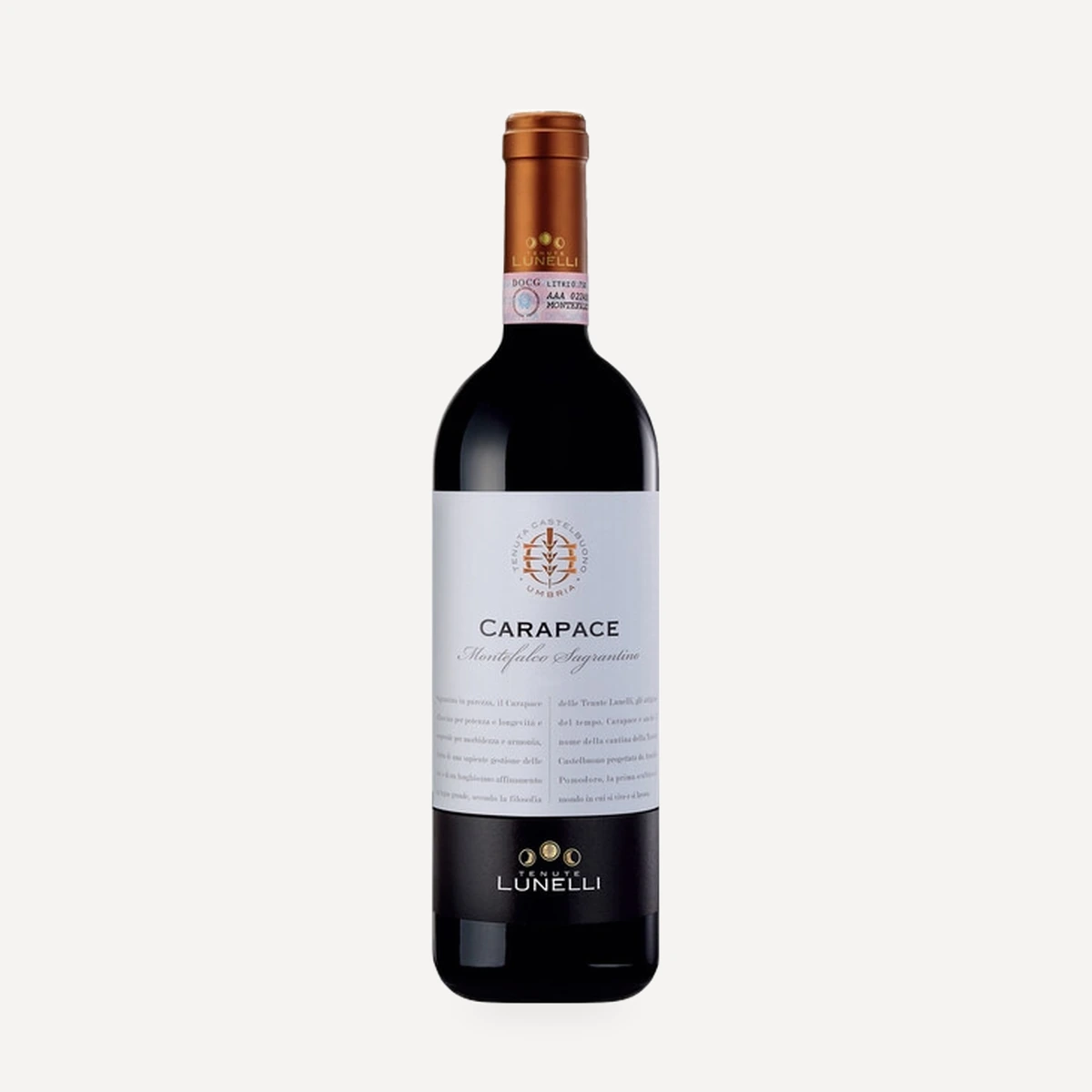
Carapace Montefalco Sagrantino DOCG